
12 Jyotirlinga Complete Guide (2026)
Names, Locations, How to Visit, Best Time & Spiritual Significance

The 12 Jyotirlingas are the holiest Shiva shrines in India. “Jyotirlinga” means ‘pillar of divine light’, symbolizing Shiva as the infinite, formless reality. According to tradition, visiting all 12 is considered highly meritorious and spiritually transformative.
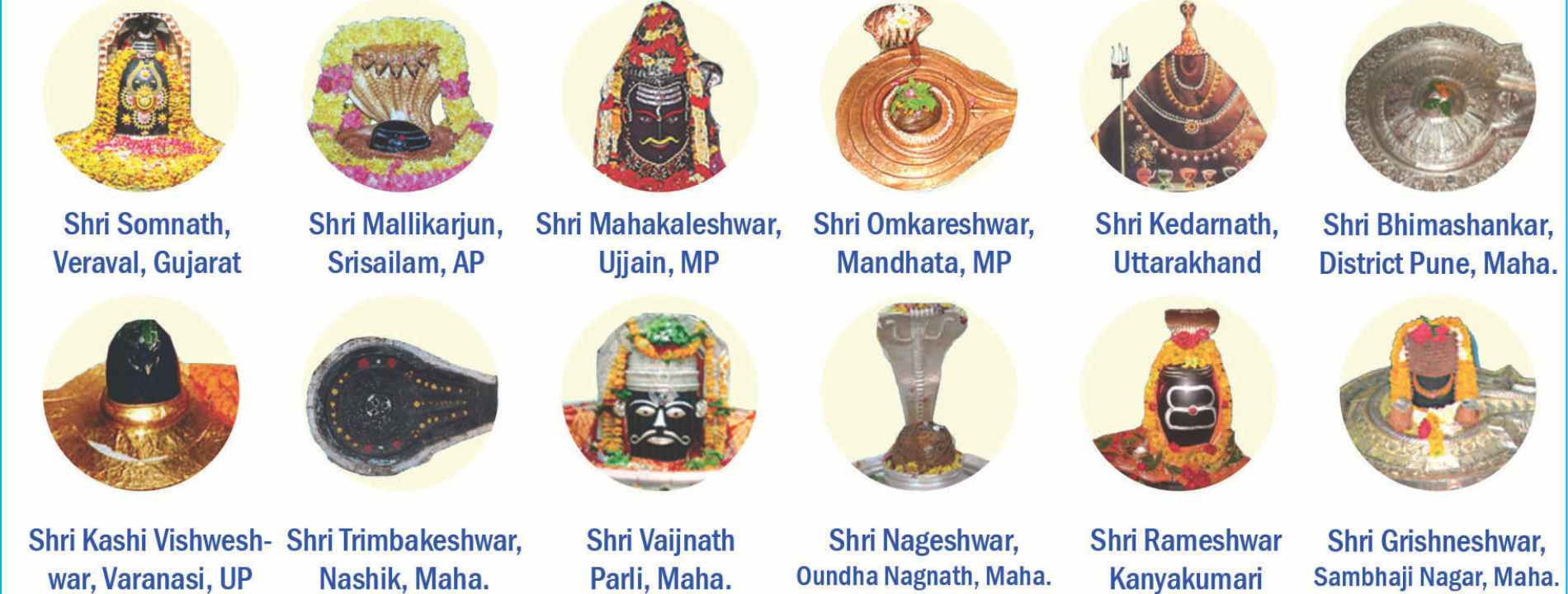
This is a complete, reference-style guide for:
✅ 12 Jyotirlinga list with location
✅ Jyotirlinga yatra planning
✅ Best time to visit each
✅ Travel routes
✅ Nearby temples & practical tips
Complete List of 12 Jyotirlingas with Location
Somnath Jyotirlinga – Prabhas Patan, Gujarat
Mallikarjuna Jyotirlinga – Srisailam, Andhra Pradesh
Mahakaleshwar Jyotirlinga – Ujjain, Madhya Pradesh
Omkareshwar Jyotirlinga – Mandhata Island (Narmada River), Madhya Pradesh
Kedarnath Jyotirlinga – Kedarnath, Uttarakhand
Bhimashankar Jyotirlinga – Pune District, Maharashtra
Kashi Vishwanath Jyotirlinga – Varanasi, Uttar Pradesh
Trimbakeshwar Jyotirlinga – Trimbak (Nashik), Maharashtra
Baidyanath (Vaidyanath) Jyotirlinga – Deoghar, Jharkhand
Nageshwar Jyotirlinga – Near Dwarka, Gujarat
Ramanathaswamy (Rameshwaram) Jyotirlinga – Rameswaram, Tamil Nadu
Grishneshwar Jyotirlinga – Verul (Ellora), Maharashtra
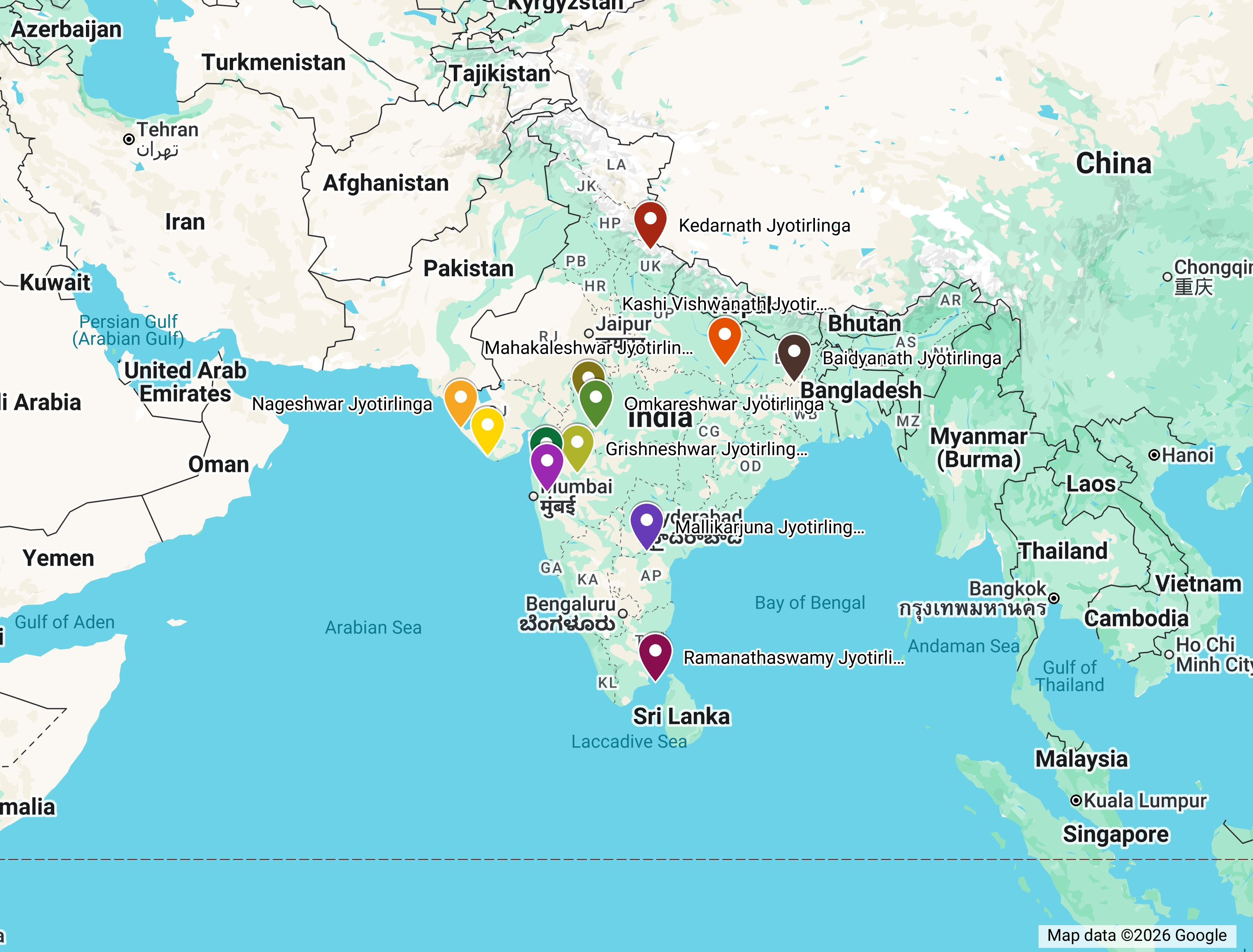
https://www.google.com/maps/d/u/0/viewer?hl=en&mid=1_iirDueRc0uOG11w4urrkitFbqCuaHQ&ll=20.38267941526585%2C77.83421845&z=5
Spiritual Significance of Each Jyotirlinga
1. Somnath (Gujarat)
Believed to be the first Jyotirlinga, associated with the Moon God (Soma). Symbolizes renewal and healing of ego and pride.
2. Mallikarjuna (Srisailam)
Represents the union of Shiva and Parvati (Shakti). One of the rare temples that is both a Jyotirlinga and a Shakti Peetha.
3. Mahakaleshwar (Ujjain)
Shiva as Mahakal – Lord of Time and Death. The only south-facing Jyotirlinga. Famous for the early morning Bhasma Aarti.
4. Omkareshwar (Madhya Pradesh)
Located on an island shaped like the sacred syllable “Om” in the Narmada River. Associated with meditation and spiritual knowledge.
5. Kedarnath (Uttarakhand)
High Himalayan shrine linked to the Mahabharata and the Pandavas. Represents penance and liberation.
6. Bhimashankar (Maharashtra)
Associated with Shiva defeating the demon Bhima. Surrounded by forest and wildlife sanctuary.
7. Kashi Vishwanath (Varanasi)
The most spiritually significant Shiva temple in India. Kashi is believed to grant moksha (liberation).
8. Trimbakeshwar (Nashik)
Origin region of the Godavari River. Unique three-faced lingam representing Brahma, Vishnu, and Shiva.
9. Baidyanath (Deoghar)
Shiva as the Divine Healer (Vaidya). Strongly associated with the Kanwar Yatra during Shravan month.
10. Nageshwar (Dwarka)
Represents protection from poison and negativity. Associated with the serpent (Naga) symbolism.
11. Rameshwaram (Tamil Nadu)
Established by Lord Rama before crossing to Lanka. Pilgrims perform ritual baths in 22 sacred wells.
12. Grishneshwar (Ellora)
The smallest Jyotirlinga temple. Associated with devotion and marital harmony.
Best Time to Visit Each Jyotirlinga
Somnath (Gujarat)
Best time: October to March – Pleasant weather and ideal for temple visits and coastal sightseeing.
Mallikarjuna (Srisailam, Andhra Pradesh)
Best time: October to February – Comfortable climate for darshan and exploring the hill surroundings.
Mahakaleshwar (Ujjain, Madhya Pradesh)
Best time: October to March – Cooler weather makes temple visits and Bhasma Aarti more comfortable.
Omkareshwar (Madhya Pradesh)
Best time: October to March – Ideal for visiting the temple island and Narmada ghats.
Kedarnath (Uttarakhand)
Best time: May to June and September to October – Temple opens seasonally (usually April/May to October/November). Avoid peak monsoon (July–August).
Bhimashankar (Maharashtra)
Best time: October to February – Pleasant weather for temple visit and nearby trekking.
Kashi Vishwanath (Varanasi, Uttar Pradesh)
Best time: October to March – Comfortable for temple darshan and Ganga Aarti.
Trimbakeshwar (Maharashtra)
Best time: October to February – Cool and ideal for pilgrimage and nearby sightseeing.
Baidyanath (Deoghar, Jharkhand)
Best time: October to March – Weather is comfortable. Extremely crowded during Shravan month.
Nageshwar (Gujarat)
Best time: October to March – Pleasant coastal weather.
Rameshwaram (Tamil Nadu)
Best time: October to March – Cooler and less humid compared to summer months.
Grishneshwar (Maharashtra)
Best time: October to March – Comfortable weather for darshan and visiting nearby Ellora Caves.
⚠ Try to avoid peak crowds if possible:
Shravan month
Mahashivratri
Mondays (especially in Shravan)
How to Plan 12 Jyotirlinga Yatra (Smart Route Planning)
Instead of random travel, plan by geographical clusters:
1️⃣ Gujarat Cluster
Somnath
Nageshwar (Dwarka)
2️⃣ Maharashtra Cluster
Bhimashankar
Trimbakeshwar
Grishneshwar
3️⃣ Madhya Pradesh Cluster
Mahakaleshwar (Ujjain)
Omkareshwar
4️⃣ North India
Kashi Vishwanath (UP)
Kedarnath (Uttarakhand)
5️⃣ East India
Baidyanath (Jharkhand)
6️⃣ South India
Mallikarjuna (Andhra Pradesh)
Rameshwaram (Tamil Nadu)
Suggested Yatra Duration Options
🔹 12–15 Days (Fast Track)
Flight-heavy, darshan-focused, minimal sightseeing.
🔹 18–25 Days (Balanced)
Includes nearby temples, local sightseeing, rest days.
🔹 30+ Days (Spiritual Immersion)
Slow travel, rituals, local parikrama, river baths.
Nearby Temples & Sacred Add-ons
Somnath
Bhalka Tirth
Triveni Sangam
Mallikarjuna (Srisailam)
Bhramaramba Devi Temple
Patal Ganga
Mahakaleshwar (Ujjain)
Kal Bhairav Temple
Harsiddhi Mata Temple
Ram Ghat
Omkareshwar
Mamleshwar Temple
Omkareshwar Parikrama Path
Kedarnath
Bhairavnath Temple
Triyuginarayan Temple
Bhimashankar
Hanuman Lake
Gupt Bhimashankar
Kashi
Annapurna Temple
Kaal Bhairav
Dashashwamedh Ghat
Trimbakeshwar
Kushavarta Kund
Brahmagiri Hills
Baidyanath
Basukinath Temple
Nageshwar
Dwarkadhish Temple
Bet Dwarka
Rameshwaram
Agni Theertham
Dhanushkodi
Grishneshwar
Ellora Caves
Daulatabad Fort
Practical Travel Tips
✔ Book darshan tickets in advance (where available)
✔ Reach temples early morning for shorter queues
✔ Carry light cotton clothes and shawl
✔ Check temple dress codes
✔ Keep buffer days for Kedarnath (weather dependent)
✔ Avoid heavy luggage (bag restrictions at some temples)
✔ Stay near temple area for early darshan convenience
Option A: Start from Delhi (Balanced, ~18 Days)
Day 1 — Delhi → Deoghar (Baidyanath)
Travel: Fly to Deoghar (if direct) or via Ranchi/Patna, then drive.
Evening: Local rest + temple area orientation.
Day 2 — Baidyanath Jyotirlinga (Deoghar, Jharkhand)
Early darshan.
Optional add-on: Basukinath (if time + energy).
Night: Deoghar → fly/overnight to Varanasi route next day.
Day 3 — Deoghar → Varanasi (Kashi)
Travel: Fly (via hub) or drive/train (long).
Evening: Ganga Aarti (optional), rest early.
Day 4 — Kashi Vishwanath (Varanasi, UP)
Early darshan (best for shorter queues).
Optional add-ons: Annapurna, Kaal Bhairav, ghats.
Night: Prep for Uttarakhand sector.
Day 5 — Varanasi → Dehradun / Rishikesh
Travel: Fly to Dehradun (Jolly Grant) or train to Haridwar.
Night stay: Rishikesh / Haridwar.
Day 6 — Dehradun/Rishikesh → Guptkashi / Sonprayag
Drive day (mountain).
Night: Guptkashi / Sonprayag.
Day 7 — Sonprayag → Gaurikund → Kedarnath
Trek/heli as per preference.
Night: Kedarnath (basic stays), or return same day only if heli allows.
Day 8 — Kedarnath Jyotirlinga (Uttarakhand)
Early darshan.
Return trek/heli to Sonprayag/Guptkashi.
Night: Guptkashi/Sonprayag.
Day 9 — Return to Dehradun → Fly to Indore
Drive back + flight to Indore.
Night: Indore / Ujjain depending on time.
Day 10 — Mahakaleshwar (Ujjain, MP)
Darshan + (optional) Bhasma Aarti planning if you’re doing it.
Later: Drive to Omkareshwar / stay Ujjain.
Day 11 — Omkareshwar (MP)
Early darshan.
Optional: Parikrama (partial or full depending on fitness/time).
Evening: Return to Indore for next day flight.
Day 12 — Indore → Aurangabad → Grishneshwar (Maharashtra)
Travel: Fly to Aurangabad (or via Mumbai), drive to Verul.
Evening: Quick darshan if time; otherwise next morning.
Day 13 — Grishneshwar + Ellora (optional) → Nashik
Early darshan.
Optional: Ellora Caves (if you want a heritage add-on).
Drive to Nashik/Trimbak.
Day 14 — Trimbakeshwar (Nashik)
Early darshan.
Optional: Kushavarta Kund, Panchavati.
Night: Pune area / Bhimashankar approach.
Day 15 — Bhimashankar (near Pune)
Early darshan (traffic can build later).
Night: Pune or Mumbai.
Day 16 — Mumbai → Ahmedabad/Rajkot → Somnath (Gujarat)
Travel: Fly to Rajkot/Porbandar/Diu/Ahmedabad (best available), then drive.
Night: Somnath.
Day 17 — Somnath → Dwarka
Morning darshan + nearby spots.
Drive to Dwarka (long but doable).
Night: Dwarka.
Day 18 — Nageshwar (near Dwarka) → Fly to Hyderabad → Srisailam
Early darshan at Nageshwar (and Dwarkadhish if desired).
Fly to Hyderabad; drive towards Srisailam (or stay Hyderabad if late).
Day 19 — Mallikarjuna (Srisailam, AP)
Early darshan.
Night: Return Hyderabad.
Day 20 — Hyderabad → Madurai/Rameswaram
Fly to Madurai; drive/train to Rameswaram.
Night: Rameswaram.
Day 21 — Ramanathaswamy (Rameswaram, TN) → Return
Early darshan + (optional) theertham baths (time-consuming).
Return: Madurai → Delhi (via hub).
✅ This is the “balanced + realistic” plan. If you want it tighter, we can compress to ~16–18 days by removing buffers and optional add-ons.
Option B: Start from Mumbai (Balanced, ~18 Days, smoother logistics)
This version starts by finishing the Maharashtra + MP cluster first (very efficient), then jumps to Gujarat + South + East + North.
Day 1 — Mumbai → Pune → Bhimashankar
Drive early; darshan; night Pune/Mumbai.
Day 2 — Nashik/Trimbak → Trimbakeshwar
Travel to Nashik; early darshan; night Nashik.
Day 3 — Nashik → Aurangabad/Verul → Grishneshwar
Early darshan; optional Ellora; night Aurangabad.
Day 4 — Aurangabad → Indore/Ujjain
Fly/drive; night Ujjain.
Day 5 — Mahakaleshwar (Ujjain)
Darshan; night Ujjain/Indore.
Day 6 — Omkareshwar
Darshan + short parikrama; night Indore.
Day 7 — Indore → Gujarat → Somnath
Fly to Rajkot/Ahmedabad + drive; night Somnath.
Day 8 — Somnath → Dwarka
Darshan + drive; night Dwarka.
Day 9 — Nageshwar (Dwarka) → Fly to Hyderabad
Early darshan; fly to Hyderabad; night Hyderabad.
Day 10 — Hyderabad → Srisailam → Mallikarjuna
Drive early; darshan; night Srisailam/Hyderabad.
Day 11 — Fly Hyderabad → Madurai → Rameswaram
Travel day; night Rameswaram.
Day 12 — Ramanathaswamy (Rameswaram)
Early darshan; optional theerth baths; night Rameswaram/Madurai.
Day 13 — Madurai → Deoghar (via hub)
Long travel day; night Deoghar.
Day 14 — Baidyanath (Deoghar)
Early darshan; night Deoghar or move onwards.
Day 15 — Deoghar → Varanasi
Travel; night Varanasi.
Day 16 — Kashi Vishwanath (Varanasi)
Early darshan; night Varanasi.
Day 17 — Varanasi → Dehradun/Rishikesh
Fly/train; night Rishikesh/Haridwar.
Day 18 — Drive to Guptkashi/Sonprayag
Night Guptkashi/Sonprayag.
Day 19 — Kedarnath
Trek/heli; night Kedarnath/return base.
Day 20 — Kedarnath darshan + return
Return to Dehradun.
Day 21 — Fly back to Mumbai
✅ This route is usually less backtracking than starting Delhi, especially for the Maharashtra + MP + Gujarat cluster.
Important Kedarnath Note (so your itinerary stays real)
Kedarnath is seasonal. If it’s closed when you travel, do the other 11 now and keep Kedarnath as a dedicated trip later (or swap in another Uttarakhand circuit for those days).
Even when open, add 1–2 buffer days for weather/landslides/heli variability.
Budget Estimate (Per Person) - Economy vs Premium vs Elite
These are planning ranges for a ~18–21 day all-India circuit. Costs vary heavily based on flight prices and festival dates.
Assumptions (so the numbers make sense)
Sharing twin room (Economy/Premium), single or luxury properties (Elite)
Mix of flights + road (not trains-only)
Local taxis for hill/remote legs
Does not include major shopping/donations beyond normal
A) Economy (value-focused, clean & practical)
Stay: 2–3★ / dharamshala mix where suitable
Transport: budget flights + shared taxis where feasible
Food: simple veg meals
Estimated total (18–21 days): ₹1.6L – ₹2.6L per person
Typical daily average: ₹8,000 – ₹12,500
B) Premium (comfort + time-saving)
Stay: 4★ or best-in-city, consistent comfort
Transport: better flight timings, private cab more often
Food: good restaurants + flexibility
Estimated total: ₹2.8L – ₹4.8L per person
Typical daily average: ₹14,000 – ₹23,000
C) Elite (luxury + minimal friction)
Stay: 5★/heritage/resort wherever possible
Transport: business class on key legs (optional), always private SUV, VIP assistance where available
Food: fine dining, concierge handling, extra buffers
Estimated total: ₹6.5L – ₹12L+ per person
Typical daily average: ₹32,000 – ₹60,000+
Big “swing factors” that change budget a lot
Kedarnath by helicopter vs trek (heli can raise total noticeably)
Peak season (Shravan/Mahashivratri/holidays) flight/hotel spikes
Number of people (private cab split reduces per-person cost)
Doing Ellora, Dwarka add-ons, extra nights for comfort
Frequently Asked Questions
How many Jyotirlingas are there?
There are 12 sacred Jyotirlingas in India.
Which state has the most Jyotirlingas?
Maharashtra has three: Bhimashankar, Trimbakeshwar, and Grishneshwar.
Can 12 Jyotirlingas be completed in one trip?
Yes, with careful planning (minimum ~12–15 days), though many devotees complete them over multiple years.
Which Jyotirlinga is hardest to reach?
Kedarnath, due to high altitude and seasonal access.