
59% of Gen Z Now Choose Rishikesh Over Goa. Here's What Nobody's Talking About.
India's youngest generation isn't rejecting fun - they're redefining what "living fully" actually means.

A Friday night in 2016: You’re 22. You split an Uber to Hauz Khas Village. The bass hits before you even walk in. You post an Instagram story with a neon sign behind you. You wake up at noon feeling hollow.
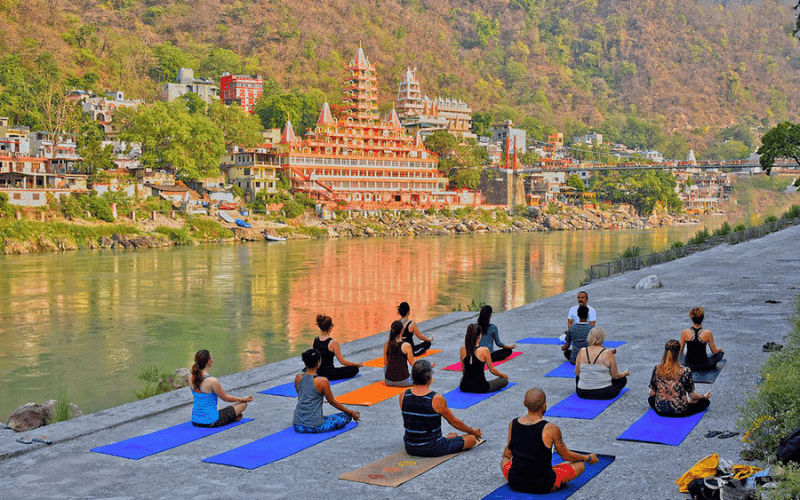
A Friday night in 2026: You’re 22. You board the Vande Bharat to Haridwar. You sit on the ghats at 5 AM listening to the Ganga. You post nothing. You feel everything.
Something massive has shifted. And it’s not what the headlines think.
The Numbers That Shocked the Travel Industry
Here’s a statistic that made marketing teams across India rewrite their entire strategy: in 2025, Gen Z made up 59% of all visitors to Rishikesh, with millennials adding another 38%. That’s not a spiritual niche. That’s an entire generation voting with their feet.
But it doesn’t stop there.
Accommodation bookings at religious destinations across India grew by 19% to 25% year-on-year. Gokarna saw a 25% surge. Hampi grew nearly 18%. Varanasi — once considered “your grandmother’s holiday” by young urbanites — is now one of the most-searched weekend destinations for under-30 professionals.
Spiritual tourism revenue in India nearly doubled from ₹65,070 crore in 2021 to over ₹1,34,543 crore in 2022 — and millennials were the top spenders, followed closely by Gen Z.
Meanwhile, alcohol consumption among young Indians is declining. Nightclubs in metros are quieter. The “sober curious” movement has gone mainstream.
The party isn’t dying. It’s just moving — to a ghat, a mountain trail, a temple courtyard at dawn.
This Isn’t Your Parents’ Spirituality
Let’s get something straight. This generation isn’t suddenly becoming “religious” in the way their grandparents were. They’re not visiting temples because someone told them to. They’re going because they chose to.
That distinction matters enormously.
Young Indians today are dealing with something no previous generation faced at this scale: relentless digital noise, career anxiety from a hyper-competitive economy, social comparison on a device they check 150 times a day, and a deep, gnawing sense that the “success script” they were handed — degree, job, EMI, repeat — doesn’t actually lead anywhere meaningful.
Meditation apps, breathwork sessions, and lo-fi mantra playlists aren’t trends. They’re coping mechanisms for a generation under siege.
And when that same generation discovers that India — their own country — has an unbroken 5,000-year tradition of addressing exactly these questions of meaning, purpose, and inner peace?
The pilgrimage begins. Not out of obligation. Out of hunger.
The Instagram Paradox
Here’s what makes this movement genuinely interesting: social media — the very thing causing the burnout — is also the gateway drug to spirituality for Gen Z.
A reel of the Ganga Aarti at Varanasi, shot in golden hour with cinematic music, does something that no tourism ad ever could. It bypasses logic and hits emotion. A short video of someone meditating at Kedarnath with snow-capped peaks behind them makes spirituality look like what it actually is: the most adventurous thing you can do with your life.
Temple visits have become “cool” — not because of a government campaign, but because young creators made them so. The aesthetic of devotion — diyas, marigolds, morning mist over ancient stone — turns out to be more visually powerful than any nightclub could ever be.
But here’s the paradox nobody talks about: the same kids who discover temples through Instagram eventually put their phones down once they get there. The medium that brought them in is the first thing they let go of.
That’s not a trend. That’s transformation.
What They’re Actually Seeking (It’s Not What You Think)
When you talk to young people making these journeys, the word “God” doesn’t always come up first. Instead, you hear:
“Silence.” In a world that never stops talking at them — notifications, news, opinions, algorithms — the simple experience of sitting somewhere ancient and quiet has become radical. Varanasi’s ghats at 4:30 AM, before the tourists arrive, offer something no meditation app can replicate.
“Rootedness.” Many young NRIs and second-generation urban Indians describe a specific kind of grief: feeling disconnected from their own culture. A trip to Mathura or Ayodhya isn’t just tourism for them — it’s an act of reclamation.
“Community without performance.” At a temple or ashram, nobody asks what you do for a living. Nobody is networking. The social dynamics are radically different from any space this generation usually inhabits.
“Awe.” Standing inside a 1,000-year-old temple and realizing that the mathematics of the architecture are more precise than modern engineering does something to you. It makes you feel simultaneously tiny and connected to something vast.
The Economics of Devotion
This isn’t just a cultural story — it’s reshaping entire economies.
Small towns built around temples are experiencing a renaissance. Ayodhya went from a sleepy town to a booming destination virtually overnight. Varanasi’s hotel industry is scrambling to meet demand, with premium room bookings (₹7,000-₹10,000/night) surging by 24%. Heritage havelis are being converted into boutique stays. Local artisans are seeing demand they haven’t experienced in decades.
A new category of travel entrepreneur has emerged: the spiritual experience curator. These aren’t old-school tour operators printing laminated itineraries. They’re young founders building apps for temple navigation, creating curated “sacred circuits,” organizing sunrise yoga treks to Jyotirlinga temples, and packaging ashram stays with Ayurvedic wellness.
The Indian government has responded too, investing heavily in spiritual circuits under the PRASHAD scheme and upgrading infrastructure at pilgrimage sites. Helicopter services to Kedarnath and Vaishno Devi, smart ticketing with QR codes, slot-based darshan bookings — the ancient and the digital are fusing seamlessly.
The Global Dimension
This isn’t just an Indian story.
Across the world, bookings to yoga and meditation destinations rose by 60% between 2024 and 2025. Nearly 64% of Gen Z globally now identifies as “spiritual.” Astrology apps are mainstream. Wellness retreats have replaced beach resorts as aspirational getaways.
But India holds a unique position in this global awakening: it’s the source. The original. When a 25-year-old in London or Toronto or Sydney decides to explore spirituality seriously, the trail eventually leads here — to Rishikesh, to Bodh Gaya, to Kashi.
For the Indian diaspora, this pull is even stronger. NRIs who grew up with fragments of tradition — a diwali puja here, a grandparent’s story there — are now returning for the full experience. They want to stand where Ram stood. They want to hear the conch at Somnath. They want to give their children what distance and modernity slowly eroded.
Why This Matters More Than You Think
Every few decades, a generation redefines what “the good life” means.
For boomers, it was stability — a house, a government job, a pension. For millennials, it was experience — travel the world, try everything, optimize your life. For Gen Z, it’s increasingly becoming alignment — does my life reflect what I actually believe? Am I at peace, or just busy?
That’s a profoundly spiritual question. And the fact that millions of young Indians are answering it by turning toward their own civilizational wisdom — rather than importing Western self-help frameworks — is one of the most significant cultural developments of this decade.
This isn’t a rejection of modernity. It’s a correction. Young India is saying: we can build startups and do Sundarkand Path. We can code and meditate. We can be globally ambitious and deeply rooted.
The temples aren’t pulling them backward. They’re grounding them for what comes next.
The Invitation
If you haven’t yet made that journey — the one where you trade a weekend of scrolling for a weekend of stillness — consider this your sign.
You don’t need to have it all figured out. You don’t need to be “religious enough.” You don’t need permission.
You just need to go.
Start with one temple. One ghat. One sunrise where you leave your phone in your bag and just be somewhere ancient and alive. See what surfaces when the noise stops.
Millions of your peers have already started walking this path. The only question is: are you ready to take the first step?
DharmikVibes is India’s devotion-first spiritual platform — helping seekers plan sacred yatras, book VIP darshans, connect with trusted pandits, and experience India’s spiritual heritage with comfort and care. Whether you’re in Delhi or Dallas, your journey home begins at dharmikvibes.com
🙏 If this resonated, share it with someone who needs to read it.
Planning your first spiritual journey? Explore curated yatras at DharmikVibes - from Char Dham to Kashi to Kailash Mansarovar.
#SpiritualTravel #GenZSpirituality #DharmikVibes #TempleTravel #IndiaTravel #Rishikesh #Varanasi #SanatanDharma #YatraWithDharmikVibes #DekhoApnaDesh #SpiritualAwakening