

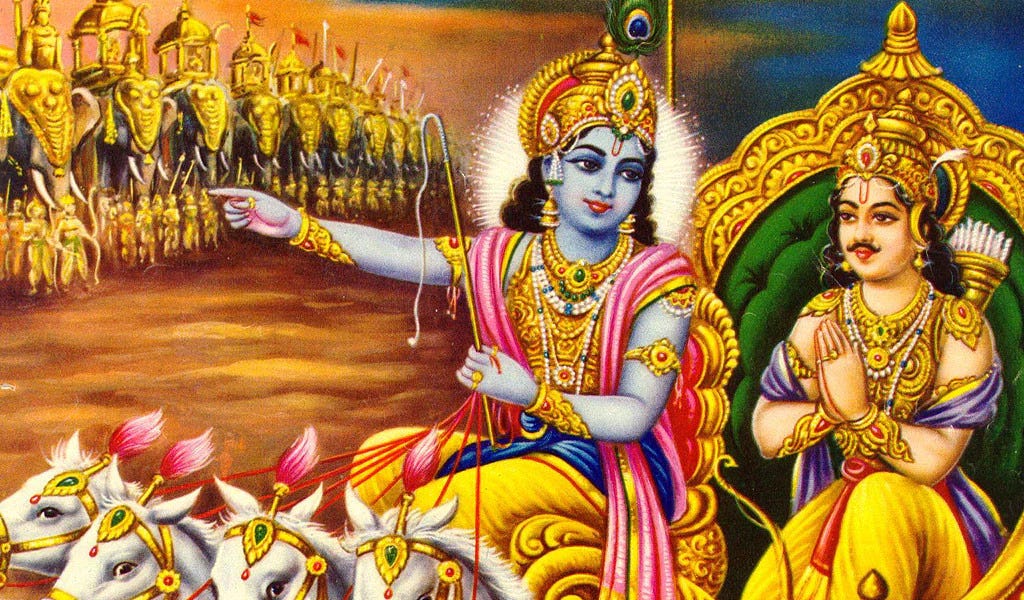
In the middle of a battlefield, facing uncertainty, moral conflict, fear, and immense responsibility - Arjuna collapses.
Not because he lacks skill.
Not because he lacks resources.
But because he lacks clarity.
That moment is not ancient mythology.
It is the inner state of many entrepreneurs today.
The Bhagavad Gita for business is not a metaphorical stretch - it is a practical manual for leadership under pressure.
Here are 7 profound Gita lessons for entrepreneurs and business leaders - rooted in original shlokas and deeply relevant to modern organizations.
1. Focus on Excellence in Action — Not Anxiety About Results
Bhagavad Gita 2.47
कर्मण्येवाधिकारस्ते मा फलेषु कदाचन।
मा कर्मफलहेतुर्भूर्मा ते सङ्गोऽस्त्वकर्मणि॥
Translation:
You have a right to action alone, never to its fruits. Do not let the results be your motive, nor fall into inaction.
This is perhaps the most quoted verse — and the most misunderstood.
The Gita does NOT say results don’t matter.
It says: Your psychological attachment to results weakens performance.
In business:
You control effort, not market timing
You control execution, not investor mood
You control product quality, not customer perception
Entrepreneurs burn out because they emotionally attach self-worth to outcomes.
The Gita teaches:
Work with total commitment
Measure outcomes objectively
Detach emotionally
Paradoxically, detachment improves performance.
2. Emotional Mastery is Leadership Mastery
Before strategy, Krishna stabilizes Arjuna’s mind.
Bhagavad Gita 2.14
मात्रास्पर्शास्तु कौन्तेय शीतोष्णसुखदुःखदाः
आगमापायिनोऽनित्यास्तांस्तितिक्षस्व भारत॥
Pleasure and pain, gain and loss — they come and go. Endure them with steadiness.
Business cycles are emotional cycles:
Funding highs
Revenue dips
Viral success
Public criticism
If a founder is emotionally reactive:
Teams feel unsafe
Decisions become impulsive
Culture becomes unstable
Krishna’s teaching: Emotional regulation precedes strategic clarity.
A calm leader creates resilient organizations.
3. Dharma: Know Your Core Purpose
Arjuna’s confusion was not about skill — it was about role conflict.
Krishna reminds him of his dharma — his deeper responsibility.
Bhagavad Gita 3.35
श्रेयान्स्वधर्मो विगुणः परधर्मात्स्वनुष्ठितात्
Better to perform your own duty imperfectly than to perform another’s perfectly.
For entrepreneurs:
Stop copying competitors blindly
Stop chasing every trend
Stop building what investors want but customers don’t need
Your startup’s dharma is:
The problem only you are positioned to solve
The values you refuse to compromise
The long-term mission beyond valuation
Companies without dharma drift.
Companies with dharma endure.
4. Detachment Enables Strategic Clarity
Attachment clouds judgment.
Krishna describes the downfall of a distracted mind:
Bhagavad Gita 2.62–63
ध्यायतो विषयान्पुंसः संगस्तेषूपजायते
संगात्संजायते कामः कामात्क्रोधोऽभिजायते...
Attachment leads to desire, desire to anger, anger to delusion, delusion to loss of memory, and ultimately destruction of intelligence.
In business, attachment shows up as:
Ego attachment to a product
Emotional resistance to pivot
Refusal to accept feedback
Fear of admitting mistakes
Detached leadership does not mean indifference.
It means:
Listening objectively
Killing projects without ego
Making data-driven decisions
Strategic detachment = Competitive advantage.
5. Discipline Over Motivation
Modern entrepreneurship glorifies passion.
The Gita glorifies discipline.
Bhagavad Gita 6.5
उद्धरेदात्मनाऽत्मानं नात्मानमवसादयेत्
आत्मैव ह्यात्मनो बन्धुरात्मैव रिपुरात्मनः॥
Elevate yourself by your own mind, not degrade yourself. The mind can be your best friend or worst enemy.
Motivation fluctuates.
Discipline sustains.
Great founders:
Show up daily
Build routines
Control impulses
Delay gratification
Self-mastery is business mastery.
6. Leadership by Example Shapes Culture
Bhagavad Gita 3.21
यद्यदाचरति श्रेष्ठस्तत्तदेवेतरो जनः
स यत्प्रमाणं कुरुते लोकस्तदनुवर्तते॥
Whatever a great person does, others follow.
Culture is not built in offsites.
It is built in daily behavior.
If the founder:
Cuts corners
Blames others
Reacts emotionally
The organization mirrors it.
If the founder:
Takes accountability
Acts ethically
Remains composed under pressure
The organization reflects that strength.
Leadership is imitation in motion.
7. Inner Stability is the Ultimate Competitive Edge
Krishna describes the Sthitaprajna — the person of steady wisdom.
Bhagavad Gita 2.56
दुःखेष्वनुद्विग्नमनाः सुखेषु विगतस्पृहः
वीतरागभयक्रोधः स्थितधीर्मुनिरुच्यते॥
One who is undisturbed in sorrow, free from craving in success, free from fear and anger — is called a person of steady wisdom.
Imagine a CEO who:
Is not inflated by success
Is not shattered by setbacks
Does not operate from fear
Does not make decisions from anger
That is sustainable leadership.
Today’s startup ecosystem rewards speed.
The Gita rewards steadiness.
And in the long run, steadiness wins.
Why the Bhagavad Gita for Business Is More Relevant Than Ever
Entrepreneurs today face:
Market volatility
Ethical gray areas
Investor pressure
Constant comparison
Burnout and anxiety
The Gita was spoken in the ultimate pressure situation.
Its teachings are not religious doctrine — they are principles of:
Clarity
Self-mastery
Duty
Ethical strength
Emotional intelligence
It reminds us:
Leadership is first an inner conquest.
Only then is it an external one.
Reflection for Founders & Leaders
Are you attached to outcomes or committed to excellence?
Are you leading from fear or clarity?
Is your company driven by trend or dharma?
Are you emotionally reactive or internally steady?
The battlefield has changed.
Human psychology hasn’t.
Ancient wisdom. Modern leadership.
If this resonated, share it with fellow founders exploring Gita lessons for entrepreneurs.
#BhagavadGitaForBusiness #GitaLessons #Entrepreneurship #ConsciousLeadership #StartupIndia #SpiritualLeadership #FounderMindset
Ancient frameworks like 'Nishkama Karma' are becoming modern competitive moats. It's 'Dharmic Capitalism' in action on a global scale.
Love this - time to connect these teachings in our real life applications. Thanks for sharing.