

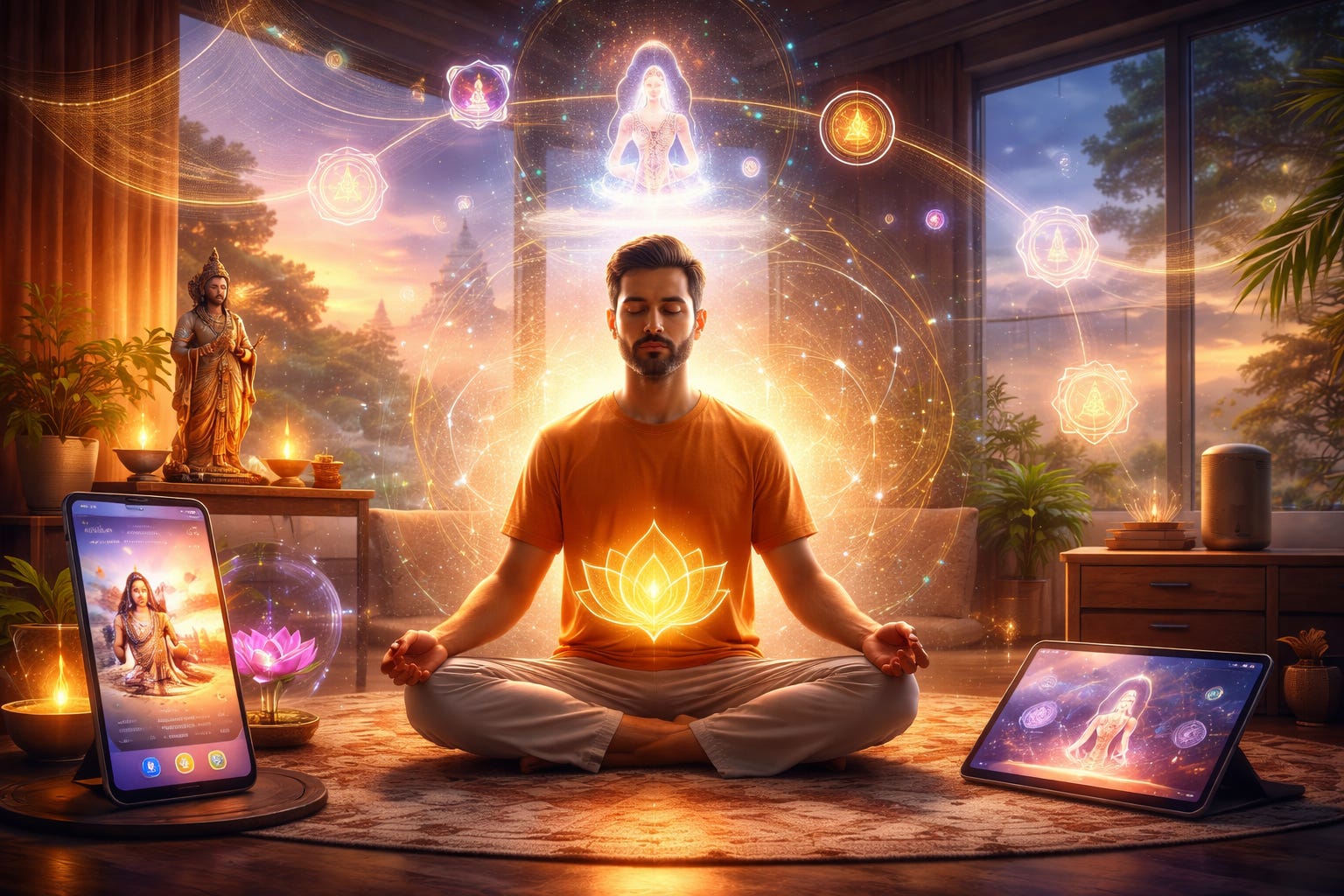
Spirituality has always been about experience.
Not information.
Not theory.
Not even belief.
But experience - of stillness, surrender, clarity, devotion, and inner expansion.
So when we ask, “Can Artificial Intelligence help on your spiritual journey?”, we are really asking something deeper:
Can technology support inner transformation?
Can algorithms guide consciousness?
Can digital tools enhance sacred experience?
The answer is nuanced - and surprisingly powerful.
From Information Age to Inner Transformation Age
We are no longer in the information age. We are in the age of overwhelm.
Sacred texts are available online.
Discourses are on YouTube.
Meditation apps are everywhere.
Yet anxiety is rising. Attention spans are shrinking. Consistency in practice is rare.
The modern seeker faces three major challenges:
Lack of guidance
Lack of discipline
Lack of immersive spiritual ecosystem
This is where AI, when designed ethically and spiritually aligned, becomes transformative.
Spirituality Is Personal - AI Makes It Personalized
No two spiritual journeys are identical.
One person seeks relief from anxiety.
Another seeks purpose.
Another seeks devotion.
Another seeks liberation.
Traditional spiritual systems recognize this - through different yogas:
Bhakti (devotion)
Jnana (knowledge)
Karma (action)
Dhyana (meditation)
AI has the unique ability to identify patterns in behavior and recommend a tailored spiritual path.
For example:
Apps like 10 Minute Gita use AI to:
Suggest relevant Gita verses based on emotional state
Simplify Sanskrit verses into relatable modern insights
Provide daily micro-reflections
Adapt explanations based on user engagement
Instead of reading randomly, the seeker receives contextual wisdom:
Feeling confused about a career decision?
The app suggests Chapter 2 teachings on detachment and right action.
This shifts scripture from philosophy to lived guidance.
The Phygital Spiritual Revolution
The future of spirituality is not purely digital.
It is phygital - a seamless blend of digital intelligence and physical sacred experience.
Let’s understand this shift.
Digital Layer: Awareness & Preparation
AI helps with:
Discovering teachings
Learning mantras
Understanding rituals
Building daily habits
Asking spiritual questions safely
This creates readiness.
Physical Layer: Embodied Experience
Then comes:
Temple visits
Yatras
Live satsangs
Personalized pujas
Retreats
In-person spiritual counseling
This creates depth.
Platforms like DharmikGuide, DharmikVibes represent this phygital bridge.
AI can:
Recommend nearby temples aligned with your Ishta Devata
Match you with verified pandits for specific rituals
Suggest astrologers based on your life concerns
Connect you with spiritual travel partners
Recommend retreats aligned with your spiritual goals
Technology initiates.
Physical experience transforms.
Can AI Enhance Spiritual Experience Itself?
Let’s go deeper.
Spiritual experience involves:
Presence
Repetition
Reflection
Community
Sacred environment
AI can support each layer.
1. Enhancing Presence Through Intelligent Prompts
Many seekers struggle with distraction.
AI can:
Track when you usually meditate
Detect inconsistency patterns
Suggest shorter sessions when attention is low
Offer guided breathing aligned with stress levels
Instead of rigid discipline, you get adaptive spiritual structure.
Presence improves.
2. Deepening Reflection
Spiritual growth requires self-inquiry.
AI can ask:
What emotion dominated your day?
Where did ego arise?
Did you act from fear or clarity?
Based on your reflections, it can suggest:
Relevant Gita verses
A mantra
A journaling prompt
A karmic perspective
It becomes a mirror - not a master.
3. Supporting Devotional Emotion (Bhava)
Bhakti is emotional.
AI can:
Recommend devotional music based on mood
Suggest festival-related rituals
Provide stories of deities
Create structured chanting schedules
Combined with platforms that connect users to:
Live aartis
Temple streaming
In-person devotional gatherings
Devotion becomes continuous - not occasional.
AI as a Spiritual Companion - Not Authority
It’s important to clarify:
AI does not have consciousness.
It does not experience God.
It does not awaken.
But it can:
Reduce confusion
Organize wisdom
Provide structure
Encourage consistency
Connect seekers to authentic human guides
The guru-disciple tradition remains sacred.
AI simply lowers the entry barrier for seekers who may otherwise never begin.
The Emotional Reality of the Modern Seeker
Today’s tech-savvy audience is:
Spiritually curious but skeptical
Time-constrained
Emotionally overwhelmed
Digitally native
Searching for meaning beyond material success
AI-powered spiritual platforms speak their language:
On-demand
Personalized
Structured
Data-driven
But when combined with real spiritual ecosystems (like DharmikGuide’s network of astrologers, pandits, spiritual mentors, retreats, travel partners), it becomes something far more powerful:
A complete spiritual infrastructure.
The Evolution of Spiritual Ecosystems
Imagine this journey:
You read a 10-minute Gita reflection suggested by AI.
You log your emotional state.
The system identifies recurring stress patterns.
It suggests:
A specific mantra
A guided meditation
A consultation with a verified astrologer
It recommends a weekend retreat aligned with your spiritual goals.
You attend physically.
Your practice deepens.
Digital awareness → Physical immersion → Inner transformation.
This is the phygital spiritual loop.
Risks: Where Caution Is Necessary
Spirituality is sensitive.
AI must:
Use authentic sources
Avoid misinterpretation of sacred texts
Protect user privacy
Avoid commercialization without integrity
Never position itself as ultimate authority
The intention behind design matters.
Conscious technology must serve consciousness.
The Future of Conscious Technology
We are entering a time where:
AI recommends your daily sadhana
Pilgrimages are discovered through intelligent matching
Devotional communities form digitally before gathering physically
Personalized scripture study becomes universal
Sacred knowledge is democratized
Spirituality will not disappear in the digital age.
It will adapt.
The question is not:
Can AI replace spiritual experience?
The real question is:
Can AI remove the friction that prevents spiritual experience?
If the answer is yes - then AI becomes not a threat to spirituality, but an accelerator of access.
Enlightenment cannot be coded.
Devotion cannot be automated.
Grace cannot be programmed.
But discipline can be supported.
Access can be expanded.
Confusion can be reduced.
Connection can be facilitated.
And sometimes, that is enough to help someone take the first step.
In a distracted world, perhaps AI’s highest spiritual contribution is simple:
Helping seekers remember to seek.