

When the Divine Enters a Period of Rest
Among the most spiritually significant observances in Sanatana Dharma is Chaturmas, the sacred period of four lunar months dedicated to devotion, self-discipline, austerity and spiritual contemplation.
Beginning with Devshayani Ekadashi, observed on the eleventh lunar day of the bright fortnight of Ashadha, and concluding with Devutthana Ekadashi, observed in the bright fortnight of Kartika, Chaturmas marks a significant transition in the traditional Hindu spiritual calendar.
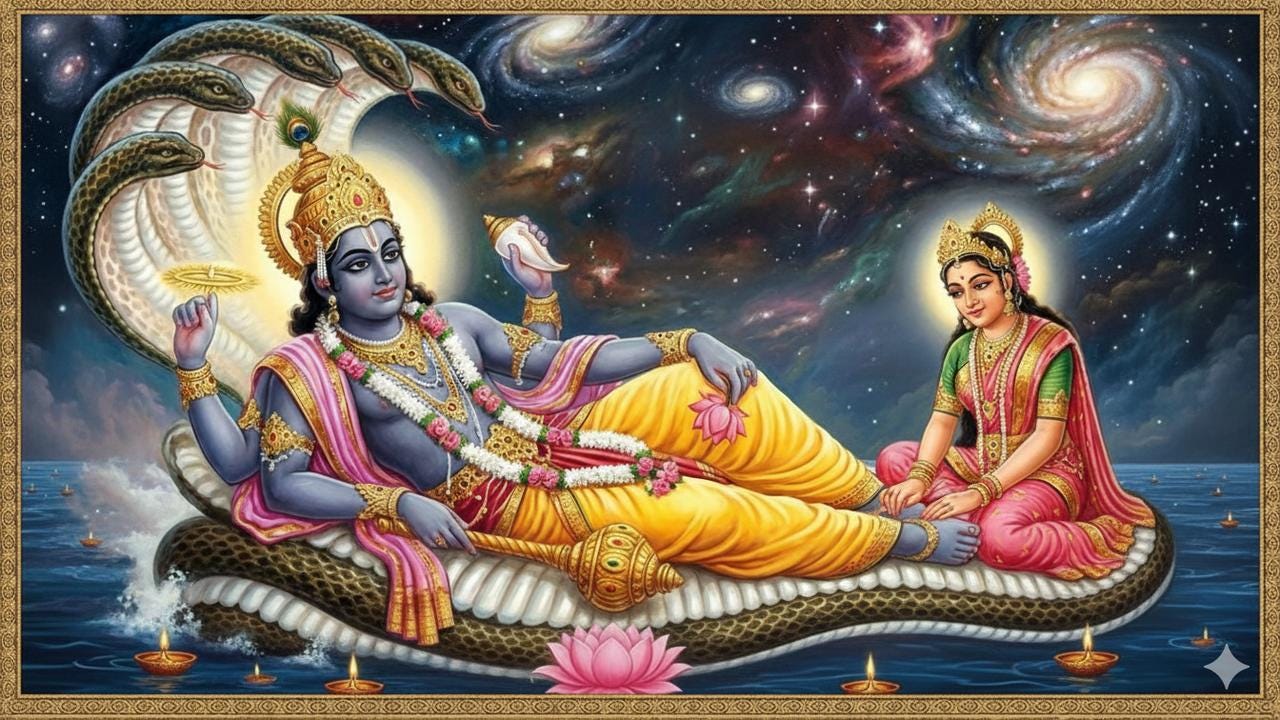
According to the Puranic tradition, this is the period during which Lord Vishnu, the preserver and sustainer of the universe, enters Yoga Nidra, His divine cosmic repose, upon the serpent Shesha in the Kshira Sagara, the Ocean of Milk.
Yet the story of these four sacred months is not merely a narration of the Lord’s divine rest. It is also a story of an extraordinary devotee, a promise honoured beyond the limits of worldly power, and the immeasurable compassion of the Supreme Divine.
At the heart of this account lies the remarkable story of King Mahabali and Lord Vamana, whose divine encounter gives Chaturmas its deeper spiritual significance.
The Story of King Mahabali: A King Who Would Not Abandon His Word
In the ancient age of Treta Yuga, there lived a mighty Asura king named Mahabali, the grandson of Prahlada, who was renowned for his unwavering devotion to Lord Vishnu.
Unlike the conventional image of an Asura ruler, Mahabali was distinguished by his generosity, religious observances, discipline and commitment to truth. Through his strength, spiritual merit and valour, he had established his authority over the three worlds, including the celestial kingdom of Indra.
Concerned by the loss of their kingdom, the Devas approached Lord Vishnu and sought His intervention to restore the balance of the cosmic order.
In response, Lord Vishnu resolved to manifest in His fifth divine incarnation as Vamana, appearing in the form of a young Brahmin dwarf.
At that time, King Mahabali was performing a grand sacrificial ceremony, during which he had undertaken to grant the wishes of those who approached him.
It was here that Vamana arrived.
Radiant with spiritual brilliance, carrying a parasol and a water pot, the young Brahmin approached the king. Mahabali received Him with reverence and offered Him whatever He desired.
Vamana asked for a seemingly insignificant gift: three paces of land, measured by His own steps.
Amused by the modest request, Mahabali offered Him far greater wealth. However, Vamana remained firm in His desire for only three steps of land.
The king’s spiritual preceptor, Shukracharya, soon recognised the divine identity of the young Brahmin. Understanding that this was Lord Vishnu Himself, he warned Mahabali against fulfilling the promise.
But Mahabali had already given his word.
He understood that the sanctity of a promise was greater than the preservation of his possessions. Despite his Guru’s warning, he refused to withdraw his commitment.
And thus, the divine revelation unfolded.
The Cosmic Form of Lord Trivikrama
As Mahabali completed the ritual offering, Vamana began to expand beyond all earthly dimensions.
His form grew immeasurably, assuming the magnificent cosmic manifestation known as Trivikrama.
The universe itself appeared encompassed within His divine presence.
With His first stride, the Lord covered the earthly realm. With His second, He extended across the celestial regions, leaving no space in the three worlds for the promised third step.
The Lord then asked Mahabali where He should place His remaining step.
The king stood with nothing left to offer.
His kingdom, wealth and possessions had all been surrendered. Yet his commitment to truth remained untouched.
With folded hands and complete humility, Mahabali bowed before the Supreme Lord and offered his own head as the final place for the divine step.
It was a moment of extraordinary surrender.
Mahabali had lost the dominion over the three worlds, but he had demonstrated something far greater: the ability to uphold his word even when it demanded the surrender of everything he possessed.
The Lord’s Grace: A Divine Promise to Mahabali
Pleased by Mahabali’s humility, truthfulness and unwavering devotion, Lord Vishnu granted him a place in Sutala, a magnificent subterranean realm described in the Puranas as exceptionally prosperous and protected.
More importantly, the Lord assured Mahabali of His personal presence and protection.
The Shrimad Bhagavata Mahapurana describes how Lord Vishnu promised to remain with Mahabali in Sutala, protecting him and his kingdom.
Thus, what appeared to be the defeat of a powerful king became the occasion for one of the most profound expressions of divine grace.
Mahabali was no longer merely a ruler who had conquered kingdoms. He became a devotee who had surrendered himself to the Supreme.
Why Does Lord Vishnu Sleep During Chaturmas?
The connection between Mahabali and Chaturmas is explained in the Padma Purana, Uttara Khanda, Chapter 53, which narrates the glory of Devshayani Ekadashi.
In this account, King Yudhishthira asks Lord Krishna a significant question: Why does Lord Vishnu enter His divine sleep, and why does He also remain with King Bali?
Lord Krishna explains that following the episode of Vamana and Mahabali, on the sacred Ekadashi of Ashadha’s bright fortnight, one divine form of Lord Vishnu remains with Mahabali, while another reclines upon Shesha in the cosmic Ocean of Milk.
The Lord remains in this divine state until the arrival of the Ekadashi of Kartika.
This sacred day is known as Devshayani Ekadashi, also called Harishayani Ekadashi or Ashadhi Ekadashi.
The word ‘Devshayani’ signifies the divine act of resting or entering sleep.
The four-month period beginning on this day is known as Chaturmas.
It is regarded as a time when devotees are encouraged to turn away from excessive material pursuits and dedicate themselves to spiritual refinement.
Chaturmas: Four Months of Spiritual Discipline
Chaturmas literally means ‘four months’. Traditionally, it encompasses the lunar months of Shravana, Bhadrapada, Ashwin and Kartika.
The Padma Purana describes specific disciplines and dietary restraints associated with these months.
Among the traditional observances are:
1. Shravana
Devotees traditionally practise restraint by giving up leafy vegetables. The month is also associated with prayer, worship and devotion.
2. Bhadrapada
The traditional observance includes abstaining from curd, alongside other forms of spiritual discipline.
3. Ashwin
The prescribed restraint includes giving up milk, according to the observances described in the Padma Purana.
4. Kartika
The traditional discipline includes abstaining from certain pulses or two-seeded grains.
Other observances include offering lamps, maintaining celibacy, sleeping on the ground and undertaking regular worship, according to individual capacity and family tradition.
These practices are not merely dietary restrictions. They represent the larger principle of self-restraint, conscious living and the purification of one’s thoughts and actions.
Chaturmas therefore becomes an opportunity to cultivate inner discipline while strengthening one’s relationship with the Divine.
Devutthana Ekadashi: The Divine Awakening of Lord Vishnu
After the completion of these four sacred months comes Devutthana Ekadashi, also known as Prabodhini Ekadashi or Haribodhini Ekadashi.
Observed on the eleventh lunar day of the bright fortnight of Kartika, it marks the traditional awakening of Lord Vishnu from His divine Yoga Nidra.
The word ‘Devutthana’ signifies the awakening of the Devas, while ‘Prabodhini’ refers to awakening or becoming fully conscious.
The day symbolises the conclusion of the sacred period that began with Devshayani Ekadashi.
Devotees celebrate the occasion by worshipping Lord Vishnu, offering lamps, singing devotional hymns and performing special prayers.
In many Hindu traditions, this occasion is also associated with Tulsi Vivah, the ceremonial marriage of Goddess Tulsi with Lord Vishnu in His Shaligram form. The observance is generally performed on Devutthana Ekadashi or the following auspicious days, depending on regional and family traditions.
The awakening of Lord Vishnu also marks the resumption of many auspicious ceremonies, including traditional Hindu weddings and other mangalik observances that are generally avoided during Chaturmas.
The Deeper Spiritual Meaning of Chaturmas
The narrative of Chaturmas offers a profound reflection on the relationship between the Divine, devotion and human conduct.
The story of Mahabali teaches that true greatness does not arise from material possessions, political authority or worldly achievements. It arises from character, humility and an unwavering commitment to truth.
The divine response of Lord Vishnu demonstrates that sincere devotion transcends distinctions of power, status and birth.
The four months of Chaturmas further remind humanity that spiritual progress requires discipline. Just as nature moves through cycles of rest and renewal, human life too requires periods of introspection, restraint and conscious transformation.
Devshayani Ekadashi invites the devotee to begin this inward journey.
Devutthana Ekadashi signifies its completion and the renewal of auspicious activity.
Together, these two sacred observances frame Chaturmas as a period of spiritual awakening, even as the Lord is described as resting in Yoga Nidra.
Jai Shri Hari.