

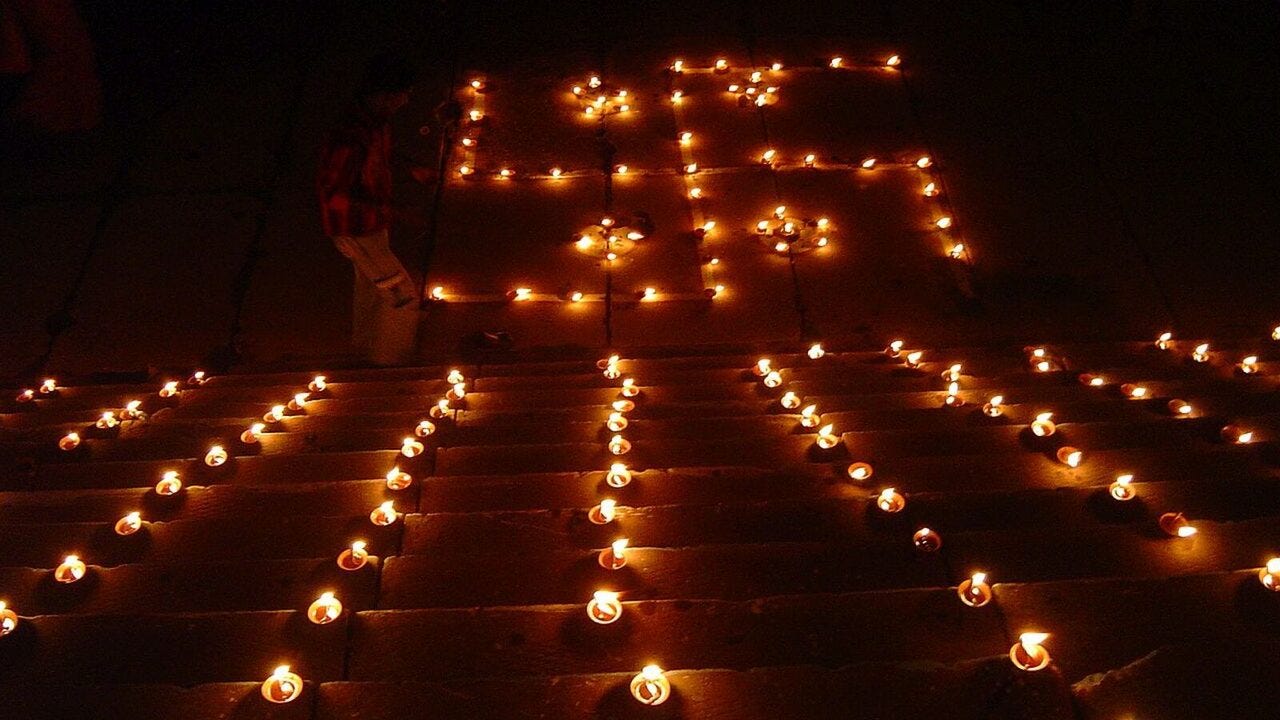
Diyas on the ghat steps, Dev Deepavali at Varanasi. Photo: Sumita Roy Dutta, CC BY-SA 4.0, via Wikimedia Commons
Har Har Mahadev.
Fifteen days after Diwali, Kashi lights its lamps again. This time they are not for us. They are for the Gods.
Dev Deepawali, also called Dev Diwali, is the Diwali of the Gods. It falls on Kartik Purnima, the full moon of the month of Kartik. It is the one evening of the year when the ghats of Varanasi are covered with diyas, and the Ganga carries their light.
If you have been meaning to make your first Kashi yatra, or return after years, this is a night to plan around. And because Kashi on this evening is very full, the planning starts weeks earlier than most people expect.
This guide gives you the date, the timings, the story, what you will see, and how to plan the days around it.
The date for 2026
Dev Deepawali 2026 is on Tuesday, 24 November 2026.
According to Drik Panchang’s calendar for Varanasi:
Pradosh Kaal Dev Deepawali muhurat: 5:08 PM to 7:47 PM (about 2 hours 39 minutes)
Purnima Tithi begins: 11:42 PM on 23 November 2026
Purnima Tithi ends: 8:23 PM on 24 November 2026
The lamps are lit at dusk, in the Pradosh window. Panchang timings are worked out for Varanasi’s location, so use the Varanasi figures and not the ones for your own city.
A small note: you may see a few websites quoting a different weekday or a different tithi start. Our dates above follow the Varanasi panchang from Drik Panchang. Before you book anything non-refundable, check the date again about a week before, as local committees sometimes announce programme details late.
Why the Gods light lamps
Kartik Purnima is also called Tripuri Purnima or Tripurari Purnima. The name comes from Tripurari, a name of Lord Shiva: the One who ended Tripurasura.
In the story, the demon Tripurasura had conquered the world and defeated the Gods. He had three cities in the sky, together called Tripura. On this day, Lord Shiva as Tripurantaka destroyed the three cities with a single arrow. The Gods were overjoyed, and they declared the day a festival of lights.
That is why it is called Dev Deepawali, and why it belongs so naturally to Kashi, the city of Shiva. The Ganga here becomes the stage, and the ghats become the lamps.
It is also a day of the holy dip. On Kartik Purnima, devotees bathe in the Ganga in the morning, and light diyas in the evening.
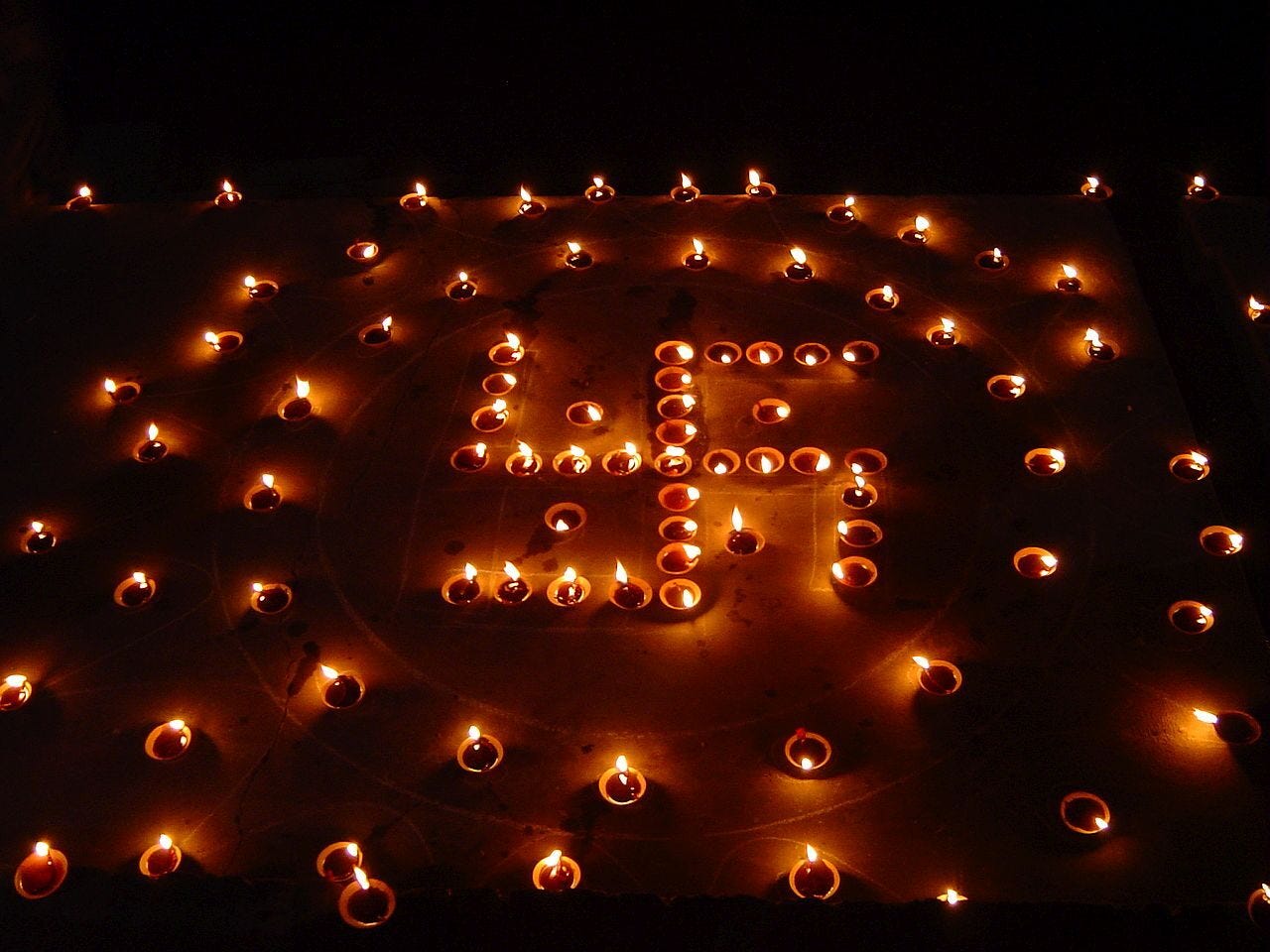
A swastik drawn in diyas on the ghat steps. Photo: Sumita Roy Dutta, CC BY-SA 4.0, via Wikimedia Commons
What the evening looks like
Here is what the 2025 Dev Deepawali (5 November 2025) looked like, as reported by the Hindustan Times, Akashvani (All India Radio) and the Times of India. Programmes change a little each year, so treat this as a picture of what to expect and not a promise for 2026.
The first lamp. Chief Minister Yogi Adityanath lit the first lamp at Namo Ghat and watched the Ganga aarti from a cruise on the river.
The lamps. The state had set a target of about 10 lakh (one million) diyas on the ghats. With public participation, the Hindustan Times reported the number reaching 15 to 25 lakh lamps across Kashi, including about 1 lakh eco-friendly diyas made of cow dung. Different newspapers quoted different totals, which is normal for a count this large. The honest answer is: a very large number, lit by the city together.
The ghats. All 88 ghats of the Ganga were lit, according to the government statement carried by Hindustan Times.
The Maha Aarti at Dashashwamedh Ghat. 21 priests and 42 girls performed the aarti in the form of Riddhi and Siddhi, with conch shells and bells. The ghat was decorated with 21 quintals of flowers and 51,000 lamps.
Kashi Katha. A 25-minute 3D projection show at Chet Singh Ghat told stories of Shiva and Parvati’s marriage, the Chakra Pushkarni, the teachings of Lord Buddha, the devotion of Kabir and Tulsidas, and the story of Banaras Hindu University.
A green fireworks show was held on the sands across the Ganga, and a laser show lit up Shivala Ghat.
In the temple. Special prayers were offered at Kashi Vishwanath, with the premises decorated with flowers and lights.
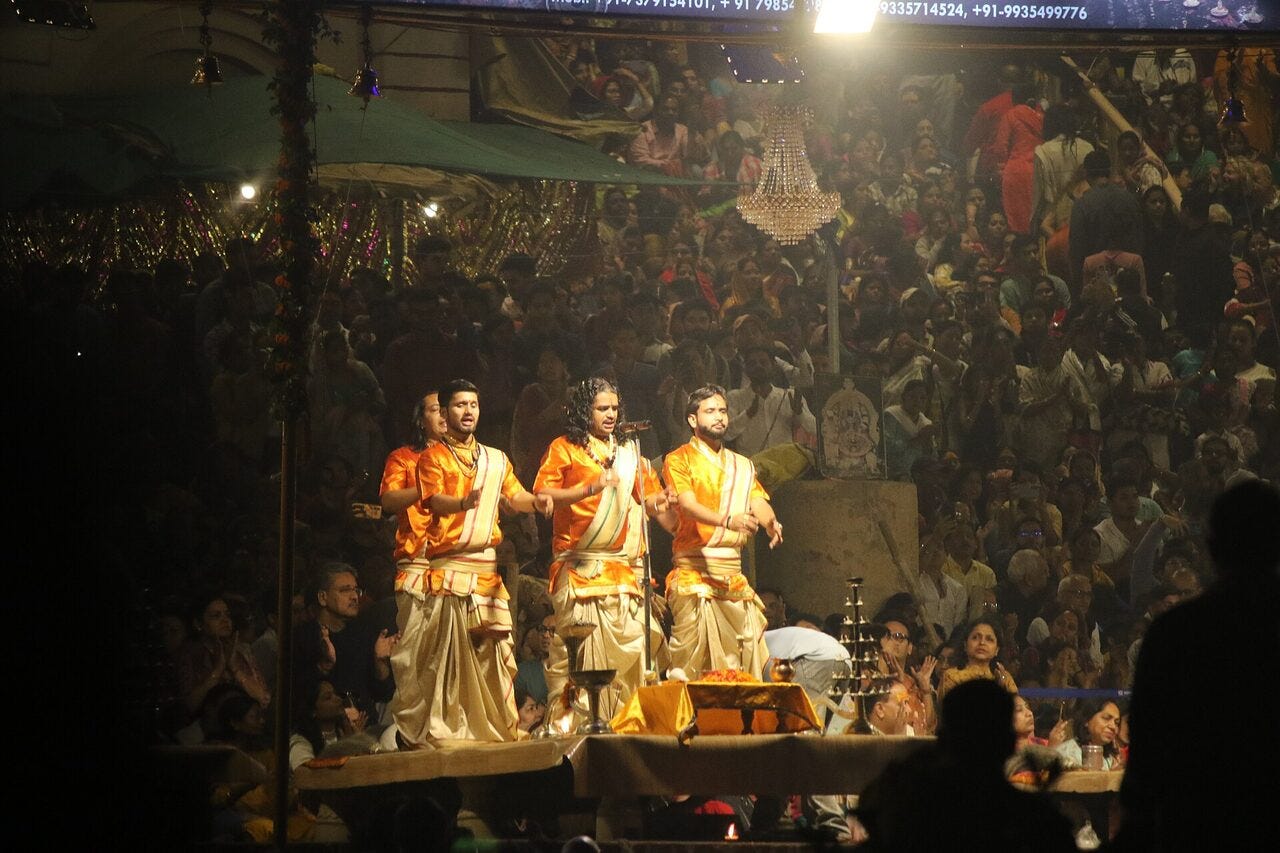
Ganga aarti at Dashashwamedh Ghat. Photo: Goutam1962, CC BY-SA 4.0, via Wikimedia Commons
What time to be where
Think of the day in four parts.
Morning: the Ganga snan. Kartik Purnima is a day of the holy bath. Early morning at the ghats is calm compared to the evening. Go early, bathe with care, and keep your phone and valuables in a safe place.
Midday: darshan at Kashi Vishwanath. Plan your darshan for the day, not for the evening. According to the temple’s official portal, the temple opens daily at 2:30 AM, and the aartis are: Mangla Aarti 3 to 4 AM, Bhog Aarti 11:15 AM to 12:20 PM, Sapt Rishi Aarti 7 to 8:15 PM, Shringar Bhog Aarti 9 to 10:15 PM, and Shayan Aarti 10:30 to 11 PM. The portal marks Mangla Aarti as “normal days only”, so on a festival day check the temple’s notice before you count on it. The portal also lists a special Purnima Shringar seva.
Late afternoon: reach your spot early. The Pradosh muhurat begins at 5:08 PM. The Ganga aarti at Dashashwamedh Ghat starts soon after sunset on a normal day (around 6 PM in winter, according to Wikipedia’s entry on the ghat). On Dev Deepawali, the programme around the ghats is larger, and the area near Dashashwamedh fills up well before it begins. Some local sources quote about 8 PM for the main aarti on Dev Deepawali. Exact timing is set by local committees and the administration, so confirm it a few days before.
Evening: the river or the ghat. You have two ways to see the night. You can stand on the ghat steps, close to the aarti but in a very tight crowd. Or you can see it from a boat on the river, where you see many lit ghats at once. If you choose a boat, ask for a life jacket, a fixed time and a fixed rate before you step in, and know that boats near Dashashwamedh may not be able to stop right in front of the aarti because of the rush.
When to begin your yatra
Our suggestion for most families:
Reach Kashi on 22 or 23 November. This gives you a day for darshan and rest before the busy evening. It also means you are not on the road on the day itself, when traffic and the area near the ghats are controlled. (In 2025, the administration controlled traffic, parking and entry and exit on the roads, according to Hindustan Times.)
Plan the Mangla Aarti separately. The official portal says general Mangla Aarti booking opens every day at 11 AM for the next 30 days, and a limited Tatkal booking opens at 11 AM for the next day. If you want Mangla Aarti, book as soon as the date opens, and check that it is being held on that day.
Keep the evening of 24 November free. Do not stack darshan, a meal and a boat on the same afternoon.
Stay near the river or near the temple lanes. Movement on the day itself can be slow. Staying close means you can walk.
Stay one more day. Many families find that the day after Dev Deepawali, when the ghats are quiet again and the lamps have burned out, is when they actually feel the city.
For parents, senior family members and children
The crowd on this evening is large. Some simple things that help:
Choose a fixed meeting point on the ghat and tell everyone where it is.
Carry water, a light shawl for the evening cold on the river, and a printed copy of your booking details.
For senior family members, a boat or a raised seating spot is often more comfortable than standing on the steps.
Keep children close, and keep a small card with your phone number in their pocket.
One thing to remember
Dev Deepawali is easy to describe and hard to explain. The numbers of lamps, the shows and the fireworks are the visible part. What stays with most people is quieter: a single diya, lit by someone’s hand, placed on a step of the Ganga, and the whole city doing the same thing at once.
If you would like to experience Dev Deepawali in Kashi with your family, DharmikVibes can guide you through darshan, aarti and stay planning as a spiritual experience, in the devotional way. Write to us at dharmikyatra@dharmikvibes.com.
Har Har Mahadev.