

Where Stone Becomes Philosophy
Rising from the plains of Bundelkhand, the temples of Khajuraho are not merely monuments of stone - they are crystallized philosophies. Built between 950 and 1050 CE under the Chandela Rajput dynasty, these temples represent one of the highest achievements of Nagara-style Hindu temple architecture.
This article focuses on the two crowning jewels of the Western Group - Kandariya Mahadeva Temple and Lakshmana Temple - while situating them within the larger sacred, artistic, and metaphysical landscape of Khajuraho.
Often misunderstood for their erotic imagery alone, the Khajuraho temples instead narrate a complete vision of life - Dharma (duty), Artha (prosperity), Kama (desire), and Moksha (liberation) - a journey from the corporeal to the cosmic, carved meticulously in sandstone
.
The Chandela Legacy: Fast Facts
Period of Construction: c. 950–1050 CE
Dynasty: Chandela Rajputs
Key Patrons:
Yashovarman – Lakshmana Temple
Vidyadhara – Kandariya Mahadeva Temple
Material: Fine-grained sandstone (early temples in granite)
Original Count: ~85 temples
Surviving Today: ~25 temples
UNESCO World Heritage Site: Since 1986
Group 12 Khajuraho Group of Mon…
The architectural grammar seen here likely drew inspiration from earlier sites such as Padavali Temple, Morena (near Gwalior), which scholars consider a stylistic precursor to Khajuraho’s mature grandeur.
Nagara Architecture: The Mountain Form
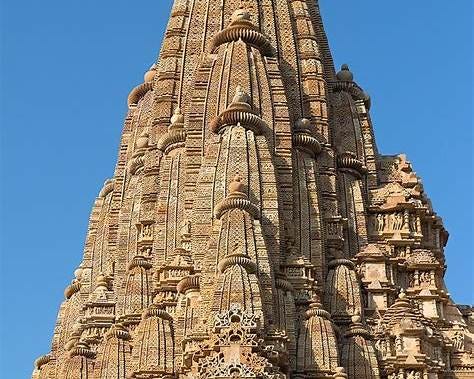
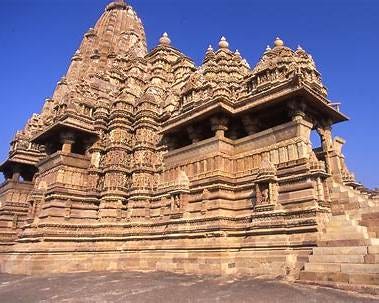
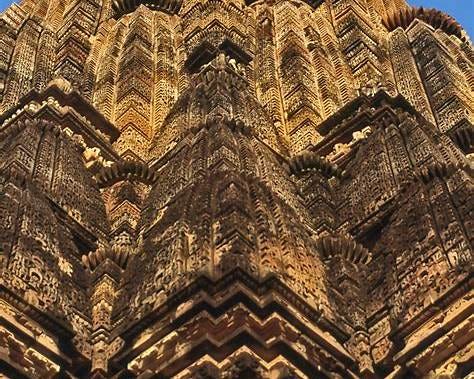
The defining visual signature of Khajuraho is its curvilinear shikhara, a soaring spire that resembles a mountain range in miniature. Unlike Dravidian pyramidal towers, Khajuraho’s Nagara shikharas rise in rhythmic vertical waves, culminating in a central peak that symbolizes Mount Meru, the cosmic axis of Hindu cosmology.
These temples follow the Vastu-Purusha-Mandala, a sacred geometric grid where:
The plan is divided into 64 sub-squares (padas)
The central square (Brahma Pada) houses the sanctum
Squares symbolize the divine; circles symbolize the earthly
The temple thus becomes a cosmic diagram in stone, aligning the human body, the universe, and the divine
.
The Jagati: Stepping into the Sacred
Each major temple stands on a raised Jagati (platform), physically and symbolically separating sacred space from the earthly realm. As one ascends the steps, the act mirrors a metaphysical transition - from the mundane to the divine.
A wide, ground-level view of the Western Group reveals how these structures dominate the landscape while remaining harmoniously proportioned, never overwhelming the human scale.
The Western Group: Zenith of Chandela Power
The Western Group represents the political, artistic, and spiritual high point of Chandela rule. These temples are the most refined, best preserved, and most ambitious in scale.
Kandariya Mahadeva Temple: The Mountain of Shiva
Standing at nearly 30.5–31 meters, Kandariya Mahadeva is the tallest and most complex temple at Khajuraho. Built around 1025–1050 CE by King Vidyadhara, it commemorates both devotion to Lord Shiva and a successful military defense of the kingdom
Group 12 Khajuraho Group of Mon…
.
Architectural Highlights
Over 870 sculptures adorn the exterior
Multiple tiers of sculptural friezes wrap the temple
Shikhara composed of graded replicas of itself, forming a stone “mountain range”
Marble Shiva-linga placed precisely at the sanctum’s center
Sculpture as Rhythm
Low-angle views reveal the crescendo-like rhythm of the superstructure, while mid-section panels display divine beings, celestial dancers, musicians, warriors, and lovers- each figure animated with remarkable dynamism.
Lakshmana Temple: Guardian of the Threshold
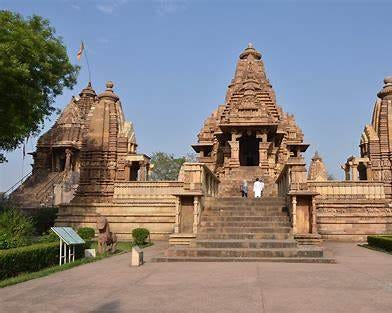
Earlier yet no less sophisticated, the Lakshmana Temple (c. 930–950 CE) was commissioned by King Yashovarman and dedicated to Vaikuntha Vishnu. It is the oldest fully developed Nagara temple at Khajuraho
Group 12 Khajuraho Group of Mon…
.
Distinguishing Features
Panchayatana layout (five shrines)
Two-loop Makara-Torana (crocodile arch) at the entrance
Sculptures of Vishnu’s incarnations and divine assemblies
Rare depiction of Panchagni (five fires) on exterior walls
Ascending its grand staircase, flanked by subsidiary shrines, the visitor experiences a carefully choreographed spiritual approach—architecture guiding emotion.
A Theology of the Body: Sculpture and Meaning
The sculptures of Khajuraho form a “symphony of life”:
Erotic imagery accounts for less than 10% of carvings
The majority depict gods, goddesses, celestial beings, musicians, dancers, warriors, and scenes of daily life
Eroticism here is not indulgence, but philosophy - Kama acknowledged as a legitimate step on the path toward Moksha
Group 12 Khajuraho Group of Mon…
.
Iconography Highlights
Apsaras & Sura-Sundaris: Grace, beauty, movement
Mithunas: Cosmic balance of male and female principles
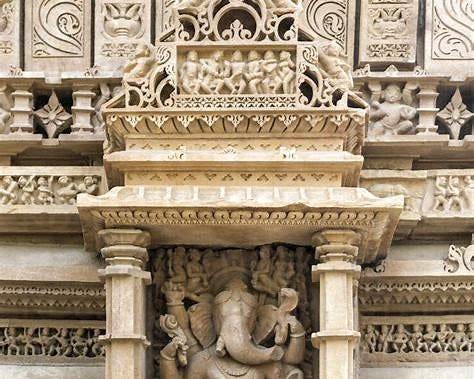
Ganesha: Precision carving, devotional intimacy
Doorway Guardians: Dense layers of divine and celestial figures protecting the sanctum
Sound, Light, and Memory: Night at Khajuraho
When darkness falls, the Son-et-Lumière show transforms the Western Group into a living chronicle. Under star-filled skies, shifting lights animate the temples as narration recounts the rise and decline of the Chandela kings. It is history experienced not through text, but through atmosphere.
Travel Guide: Planning Your Khajuraho Visit
Getting There
✈️ Khajuraho Airport (HJR): Delhi, Varanasi connections
🚆 Rail: Direct trains incl. Vande Bharat, Sampark Kranti
🚗 Road: Jhansi–Khajuraho highway
Best Time to Visit
October–March: Ideal weather
September–November: Best flow at Raneh Falls
Weather
Summer: Up to 45°C
Winter: 5–25°C, pleasant days
Tickets
Western Group: Ticketed (digital preferred)
Eastern & Southern Groups: Mostly free
Pro Tip
Visit the Western Group at sunrise for golden light on sculptures and minimal crowds.
Mountains of Light
Kandariya Mahadeva and Lakshmana Temples are not frozen relics of the past - they are living philosophies carved in stone. Together, they express a worldview where desire and devotion coexist, where architecture becomes metaphysics, and where stone rises toward transcendence.
Khajuraho remains one of India’s most profound conversations between art, faith, and humanity - a journey from the real to the surreal, from body to soul.
Kandariya temple is one of the most beautiful temples in all of India