
From Darshan to Destination: India's Sacred Journeys Are Being Reborn - and DharmikVibes Is Building the Bridge
KPMG and PHDCCI have put a number, and a name, to a shift every Devotee can already feel. Here is what their new report says - and how DharmikVibes is quietly making it real.

Dear Devotees,
For generations, a sacred journey in our land followed one unbroken rhythm. You set out - often across hard roads and harder distances - to stand before the deity for a few sacred moments of darshan. To see, and to be seen by, the divine. Then you returned home, carrying that moment in your heart.
That rhythm is now being reborn into something deeper and more lasting.
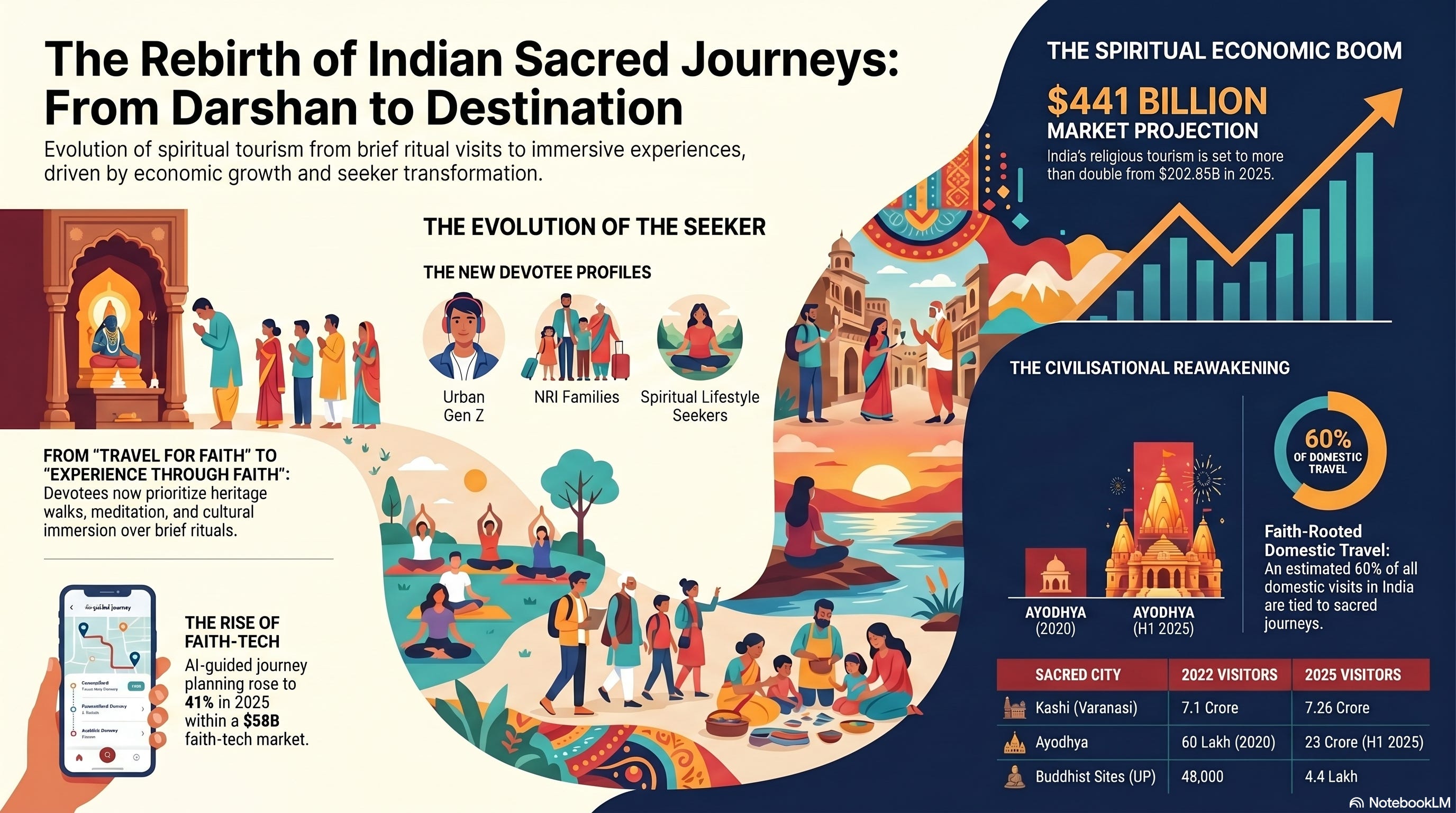
A new thought-leadership report from KPMG in India, prepared with the PHD Chamber of Commerce and Industry (PHDCCI) and released this June, carries a title that says everything: From darshan to destination: The transformation of spiritual tourism in India. Its message is one that every seeker, every host community, and every steward of our heritage should hear closely. Our sacred sites are no longer being approached as places of brief ritual alone. They are becoming living ecosystems - where Devotees arrive, stay longer, walk deeper, take part more fully, and leave transformed.
This is not a turning away from faith. It is faith opening its arms wider.
The scale of devotion, in numbers
The report makes plain just how vast this sacred sphere has become. India’s religious tourism sector stood at around USD 202.85 billion in FY2025, and is projected to reach USD 441.19 billion by 2035. Of the 303 crore domestic visits India recorded by August 2025, an estimated 60 per cent were tied to faith-rooted journeys - proof, as the report notes, that devotion is not a niche but the very heartbeat of how Bharat moves.
The transformation is most visible in our great sacred cities. Kashi (Varanasi) drew around 7.1 crore Devotees in 2022, rising to over 11 crore in 2024, and a record 7.26 crore in 2025. Ayodhya, reborn around the Ram Mandir, leapt from roughly 60 lakh visitors in 2020 to over 16 crore in 2024, drawing more than 23 crore in just the first half of 2025, supported by nearly ₹85,000 crore in infrastructure development. These are not gentle increases. They are a civilisational reawakening.
The distance between two words
Consider the two words in that title.
Darshan is the old, beloved logic — arrive, behold the divine, depart. Destination is the new logic — arrive, dwell, walk the sacred geography, take part in the living devotion of a place, and carry home an experience, not just a memory.
The report’s own framing is striking: the shift is from “travel for faith” to “travel for experience through faith.” The Devotee of today still comes first to pray. But many now also come to learn the sacred history of a place, to witness an evening aarti in its full glory, to sit in meditation and sadhana, to walk a heritage trail that links shrine to shrine, and to feel woven into a living community rather than passing through alone.
The Devotees are changing - and growing
One of the report’s clearest findings is that the seekers undertaking these journeys are no longer a single kind. The circle has widened to welcome several distinct souls:
The experience seeker, drawn by the atmosphere, rituals, architecture and stories of a sacred place as deeply as by devotion. The report links this very rise to Kashi’s surge to over 11 crore visitors, alongside heritage walks, river experiences and cultural programming.
The spiritual lifestyle seeker, for whom spirituality is an ongoing pursuit, not a one-time act — drawn to extended stays, yoga, meditation and Ayurveda in places like Rishikesh, Kerala and Auroville. Rishikesh’s International Yoga Festival in 2026 alone drew over 1,500 participants from nearly 80 countries; in Kerala, Ayurveda and wellness account for an estimated 70–80 per cent of the state’s tourism foreign-exchange earnings.
The young, urban Devotee, whose bond with faith is fluid, personal, and shared online — engaging through devotional concerts, hybrid formats, and digital-first experiences. The report notes how Isha’s Mahashivratri 2026 drew over 4.5 million views on YouTube, and how Gen Z is even reshaping nightlife through devotional formats.
The Devotee from across the seas — our NRI families and international seekers — whose longing remains strong, especially for yoga, meditation, Ayurveda and the Buddhist heritage circuits. Foreign visits to Uttar Pradesh’s Buddhist sites rose nearly nine-fold, from about 48,000 in 2022 to around 4.4 lakh in 2025.
The age of immersive experience
Beneath all of this lies what the report calls the rise of the experience economy within our sacred spaces. The heart of it is simple: Devotees increasingly seek to take part, not merely to be present.
The report shows how destinations are answering this call — through guided storytelling that opens up the meaning of a place (as at Bhubaneswar’s Ekamra Kshetra), through ritual participation, through a vibrant night-time spiritual economy (the evening Ganga Aarti at Dashashwamedh Ghat; the illuminated Adiyogi at Coimbatore), and through festivals as anchors. The Braj Holi across Mathura, Vrindavan, Barsana and Nandgaon helped draw around 7.9 crore visitors and ₹15,380 crore in devotional spending to the region in 2023.
A second great shift is the rise of circuit-based sacred journeys — where Devotees experience many connected holy places within one unified DharmikYatra. This is the very spirit in which a Jyotirlinga circuit or a Char Dham journey has always been walked. It is also, as you will see, the spirit on which DharmikVibes was founded.
Technology in service of devotion
If immersive experience is the heart of this change, technology is becoming its quiet hand. The report identifies a third pillar — alongside experience design and infrastructure — built on digital platforms, AI-guided personalisation, live darshan, and immersive previews. It records that AI use in journey planning rose from 26 per cent in 2024 to 41 per cent in 2025, and that India’s emerging faith-tech sphere is valued at roughly USD 58.6 billion, supported by over 900 startups.
The report is honest, too, about the shadows: information overload, misinformation, and the risk that digital noise drowns out genuine devotion. Its counsel is clear — technology must deepen reverence, never dilute it.
This is precisely the conviction on which DivineAI and the DharmikVibes ecosystem have been built.
How DharmikVibes is making this happen
The KPMG–PHDCCI report describes, in the language of policy and economics, a future that DharmikVibes — a brand of DIVVIB Lifestyle Private Limited — has been quietly building for our Devotees. Where the report names three pillars — experience design, integrated infrastructure, and technology — DharmikVibes already lives in all three.
On experience-led, circuit-based journeys. The report calls for the sector to move from single-shrine visitation to integrated, multi-destination journeys. This is the founding logic of DharmikYatra — sacred journeys designed not as point-to-point logistics but as continuous, meaningful arcs of devotion, from the Sawan Jyotirlinga circuit to the Char Dham. Where the report points to Maharashtra’s Mumbai–Pune–Nashik–Shirdi and Jyotirlinga circuits as models, DharmikVibes builds exactly such circuits as living, curated experiences for Devotees.
On longer, deeper stays. The report notes that the new Devotee seeks extended, comfortable, curated engagement. DharmikStay answers this — devotion-aligned stays that let a seeker dwell within a sacred place rather than rush through it.
On storytelling and guided meaning. Guided interpretation is named as one of the strongest experience layers. The DharmikGuide Network brings the mythology, history and sanctity of each site to life, so no Devotee stands before a shrine unknowing.
On the great sacred hubs. The report singles out Ujjain, Kashi, Ayodhya and Haridwar as destinations being reborn into integrated ecosystems. These are precisely the four anchors of DharmikHubs — DharmikVibes’ on-ground presence in the very cities the report identifies as the future of India’s spiritual sphere.
On the Kumbh as a catalyst. The report’s central spotlight is the Simhastha Kumbh 2027 at Nashik and Trimbakeshwar — over 12 crore Devotees expected, up to ₹27,000 crore in economic activity, ₹33,000 crore in infrastructure, ₹13,190 crore in MoUs, and around 32,000 jobs. DharmikVibes’ Kumbh 2027 partnership with PTTS positions the brand directly within this once-in-twelve-years sacred convergence.
On the young and the NRI Devotee. The report identifies youth, urban and international seekers as the fastest-growing segments. Through DharmikCommunities and GitaSadhana, DharmikVibes meets the young Devotee where their devotion now lives — in shared, lived, community-rooted practice — while a strong NRI focus serves the seeker across the seas who longs to stay connected to home.
On technology that serves the sacred. Where the report names AI personalisation, live darshan and faith-tech as the third pillar, DivineAI — DharmikVibes’ six-agent intelligence layer — and the DharmikSevak guidance system are built to make sacred journeys easier to plan and deeper to experience, always in service of reverence rather than spectacle. This is faith-tech with its heart in the right place.
In short: the transformation the report forecasts is not a distant horizon for DharmikVibes. It is the work already underway — darshan becoming destination, with the sanctity held intact at every step.
Honouring the balance
The report does not pretend this change is without cost. High volumes strain infrastructure, test crowd safety (it recalls the tragic Maha Kumbh stampede of January 2025), burden the environment (the Char Dham’s 48 lakh pilgrims in 2024 raised real ecological concern), and risk eroding the authenticity of heritage sites. Its deepest counsel is the one DharmikVibes holds closest: scale without dilution, modernise without losing authenticity, innovate without disconnecting from tradition.
A destination that surrenders its spiritual essence in pursuit of spectacle has lost the one thing that ever made it holy. Every experience must deepen devotion, never replace it.
In closing
India’s sacred sphere stands at a threshold — where the boundless devotion of crores of seekers meets the need to nurture these places with greater care, depth and intention. The KPMG–PHDCCI report calls this the journey from darshan to destination. We would simply call it devotion, made fuller.
The path forward lies not in managing crowds alone, but in shaping whole sacred ecosystems that honour heritage, story, and spirit together — letting Bharat’s spiritual heart beat stronger for the whole world to feel, while preserving the reverence on which it all rests. That is the future the report envisions. It is the future DharmikVibes wakes up each day to build.
May every sacred journey you undertake deepen your bond with the divine.
Har Har Mahadev. Jai Mahakal.
This reflection draws upon From darshan to destination: The transformation of spiritual tourism in India (KPMG in India with the PHD Chamber of Commerce and Industry, June 2026). DharmikVibes is a brand of DIVVIB Lifestyle Private Limited.