
From Sanctum to Sustainability: How Indian Temples Built a Circular Economy Long Before the Term Existed

Indian temples are often seen through a narrow lens: sacred spaces meant for prayer, ritual, and religious identity. But if we step back and look at temples as living institutions - not just monuments - we begin to see something deeper. Historically, temples in India functioned like complete civic ecosystems. They shaped towns, trained minds, supported livelihoods, conserved water, financed local economies, and anchored cultural memory.
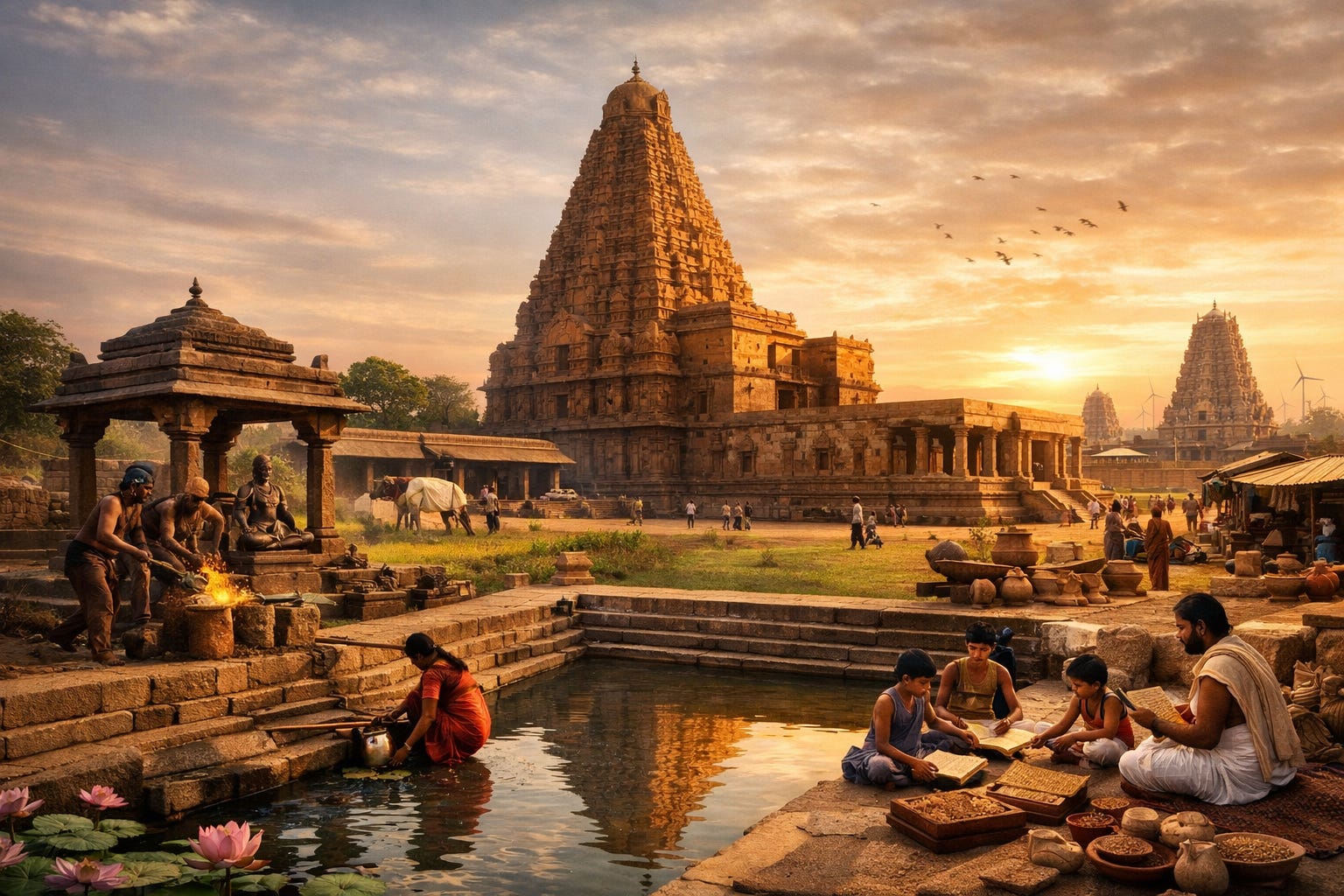
In modern times, temple construction and revival have returned to the centre of public attention. Yet the true test of this revival will not be the scale of new structures or the volume of tourism they attract. It will depend on whether modern temple-centred growth revives the older redistributive logic of temple economies - or slips into the trap of narrow commercialisation, where sacred spaces become marketplaces.
This is not nostalgia. It is a question of institutional design: what kind of society do we want our sacred spaces to support?
Temples as Civilisational Blueprints, Not Just Places of Worship
To understand the temple’s full role, we must treat it as more than a religious building. Temples were once the most visible form of community organisation - one that combined governance, culture, knowledge, economics, and environment under a single public institution. They were a shared public space where social legitimacy, resources, and duties were managed in a relatively durable manner.
Temples were not merely “expressions of faith.” They were public anchors of legitimacy - trusted enough to hold records, administer grants, manage labour obligations, and support community welfare. This is why so many inscriptions, copper plates, and administrative records revolve around temple institutions across centuries. [1][2]
Architecture that Was Technical Before It Was Symbolic
Modern education often treats sacred architecture as a product of belief - beautiful, yes, but driven mainly by metaphysics. Yet a closer look shows that temple design was often engineering-first, with symbolism following structure.
Many temples demonstrate remarkable mastery in stone construction: stable load-bearing techniques, long-lasting foundations, and precise geometric planning. Structures like the Brihadeeswarar Temple at Thanjavur continue to stand as proof of engineering competence rather than mystery. What appears miraculous is more accurately the result of skilled material understanding and construction logic. [3]
Temple layouts were usually not random. They were governed by proportional systems and geometric planning methods that regulated spatial hierarchy and human movement. Traditional planning systems such as the Vastu Purusha Mandala can be viewed as design frameworks that shaped density, orientation, ventilation, and processional pathways. In contemporary vocabulary, many of these principles match the goals of climate-responsive architecture and passive design. [4]
Temples as Environmental Infrastructure: Water, Soil, and Resilience
Perhaps the most overlooked dimension of temples is their relationship with ecology. Temples were seldom built in isolation; they were integrated with land, water systems, and community needs.
Ancient planning practices paid serious attention to the physical character of a site - soil stability, water availability, and regional resilience. Water structures around temples - especially tanks, stepped ponds, and reservoirs - were not decorative. They served as water storage systems, groundwater recharge mechanisms, flood buffers, and public resources during scarcity.
South India offers clear examples of temple-associated tanks, many of which were historically maintained as part of temple-town life. In modern times, neglect and encroachment of these water bodies has contributed to water insecurity - especially in regions that now face seasonal stress. The ecological cost of losing these systems is tangible. [5][6]
Sound, Metal, and the Science of Sensory Spirituality
Temples were designed not only to stand - but to shape human experience. Spirituality was made tangible through sound, space, and sensory impact.
Bells cast using multi-metal alloys were valued not purely for symbolism but for acoustic output. Their layered harmonic resonance, especially inside enclosed spaces, creates immersive sound environments that influence attention and perception. Modern studies on sound, vibration, and cognitive focus suggest that frequencies and rhythm can meaningfully shape mental states - even though the cultural purpose of temple soundscapes remains distinct. [7]
Similarly, traditional metalwork - whether idols, plates, or ritual instruments - often reflected practical material logic: durability, resonance, and texture mattered alongside sacred meaning.
Temples as Knowledge Networks: Public Learning Before Modern Universities
The idea that ancient Indian education was confined to forests or elite spaces is incomplete. Temples functioned as public knowledge nodes. Many temple precincts supported teaching and scholarship because they had both social legitimacy and stable patronage.
Mathematics, astronomy, grammar, music, philosophy, medicine, and commentary traditions were nourished through temple-linked networks. Knowledge was not divorced from society. It was embedded in festivals, calendars, social participation, and patronage systems - allowing learning to thrive within community life. [8][9]
In this model, temple towns became intellectual ecosystems. Pilgrimage enabled mobility, mobility enabled exchange, and exchange sustained both learning and cultural transmission.
Temples as Financial Institutions and Employment Engines
Temples were major economic institutions, not merely donation centres. In several dynastic contexts - especially in South India - temples administered resources, recorded transactions, and anchored public trust.
Temple inscriptions and administrative records show evidence of:
land grants and revenue management
irrigation endowments
wages and work allocations
loans and repayment schedules aligned with agricultural seasons
long-term maintenance funding for tanks, roads, and service networks [1][2][10]
This institutional role created employment at scale. A thriving temple economy supported priests and administrators - but equally sustained sculptors, bronze casters, musicians, dancers, gardeners, guards, cooks, suppliers, and agricultural workers.
Culture survived because it had an economic base. Craft survived because it had a stable institution.
The Circular Economy of Temple Towns: A Loop of Trust and Reinvestment
The “circular economy” idea becomes clearer when we map the temple system as a loop:
local land and production created surplus
surplus sustained people, labour, and services
people sustained temples through participation and patronage
temples reinvested into infrastructure, learning, welfare, arts
reinvestment increased prosperity and attracted more activity
the cycle repeated
Unlike extractive models where profits exit the community, this structure historically retained value within the local ecosystem and redistributed it through institutional obligations.
This did not mean the system was perfect or free from corruption in every period. But its underlying logic was community-anchored and institutionally redistributive.
The Modern Moment: Revival or Commercialisation?
Temple-centred development is resurging in many regions. Temple tourism increases demand for hotels, transport, craft, food, and services. It can strengthen local livelihoods and accelerate infrastructure upgrades.
However, the legitimacy of modern temple revival will depend on one central question: Is growth rooted in community welfare - or driven mainly by extraction and spectacle?
A circular temple economy benefits:
local artisans and workers
cultural communities
water systems and public ecology
learning and preservation
social welfare systems
A commercialised temple economy prioritises:
concentrated business interests
high-fee access models
retail extraction around sacred spaces
institutional opacity and surplus capture
The difference lies in governance and reinvestment. Temples historically remained powerful because they were more than buildings - they were institutions that returned value to society.
Reimagining Temple Sustainability Today
If modern India wants temple development to become a genuine sustainability model, it can move beyond aesthetics into institution-building:
restore temple tanks and water bodies as civic infrastructure
create artisan corridors and heritage skill hubs
fund scholarships, libraries, and music schools in temple towns
ensure waste-free pilgrim management systems and recycling
support local procurement and fair employment standards
invest in affordable housing for workers in pilgrimage zones
maintain transparency in temple funds and reinvestment cycles
In short: don’t just build stone and spectacle - build systems.
Temples as Civil Society Institutions
Indian temples are not only spiritual spaces. Historically, they were civil society institutions - balancing metaphysics with engineering, devotion with dignity, economy with ethics, and continuity with change.
They remind us that sustainability is not only technological - it is institutional. Sacred spaces can become models of resilience when they support ecology, livelihoods, learning, and redistribution.
The future of temple revival should therefore not be measured merely in footfalls or revenue. It should be measured in how deeply it rebuilds the local civic ecosystem around it. That is where cultural legitimacy becomes lasting.
References / Suggested Reading
Burton Stein, Peasant State and Society in Medieval South India (Oxford University Press).
K.A. Nilakanta Sastri, The Cholas (University of Madras).
George Michell, The Hindu Temple: An Introduction to Its Meaning and Forms (University of Chicago Press).
Stella Kramrisch, The Hindu Temple (Motilal Banarsidass).
Research work on South Indian tank systems and temple water bodies (academic and policy studies).
Studies on water stress and urban water governance in Tamil Nadu (peer-reviewed and institutional reports).
Peer-reviewed literature on acoustics, attention, and cognitive response to soundscapes.
Dharampal, The Beautiful Tree: Indigenous Indian Education in the Eighteenth Century (Other India Press).
Sheldon Pollock, works on Sanskrit knowledge systems and intellectual networks.
Kenneth R. Hall, Trade and Statecraft in the Age of the Colas.