
Hanuman Ji Puja and Sundarkand Path: The Complete Spiritual Science of Inner Strength, Devotion, and Self-Mastery

In the vast spiritual heritage of Bharat, Hanuman Ji stands not merely as a divine hero, but as a living archetype of perfected consciousness. He is strength without aggression, power without ego, wisdom without pride, and devotion without expectation.
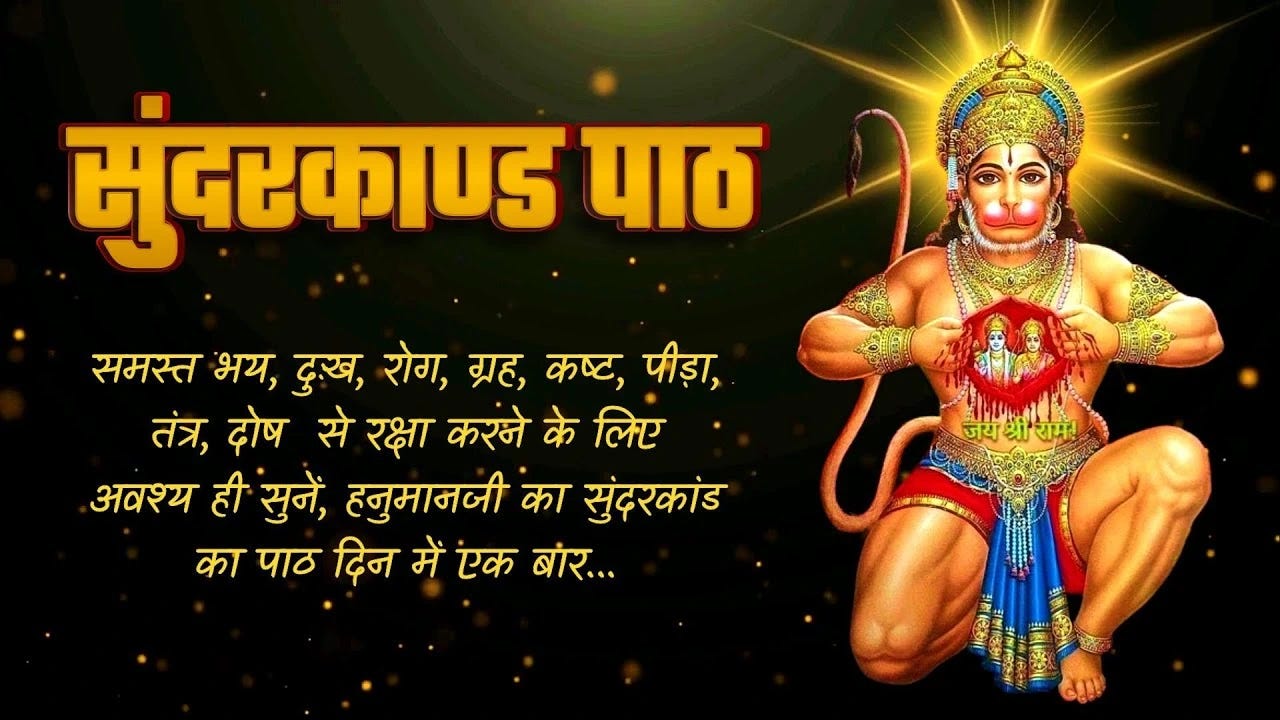
To perform Hanuman Puja alongside the Sundarkand Path from Goswami Tulsidas’ Ramcharitmanas is not simply to recite verses - it is to enter a structured psychological and spiritual discipline designed to reshape the mind, awaken inner power, and align the individual with Dharma.
In an age marked by anxiety, distraction, ego conflicts, and emotional instability, Sundarkand emerges as a timeless manual for cultivating fearless living (Abhay), balanced intellect (Vivek), and surrendered strength (Shakti through Bhakti).
This article explores its deeper metaphysics, symbolism, ritual science, psychological impact, philosophical contrast, and practical transformation.
I. Hanuman Ji – The Living Principle of Disciplined Power
Hanuman Ji is often misunderstood as merely the strongest warrior of Ramayana. In truth, he represents an inner principle - the awakened Prana (life-force) guided by Dharma.
His Core Attributes
1. Ram Bhakti (Devotion to Truth)
Hanuman’s identity dissolves in Ram. When asked who he is, he answers differently based on awareness:
At the body level — servant.
At the soul level — part of the Divine.
At the highest truth — non-different from Ram.
This layered self-understanding is Vedantic mastery.
2. Bal (Strength)
Not brute force — but disciplined, controlled power. He uses strength only when aligned with Dharma.
3. Vivek (Discrimination)
He knows when to be small (meeting Sita), when to expand (burning Lanka), and when to remain silent (before Ram).
4. Vinay (Humility)
Despite unmatched strength, he bows with folded hands. His ego is zero.
Symbolic Interpretation
Mace (Gada) → disciplined force
Folded hands → surrender
Flying posture → transcendence of limitations
Tearing open chest to reveal Ram-Sita → devotion rooted in the heart center
Hanuman is the perfected integration of Shakti and Bhakti.
II. Sundarkand – The Inner Journey of the Seeker
Sundarkand is the fifth kand of Ramcharitmanas. It describes Hanuman’s journey to Lanka. Yet spiritually, it narrates the soul’s journey across ignorance toward Divine realization.
It is called “Sundar” (Beautiful) not because Lanka is beautiful - but because the path of courage, devotion, and clarity is beautiful.
Tulsidas did not describe the problem; he described the solution.
III. Deep Symbolism of Key Events
Let us go beyond narrative and explore psychological and metaphysical meanings.
1. The Ocean (Samudra) – The Mind
The vast ocean represents:
Fear
Doubt
Uncertainty
Emotional turbulence
When Hanuman forgets his strength, Jambavan reminds him.
This is symbolic: We forget our power until wisdom reminds us.
The leap across the ocean represents:
Faith over fear
Action over paralysis
Confidence over self-doubt
2. Surasa and Simhika – Ego and Negativity
On the way, Hanuman faces:
Surasa (challenge of ego expansion)
Simhika (shadow negativity pulling him down)
He overcomes both through intelligence, not aggression.
Message: Not every obstacle requires force — some require strategy.
3. Ashok Vatika – Peace Amidst Chaos
Ashok means “absence of sorrow.”
Even in Lanka (symbol of ego), there exists an Ashok Vatika - inner peace.
Hanuman finds Sita (pure consciousness) within this space.
Lesson: Even in suffering, the soul remains untouched.
4. Meeting Sita Mata – Dialogue of Soul and Divine
Sita represents:
Pure devotion
Inner Shakti
The soul separated from higher truth
Hanuman delivers Ram’s ring — symbolic of assurance.
Faith restores hope.
5. Burning Lanka – Destruction of Ego
Hanuman burns Lanka but leaves Sita unharmed.
Meaning:
Destroy arrogance
Preserve purity
Ego must burn, not the heart.
IV. Sundarkand and the Four Ashramas
Indian civilization structured life into four progressive stages:
Brahmacharya – Discipline and study
Grihastha – Responsibility and balance
Vanaprastha – Gradual detachment
Sannyasa – Total surrender
Sundarkand teaches discipline (Brahmacharya), courage in duty (Grihastha), detachment from ego (Vanaprastha), and surrender (Sannyasa).
The Gita (6.30) reminds:
“He who sees Me everywhere and sees all in Me - to him I am never lost.”
Hanuman embodies this consciousness.
V. Contrast: The Materialist Path (Carvaka Philosophy)
Ancient Indian thought also contained materialist philosophy - Carvaka:
“While life remains, live happily; even if in debt, drink ghee.”
This path prioritizes pleasure over purpose.
Sundarkand stands in contrast — advocating:
Discipline over indulgence
Dharma over desire
Self-mastery over consumption
It is a philosophy of strength, not escape.
VI. The Science of Recitation – Ritual as Psychology
Hanuman Puja and Sundarkand Path function as structured meditation.
Why Tuesday and Saturday?
These days align with planetary energies associated with discipline and strength (Mangal and Shani).
Time: Morning or Evening
Morning energizes.
Evening stabilizes.
Required Bhava (Inner State)
Shuddh Man (pure intention)
Sthir Chit (steady mind)
Uchcharan (clear pronunciation)
Without bhava, ritual becomes mechanical.
VII. Step-by-Step Spiritual Method
Clean environment → External order reflects internal clarity.
Light ghee lamp → Awakening consciousness.
Offer red flowers → Activation of Shakti.
Chant “Ram” → Anchor of awareness.
Recite slowly → Absorb meaning.
Visualize events → Engage subconscious.
End with Hanuman Chalisa and Aarti.
Sit in silence → Integration phase.
Duration: 1–2 hours for full recitation.
VIII. Real Benefits: Psychological and Spiritual
This practice does not guarantee miracles. It guarantees transformation.
Mental Benefits
Reduction in anxiety
Stability in crisis
Lower stress response
Studies on Vedic chanting suggest:
Reduced cortisol levels (20–30%)
Activation of the vagus nerve
Enhanced parasympathetic response
Ancient rhythm aligns breath, brain, and heart.
Spiritual Benefits
Deepened devotion
Increased Vivek (clarity)
Inner courage
Practical Benefits
Better decision-making
Patience under pressure
Strength during adversity
IX. Common Myths – Clarified
Myth: Audio playing is enough.
Truth: Conscious participation is essential.
Myth: Wrong pronunciation causes sin.
Truth: Intent matters more than perfection.
Myth: Only Brahmins can recite.
Truth: Devotion is universal.
Hanuman belongs to humanity.
X. Who Should Practice?
Those battling fear
Beginners in sadhana
Individuals facing crisis
People needing emotional resilience
Seekers of disciplined growth
It is not an escape from problems.
It is preparation to face them.
XI. The Ultimate Message
Sundarkand teaches:
Discipline awakens strength.
Devotion dissolves ego.
Faith conquers fear.
Surrender generates power.
Hanuman’s life reveals the highest paradox:
The strongest being is the most humble.
Sundarkand is not about removing obstacles externally.
It is about becoming strong internally.
It does not promise supernatural miracles.
It builds natural mastery.
In a restless world of distraction and ego, Hanuman Ji reminds us:
Cross your ocean.
Burn your Lanka.
Protect your inner Sita.
Serve your highest Ram.
Strength through surrender - this is the path.