
Kanwar Yatra 2026: The Month India Walks to Shiva
Sawan has begun. Between now and Sawan Shivratri on 11 August, crores of kanwariyas will carry the Ganga on their shoulders.

Sawan arrived this week, and with it, North India changed colour.
The highways between Haridwar and Delhi, Meerut and Modinagar, Sultanganj and Deoghar are turning saffron. Loudspeakers that played film songs last month now play Bol Bam. Pandals are rising on roadsides like temporary temples. And crores of ordinary people - students, shopkeepers, farmers, software engineers - are lacing up for the same extraordinary act their ancestors performed: walking to a river, filling a pot with its water, and carrying it, unbroken and unspilled, to pour over a Shivling.
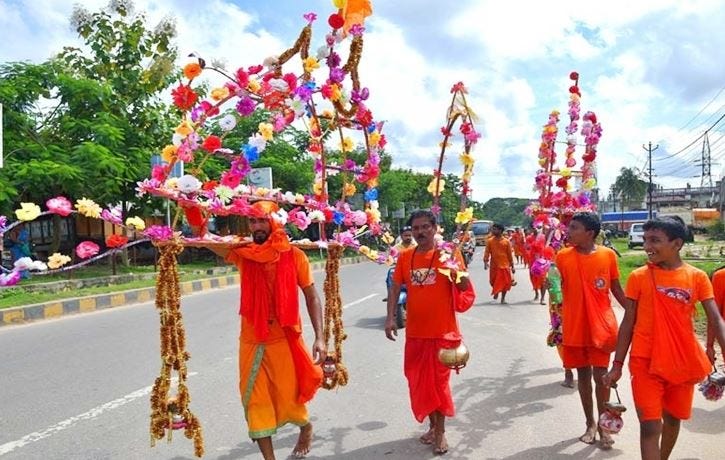
This is the Kanwar Yatra. It has no central organiser, no registration portal that created it, no brand behind it. It is arguably the largest annual human gathering on the planet — Haridwar alone hosted an estimated 4+ crore kanwariyas in recent years — and it runs entirely on one fuel: love for Mahadev.
This year, the yatra window is short and intense. Sawan 2026 began on Thursday, 30 July (North Indian Purnimanta calendar) and the kanwariya jalabhishek culminates on Sawan Shivratri, Tuesday, 11 August 2026. Thirteen days. Crores of footsteps.
The Story Behind the Water
To understand why anyone would walk 100 kilometres barefoot carrying a pot of water they are forbidden to set down, you have to go back to the churning of the ocean.
During the Samudra Manthan, when the devas and asuras churned the cosmic ocean for amrit - the nectar of immortality - the ocean did not give up its treasure easily. The first thing it yielded was halahal: a poison so potent it began to scorch all of creation. The devas panicked. The asuras retreated. And Shiva, who had asked for nothing from the churning, stepped forward and drank it.
He did not swallow the poison - it would have destroyed the worlds contained within him. He did not spit it out - it would have destroyed the world outside. He held it in his throat, suspended between himself and everything else, and his throat turned blue. Neelkanth. The blue-throated one.
But the poison burned. And so the devas poured the cooling waters of Ganga over him, again and again, to soothe the fire he had accepted on everyone’s behalf.
Every kanwar, every year, is a re-enactment of that moment. The kanwariya is saying, in the language of blisters and kilometres: You held the world’s poison for us. The least I can do is bring you water.
Tradition remembers the first kanwariyas by name. One telling honours Ravana - among Shiva’s most intense devotees - who carried Gangajal in a kanwar to Pura Mahadev. Another honours Bhagwan Parshuram, who vowed to offer Ganga water to a Shivling every Monday of Shravan. What began as individual vows of gratitude became, over centuries, a civilisational habit. No committee ever decided this. Devotion simply imitated devotion until the road itself became a tradition.
Where the Water Comes From, Where It Goes
The yatra has several great arteries, each with its own character:
Haridwar → Delhi-NCR and Western UP. The busiest corridor. Jal is collected at Har Ki Pauri - the ghat sanctified by drops of amrit - and carried to Pura Mahadev (Baghpat), Augharnath Temple (Meerut), and thousands of neighbourhood Shiva temples across Delhi, Haryana, and Rajasthan.
Haridwar/Rishikesh → Neelkanth Mahadev. The most symbolically complete route. Neelkanth Mahadev Temple, at about 1,330 metres in the forested hills above Rishikesh, is believed to be the very spot where Shiva sat with the poison in his throat. Offering Gangajal here - after the classic 32-km forest path from Haridwar, or the steep 12-km ascent from Ram Jhula - is regarded by many as the yatra in its purest form.
Sultanganj → Deoghar. The eastern classic. In Bihar, devotees collect jal at Sultanganj, where the Ganga briefly flows north - Uttarvahini - and walk roughly 105 km to Baba Baidyanath Dham in Deoghar, Jharkhand, one of the twelve Jyotirlingas. The month-long Shravani Mela here is a world of its own.
Gaumukh and Gangotri. For those who want the source itself - jal from where the Ganga is born.
Not One Yatra, But Four
Something outsiders rarely notice: kanwariyas choose their own level of austerity. There is a whole grammar of kanwars.
The samanya (common) kanwar walks at his own pace; the kanwar rests only on stands, never the ground. The dak kanwar is the express of devotion - a non-stop relay run, day and night, with temples keeping their sanctums open at all hours for these runners. The khadi kanwar must remain upright and in motion at all times, so pilgrims travel in pairs - one stands with the kanwar while the other rests. And the dandi kanwar, the most austere of all, measures the entire route in full-body prostrations - covering in weeks what others cover in days.
Nobody grades these journeys. Nobody issues certificates. Each pilgrim chooses his own difficulty and reports only to Mahadev. In a world addicted to leaderboards, the kanwar path may be the last place where effort is entirely between you and the divine.
The Republic of Bhole
Here is the sociology that should be studied in every management school: the moment a kanwar rests on a shoulder, identity dissolves.
The businessman and the daily-wager, the IIT graduate and the farmhand, the elderly uncle and the teenager with the Bluetooth speaker - on this road, all of them answer to a single name: Bhole. Nobody asks caste, income, or qualification. Greetings are exchanged as “Bhole” and returned as “Bhole.” For two weeks every year, on these particular kilometres of India, hierarchy simply has no visa.
And around this river of walkers rises an economy that runs on no currency at all. Sewa shivirs - service camps - appear along every route: free food, free water, medical aid, mattresses for the night, volunteers massaging aching calves at two in the morning, cobblers mending slippers without charge. The people who run these camps will never meet these pilgrims again. There is no QR code, no loyalty programme, no follow-up email. Strangers serve strangers as family, for the merit of service itself. Spirituality and brotherhood flowing into each other until you cannot tell them apart — that is the true sangam of this yatra.
The Discipline: What Every Kanwariya Observes
The yatra comes with a code as old as the tradition, and it is followed with remarkable seriousness:
The kanwar never touches the ground. From sankalp to jalabhishek, it rests only on stands. The unbroken jal is the whole point.
Satvik ahara only. No onion, no garlic, no alcohol, no tobacco, no non-veg. Many observe partial or full fasts; phalahar is the norm.
Shuddhata. Bathe before touching the kanwar. Keep speech gentle - every fellow pilgrim is Bhole.
Walk the designated path. State administrations now run dedicated kanwar lanes, control rooms, drone surveillance, and lakhs of personnel so that crores can walk safely - governance itself becoming a form of seva.
For those days, an ordinary person lives like a yogi: body in motion, mind on Mahadev, ego parked at the ghat. Ask any returning kanwariya what he gained and he will rarely mention a boon. He will tell you about the moment his legs gave up and his faith did not. That moment is the real darshan. The temple at the end merely confirms it.
Key Dates - Sawan 2026 (North India)
Sawan begins / Kanwar Yatra begins: Thursday, 30 July 2026
Sawan Somwar 1: Monday, 3 August
Sawan Somwar 2: Monday, 10 August
Sawan Shivratri — the great jalabhishek: Tuesday, 11 August
Sawan Somwar 3 & 4: 17 and 24 August
Sawan concludes (Shravan Purnima / Raksha Bandhan): Friday, 28 August
(Amanta-calendar states - Maharashtra, Gujarat, Karnataka, AP, Telangana, Goa, Tamil Nadu - observe Shravan from 13 August to 11 September 2026.)
If You Are Walking This Year
A few things seasoned kanwariyas will tell you: wear broken-in footwear, never new. Carry a rain poncho - Sawan showers are a certainty, and they are part of the blessing. Keep ORS and blister care handy. Start slow on Day 1; the body finds its rhythm by Day 2. If you have heart or BP conditions, take the vehicle-supported route for steep ascents like Neelkanth - Mahadev counts the intention, not the altitude. And keep a government photo ID with you for checkposts.
Above all: go with a sankalp. A yatra with a clearly held intention - spoken at the ghat before the jal is filled - walks differently from a yatra without one.
The Question the Yatra Answers
Shiva is Bholenath - the easily pleased. He asks for nothing elaborate: a lota of water, a bel leaf, an honest heart. So why do crores of people choose the hard way - the 100 kilometres, the blisters, the fasting, the sun?
Because the difficulty is not the price of the offering. The difficulty is the offering.
The divine is not moved by what we can afford, but by how far we are willing to walk for love. And every Sawan, between a river and a hundred thousand temples, India answers that question - crores of footsteps at a time.
Bol Bam. Har Har Mahadev.
At DharmikVibes, we help devotees experience yatras like these with complete seva support - from jal sankalp at Har Ki Pauri to jalabhishek at Neelkanth Mahadev, with satvik meals, medical backup, and assistance for elders and first-time kanwariyas. Our Sawan 2026 Kanwar Yatra batches are open for the Shivratri window.