

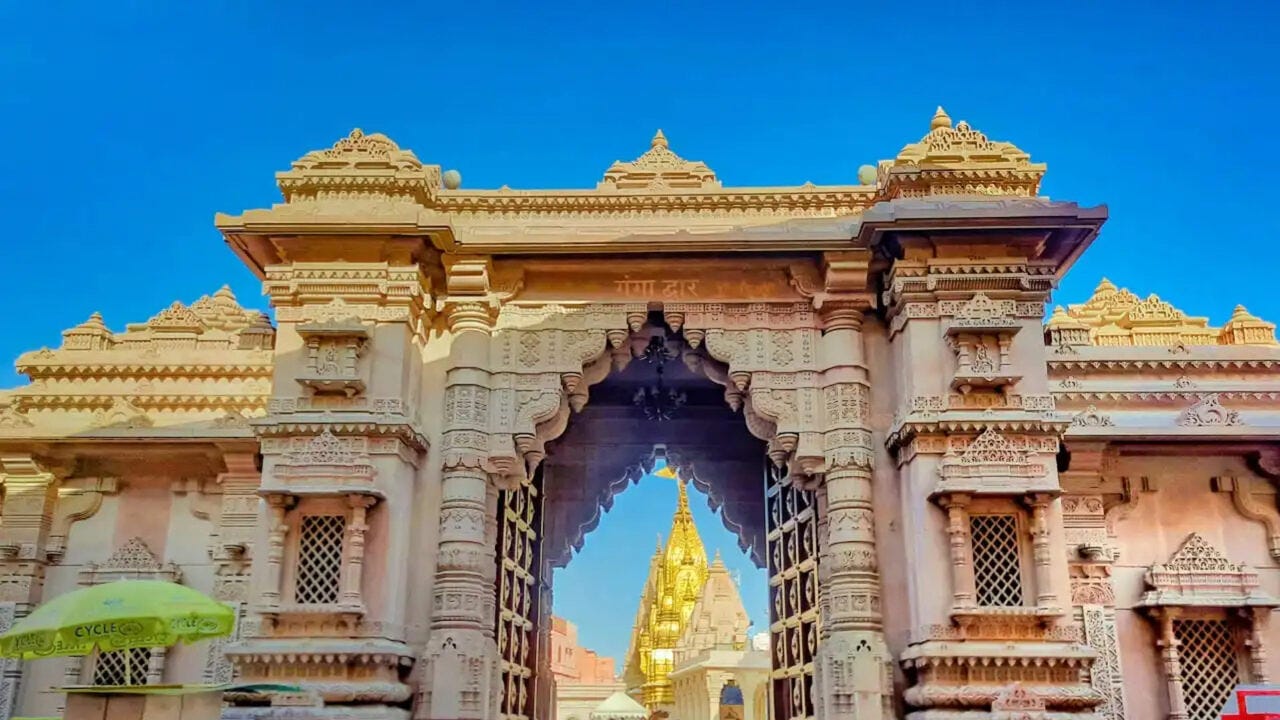
Ganga Dwar, the gateway of the Kashi Vishwanath corridor, Varanasi. Photo: Ashvin Kaitabhya, clicked by Abhishek Pandey, CC BY-SA 4.0, via Wikimedia Commons
Har Har Mahadev.
There is a saying that Kashi is not on the earth, but on the trident of Shiva. Whatever you believe about that, the city does something to people. They arrive with a list and leave without it.
Kashi is one of the oldest living cities in the world, the home of Shri Kashi Vishwanath, one of the twelve Jyotirlingas, and the Ganga flowing north past more than eighty ghats. A first yatra can feel like too much at once: the lanes, the crowd, the bells, the boats. This guide takes it in order.
Shri Kashi Vishwanath: what to know
The presiding deity is Vishwanath or Vishweshwara, “Lord of the Universe”. The present temple was built in 1780 by Maharani Ahilyabai Holkar of Indore. In 1835, Maharaja Ranjit Singh donated one tonne of gold to plate the domes, which is why the temple is known as the Golden Temple (Wikipedia).
On 13 December 2021, the Kashi Vishwanath Dham corridor, which connects the temple with the Ganga ghats, was inaugurated. Since then the number of devotees has grown very large. According to the Uttar Pradesh government, as reported by the Economic Times on 2 January 2026, Varanasi recorded a record 7.26 crore visitors in 2025. ABP Live reported in December 2025 that about 7.25 crore devotees visited Kashi Vishwanath Temple that year.
The Skanda Purana has an entire section, the Kashi Khanda, devoted to the city. And in the old story of the column of light, when Brahma and Vishnu argued over who was greater, Shiva appeared as an endless pillar of light, the Jyotirlinga. Kashi is believed to be the first place where it manifested.
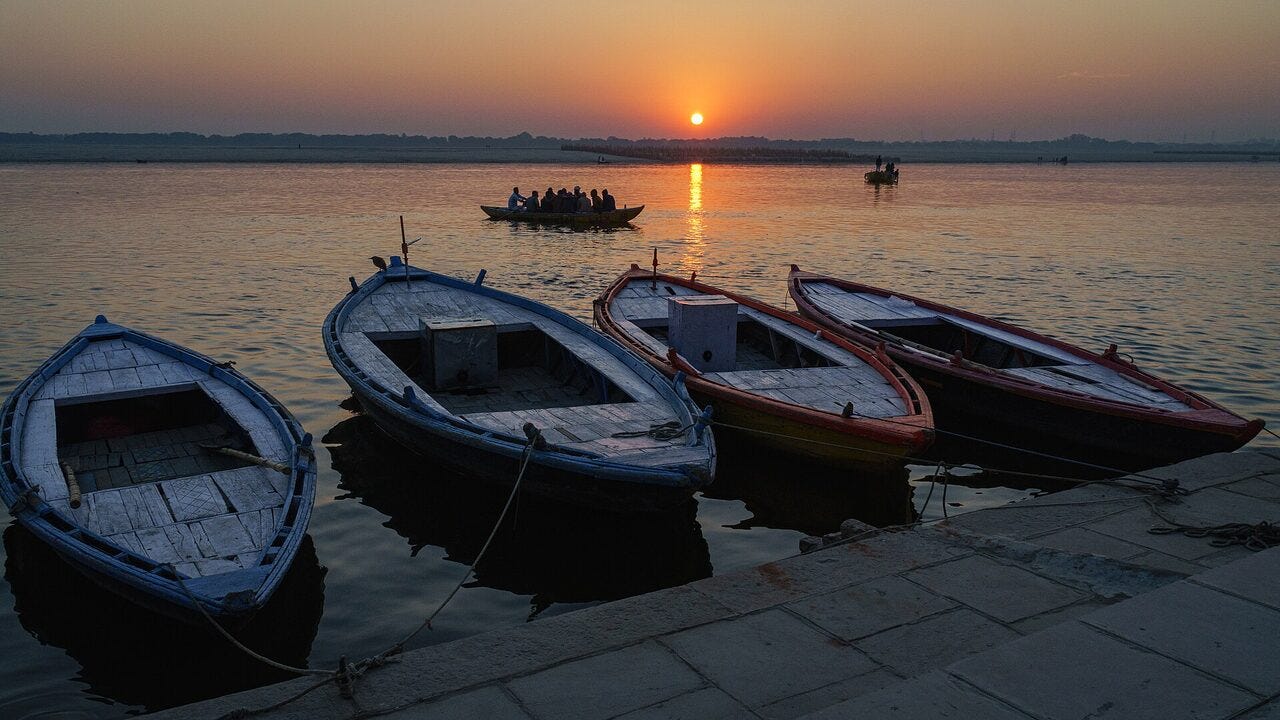
Boats at sunrise on the Ganga, Varanasi. Photo: Schwiki, CC BY-SA 4.0, via Wikimedia Commons
The daily rhythm of the temple
The temple’s official portal (shrikashivishwanath.org) lists the daily programme. Here it is in plain words:
The temple opens at 2:30 AM.
Mangla Aarti: 3:00 to 4:00 AM. Ticketed (₹500 on the portal). Marked as “normal days only”.
General darshan: from 4:00 AM until the late morning.
Sugam Darshan: 6:00 AM to 6:00 PM, a ticketed pass for a quicker, queue-free darshan, designed for people with limited time and for divyang devotees.
Bhog Aarti (mid-day): 11:15 AM to 12:20 PM.
Sapt Rishi Aarti: 7:00 to 8:15 PM. An aarti that is more than 750 years old, performed by seven priests, each of a different gotra.
Shringar and Bhog Aarti: 9:00 to 10:15 PM.
Shayan Aarti: 10:30 to 11:00 PM. Free.
Rudrabhishek can also be booked on the official portal between 4:00 AM and 6:00 PM.
Prices and timings on the portal can change and some pages list slightly different amounts for the same pass, so look at the live portal when you book. The helpdesk number on the portal is +91 6393 131 608.
Mangla Aarti: how to book it
Mangla Aarti is the first aarti of the day, in the Brahma Muhurta, and many devotees say it is the most moving darshan in Kashi.
From the official booking page:
General booking opens every day at 11:00 AM for the next 30 days. Entry is through Gate No. 1 (Dhundi Raj Ganesh), with seating in the South LED area.
Tatkal booking opens every day at 11:00 AM for the next day. Entry is through Gate 4B, with seating in the North LED area.
Devotees may enter the temple between 2:30 and 3:00 AM. The aarti begins between 3:00 and 4:00 AM.
Carry a printed copy of the ticket. The ticket must be shown at the entry point.
Entry for children below 12 years of age is free.
When we looked at the booking page on 4 October 2026, the general quota showed zero seats for the dates visible, and Tatkal showed 100 seats a day. This is why we say: book as soon as the window opens, and do not wait until you land in Varanasi.
The Ganga Aarti at Dashashwamedh Ghat
Every evening, the Ganga Aarti is performed at Dashashwamedh Ghat. According to Wikipedia’s entry on the ghat, it starts soon after sunset and lasts for about 45 minutes. In summer it begins at about 7 PM, and in winter at around 6 PM. Hundreds of people gather every evening.
You have two good ways to see it:
From the ghat steps. You are close to the priests, the lamps, the bells and the conch. Arrive early to find a place. It is free.
From a boat on the river. You see the aarti from a distance, with the lamps reflected in the water. This is usually more comfortable for senior family members. Agree on the rate and the time before you board, and ask for a life jacket.
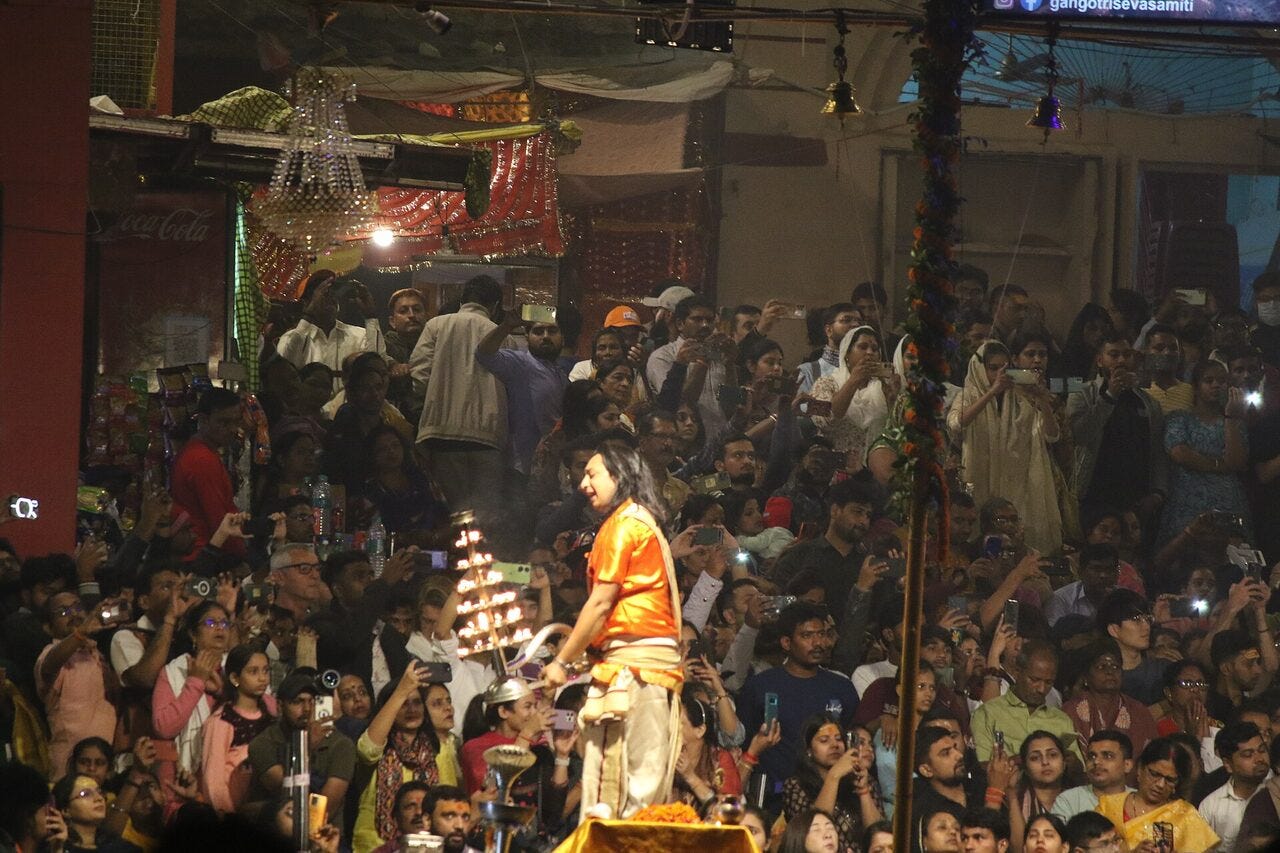
Ganga aarti at Dashashwamedh Ghat. Photo: Goutam1962, CC BY-SA 4.0, via Wikimedia Commons
A sunrise on the river
If you do only one thing outside the temple, do this. Before sunrise, go down to the ghats and take a boat on the Ganga. The city looks different from the water, the ghats slowly change colour, and you will see people bathing and offering prayers on the steps. It is a quiet start to a day that will get busy.
A three-day rhythm for families
Day 1: Reach Kashi. Rest. In the evening, the Ganga Aarti.
Day 2: Mangla Aarti if you have booked it, or general darshan in the early morning. A slow breakfast. In the afternoon, rest. In the evening, the Sapt Rishi Aarti at the temple, if you have chosen to book it.
Day 3: Sunrise on the river. A relaxed morning. Leave without a rush.
Some practical points:
Choose your stay by the lanes. Staying within walking distance of the temple makes 2:30 AM entry much easier.
Keep your phone and valuables minimal in the temple. Check the entry rules at the gate on the day, as security rules apply.
Wear simple clothes that you can walk in comfortably, and footwear that is easy to take off.
For senior family members, Sugam Darshan is built for people who cannot wait in long queues.
Festival days such as Mahashivratri, the month of Shravan and Dev Deepawali bring much larger crowds. Plan those days separately and give yourself extra time.
A note on puja
If you would like to perform a Rudrabhishek, the official portal lists it with a Shastri assigned through the temple helpdesk. Please book only through the official portal and the helpdesk. The temple’s own website is the final word.
One more thing
Most people who come to Kashi for the first time try to see everything. The ones who go home most content are usually the ones who did less: one aarti, one sunrise, one long sit on a ghat step. Kashi gives its darshan slowly.
If you would like help planning a Kashi yatra for your family, write to us at dharmikyatra@dharmikvibes.com.
Har Har Mahadev.