

On the eastern coast of Odisha stands a monument that looks less like a conventional temple and more like a giant stone chariot frozen in motion.
Its wheels are carved with extraordinary precision. Its horses appear ready to pull the Sun God across the heavens. Its walls preserve an astonishing collection of sculptures depicting gods, dancers, musicians, animals and scenes from everyday life.
This is the Konark Sun Temple, one of the most celebrated achievements of medieval Indian architecture.
Built in the 13th century, Konark was conceived as the celestial chariot of Surya, the Hindu Sun God. But behind its magnificent appearance lies a fascinating story of royal ambition, religious imagination, architectural ingenuity and artistic excellence.
The King Who Commissioned a Monument to the Sun
The Konark Sun Temple was constructed during the reign of King Narasimhadeva I (1238–1264 CE) of the Eastern Ganga dynasty.
The Eastern Gangas were among the most influential ruling dynasties of medieval Odisha. Their patronage transformed the region into an important centre of temple construction, sculpture and religious culture.
Narasimhadeva I commissioned the temple during a period when the kingdom possessed considerable political and economic strength. The monument reflected not only religious devotion but also the authority and cultural achievements of his kingdom.
Its construction required the coordinated efforts of architects, stone carvers, sculptors, engineers and numerous skilled artisans.
The result was a monumental expression of the Kalinga school of temple architecture, built primarily in stone and designed around one extraordinary idea: the chariot of Surya.
Why Does the Temple Have 24 Wheels and Seven Horses?
The most recognisable feature of Konark is its enormous chariot-like architectural composition.
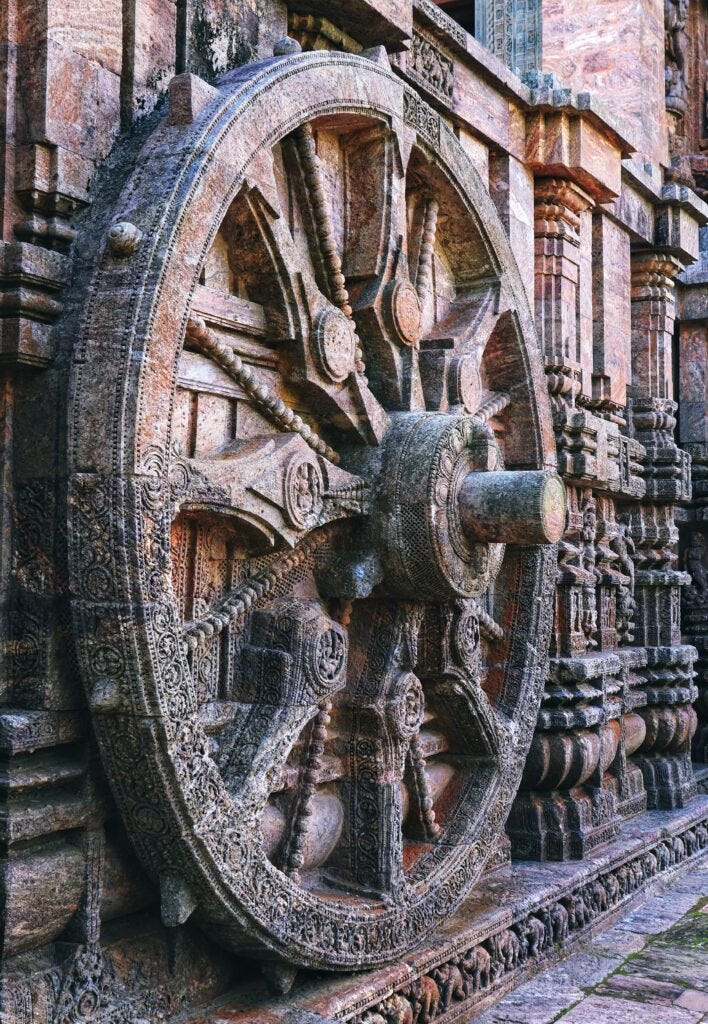
The monument is associated with 24 intricately carved stone wheels and seven horses, representing the celestial vehicle of Surya.
But what do these numbers signify?
The 24 wheels
The wheels are arranged in twelve pairs. Their symbolism is commonly associated with the twelve months of the year and the cyclical nature of time.
Each wheel features a central hub, spokes and elaborate decorative details. The craftsmanship is remarkable: floral patterns, miniature figures and ornamental designs are carved into the stone with exceptional attention.
The wheels are also popularly interpreted as sundials. Their structure and shadows invite observations about the movement of the Sun and the passage of time. However, claims about the precise timekeeping function of every wheel should be treated cautiously.
The seven horses
The seven horses represent Surya’s celestial chariot.
In traditional interpretations, they are associated with the seven days of the week. They are also connected symbolically with the sevenfold character of light in later explanations of the monument.
The imagery draws upon a much older Vedic tradition in which Surya travels across the sky in a divine chariot.
What makes Konark remarkable is that this familiar religious image was transformed into an enormous architectural composition.
The Vedic Connection: Surya as the Source of Life
The worship of the Sun occupies an important place in ancient Indian religious and philosophical traditions.
In the Rigveda, Surya and Savitr are praised through several hymns. The famous Gayatri Mantra, found in Rigveda 3.62.10, invokes Savitr and seeks illumination of the human intellect.
The Sun was understood through multiple dimensions: as the visible source of light, the sustainer of life and a symbol of knowledge and illumination.
Surya worship also developed into an important religious tradition across different parts of India.
The Konark temple reflects this heritage through its monumental dedication to the Sun God. Its architecture makes the celestial journey of Surya the central organising idea of the entire monument.
The Architectural Genius of Kalinga
Konark represents one of the finest achievements of Kalinga temple architecture, a regional architectural tradition that developed in Odisha.
A traditional Odishan temple complex often includes distinct architectural spaces, each serving a particular purpose.
At Konark, the principal components included:
Vimana: The sanctum, originally crowned by a towering structure that has since collapsed.
Jagamohana: The assembly hall, whose massive structure remains one of the most impressive surviving portions of the monument.
Natamandira: The dance hall, associated with ritual performances and adorned with sculptures of dancers and musicians.
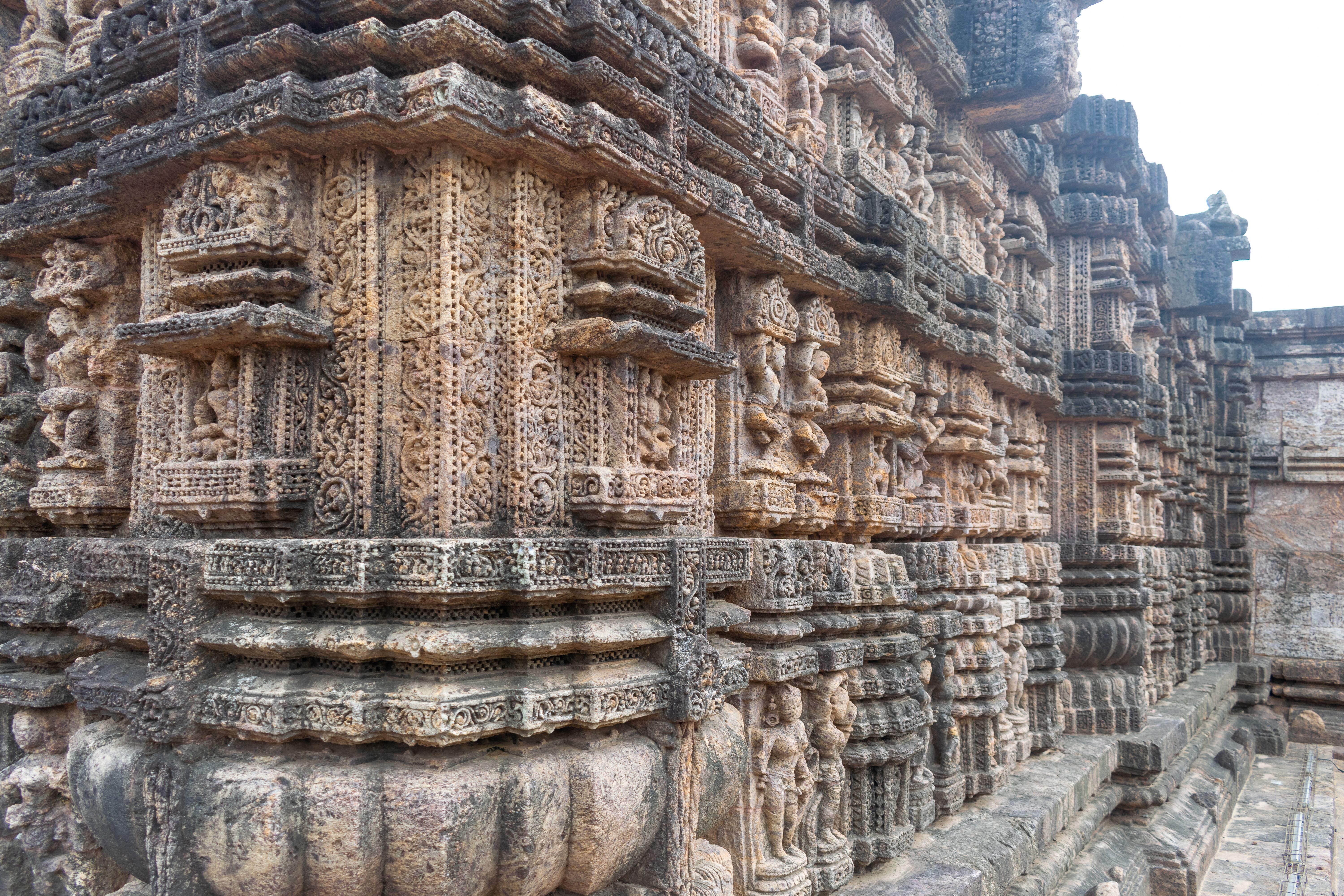
The temple was constructed using stone blocks and elaborate sculptural elements. Its exterior is covered with an extraordinary range of figures and decorative compositions.
The sculptural programme includes deities, celestial beings, dancers, musicians, animals, mythological narratives and scenes of royal and everyday life.
These carvings are valuable historical records. They offer insight into the artistic conventions, social practices, clothing, ornaments and cultural life of medieval Odisha.
Konark is therefore not merely a religious monument. It is also an extraordinary visual archive of its age.
The Sculptures: A Window into Medieval Indian Life
One of the most fascinating aspects of Konark is the sheer diversity of its sculptures.
The temple’s stone surfaces depict musicians playing instruments, dancers in expressive postures, richly ornamented figures, animals and scenes from different aspects of life.
The Natamandira is particularly associated with the artistic traditions of dance and music.
The monument also has an important cultural connection with Odisha’s classical dance heritage. Odissi draws upon the wider artistic and devotional traditions of the region, although it would be inaccurate to treat the temple sculptures as a complete historical record of the modern dance form.
The famous erotic sculptures at Konark also deserve attention. They form part of a broader tradition of temple sculpture in India, where representations of human relationships, fertility, beauty and worldly life existed alongside sacred imagery.
Together, these carvings reveal an artistic culture that did not restrict temple architecture to images of worship alone.
Dharmapada: The Legend of the Young Architect
Among the most memorable stories associated with Konark is the legend of Dharmapada.
According to popular Odia folklore, Dharmapada was the young son of the chief architect responsible for the temple’s construction.
The story recounts that the builders faced a serious challenge while completing the temple’s crowning structure. The work had reached a critical stage, and failure could have brought severe consequences for the artisans.
Dharmapada is said to have recognised the architectural difficulty and found a solution that the experienced builders had been unable to achieve.
However, the legend takes a tragic turn. Fearing that the young boy’s achievement would expose the failure of the chief architect and endanger the lives of the workers, Dharmapada is said to have sacrificed himself.
This story is part of Odisha’s cultural folklore rather than established historical documentation.
Its enduring significance lies in the values it represents: knowledge, courage, responsibility and sacrifice.
What Happened to the Great Temple?
The Konark Sun Temple did not survive in its original condition.
Over the centuries, its principal sanctum tower collapsed, and the monument gradually lost much of its former structural completeness.
The precise sequence of events behind its decline remains a subject of historical discussion. Natural deterioration, structural damage and changing political and religious circumstances have all featured in explanations of its later history.
The surviving Jagamohana and other architectural remains nevertheless preserve an extraordinary amount of the original artistic and architectural achievement.
During the colonial period, conservation efforts became increasingly important. The Archaeological Survey of India later undertook major measures to protect the monument, including structural conservation.
In 1984, Konark was inscribed on the UNESCO World Heritage List.
UNESCO recognised it as an exceptional masterpiece of human creative achievement and an outstanding example of the architectural and artistic traditions of medieval India.
Today, it remains one of the most important heritage monuments in Odisha and a major destination for visitors from across the world.
Why Konark Deserves to Be Remembered
The greatness of Konark does not depend on legends of lost technologies or exaggerated claims about ancient engineering.
Its documented achievements are extraordinary in their own right.
A 13th-century Indian kingdom commissioned an immense temple dedicated to the Sun. Its architects transformed a sacred image into a monumental stone chariot. Its sculptors covered the structure with an astonishing range of artistic expressions. Its surviving remains continue to provide historians and researchers with valuable evidence of medieval Indian civilisation.
Konark demonstrates the remarkable relationship between religious imagination, architecture, craftsmanship and cultural expression in India’s past.
It is a monument that deserves to be studied not only for its beauty but also for the historical knowledge preserved in its stones.
The chariot of Surya may no longer stand in its complete original form, but the brilliance of the civilisation that conceived it continues to illuminate India’s architectural heritage.