

For four days every January, Tamil Nadu turns its gratitude into food, fire and decoration. Pongal, which shares its name with the dish that must boil over to be auspicious, is the state’s biggest festival and one of the oldest harvest celebrations in the world.
In 2027, Pongal runs from Thursday, 14 January to Sunday, 17 January, with Thai Pongal, the main day, on Friday, 15 January 2027, the day the sun enters Capricorn and the Tamil month of Thai begins.

Day one: Bhogi, 14 January
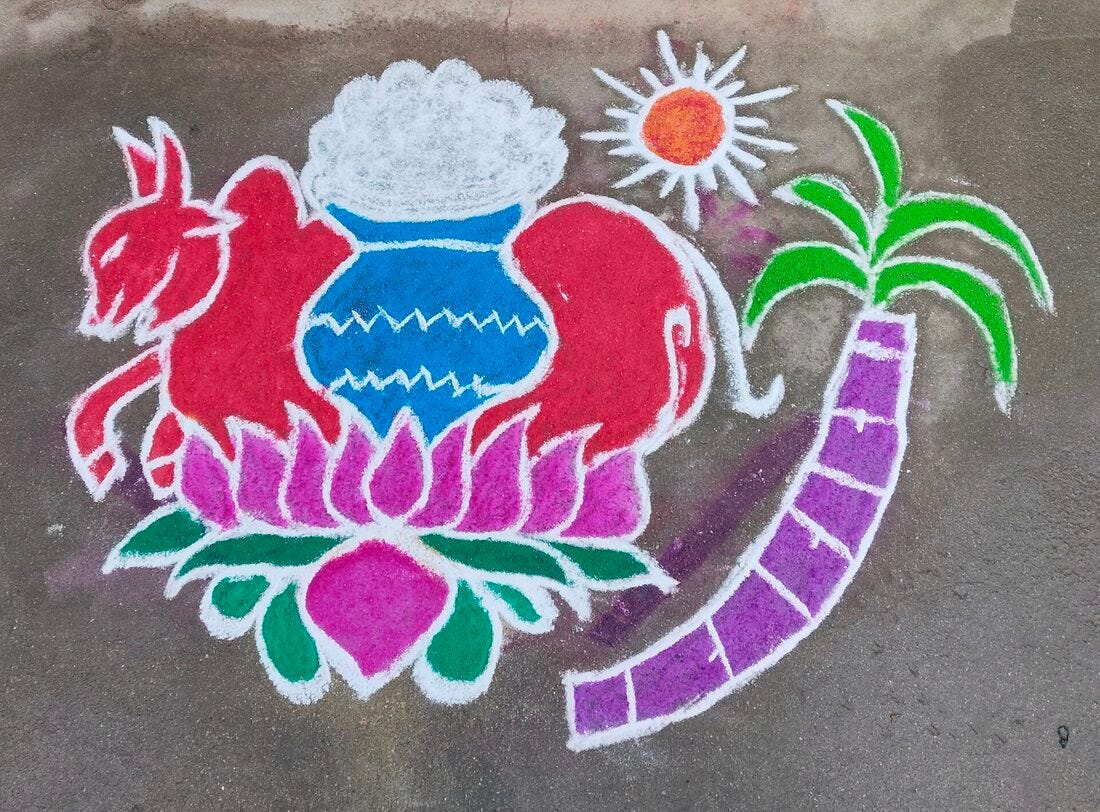
Bhogi is the festival of letting go. Homes are cleaned, old and unused things are given away, and at dawn a bonfire is lit with what cannot be given: the Bhogi mantalu, into which the old year is symbolically cast. Fresh kolam is drawn at the threshold, and the first sugarcane of the season appears at the door. The teaching of Bhogi is bare and beautiful: the new harvest needs an emptied house.
Day two: Thai Pongal, 15 January
The main day belongs to Surya, the sun, who begins his northern journey this morning. In courtyards and on terraces, families set a new clay pot facing the sun, light a fire beneath it, and cook the season’s new rice with milk. When the milk rises and spills over the rim, everyone calls out together: “Pongalo Pongal!” The overflow is the point. Abundance that cannot be contained is the blessing being invoked.
The cooked rice becomes sakkarai pongal, sweetened with jaggery and cardamom and enriched with ghee, cashews and raisins, offered first to Surya with sugarcane, turmeric plants and bananas, and then shared. A second pot makes ven pongal, the peppery savoury twin. The Thai month that begins today carries the old blessing: “Thai pirandhal vazhi pirakkum.” When Thai is born, a way is born.
Day three: Mattu Pongal, 16 January
The third day honours the partners of the harvest: the cattle. Cows and bulls are bathed, their horns painted in bright colours, their necks garlanded with flowers and beads, and they are fed pongal before the family eats. In the villages of Tamil Nadu, particularly around Madurai, this is also the season of Jallikattu, the ancient bull-taming sport held at Alanganallur, Palamedu and Avaniyapuram, an event of fierce local pride now conducted under strict rules.
Day four: Kaanum Pongal, 17 January
The final day is for people. Families visit relatives, the young seek the blessings of the old, and riversides, beaches and parks fill with picnics. Women perform the Kanya Pongal prayers for the wellbeing of their brothers, a custom of quiet tenderness that closes the festival.
If you are celebrating away from Tamil Nadu
Pongal travels well. The new pot, rice, milk, jaggery, sugarcane (or a stand-in), a small fire or a stove, and a clean courtyard corner are all the festival truly needs. Tamil sangams across the US, UK, Singapore, Malaysia, the Gulf and Australia hold Pongal vizha through January; find the nearest one, or host your own and let the pot boil over where the neighbours can see it.
At DharmikVibes, our vision is to enable Divine Experiences for every seeker, on every yatra, including the yatra from field to pot to prayer. Pongalo Pongal! May your year overflow.