
Prambanan Temple: A Shiva Temple in Java, and the 1,000-Year Thread Back to India
India is restoring Indonesia's largest Hindu temple. The reason has less to do with diplomacy than with memory - and there's a way for you to stand inside that memory yourself.

There is a temple in the middle of Java where the walls tell the Ramayana in stone, where a 47-metre Shiva shrine rises over a courtyard once filled with 240 smaller temples, and where the god’s mount, Nandi the bull, still faces him across a thousand years of silence.
It is called Prambanan. It is Indonesia’s largest Hindu temple complex. And this month, India began putting it back together.
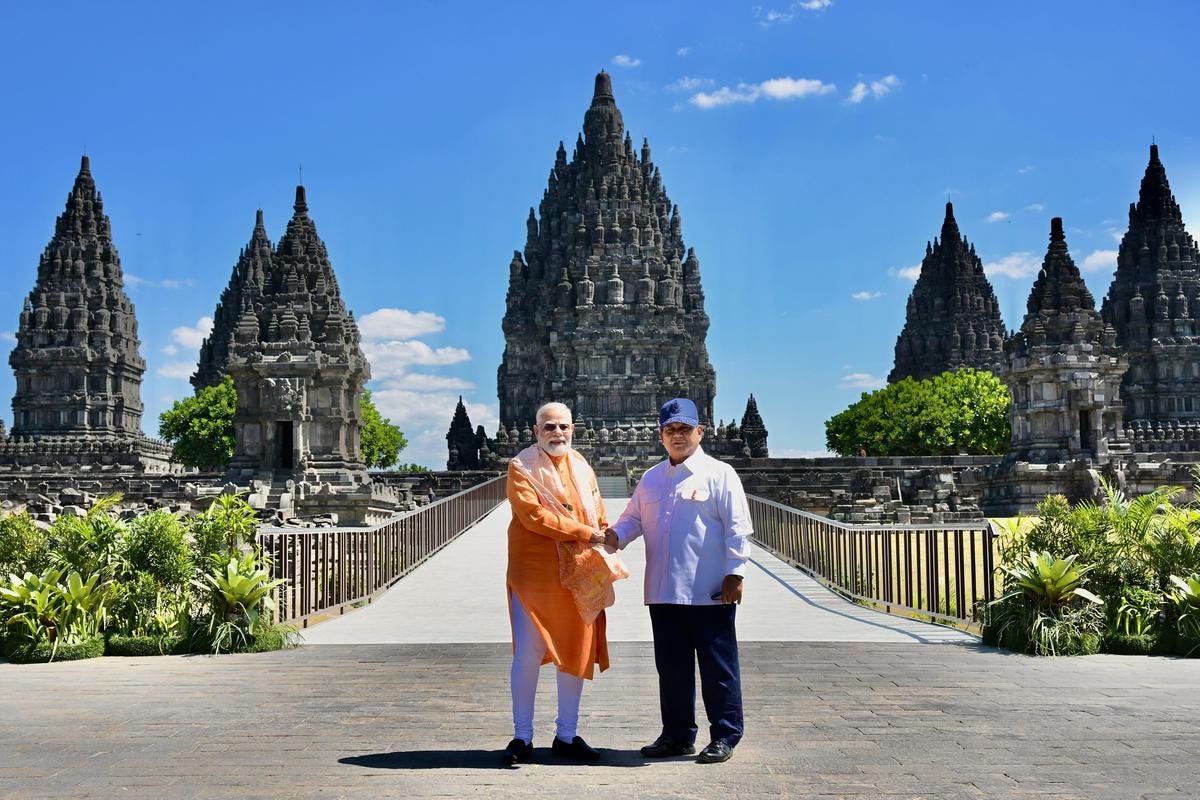
On July 8, 2026, Prime Minister Narendra Modi and Indonesian President Prabowo Subianto stood before that Shiva shrine, offered prayers, and jointly inaugurated an India-backed restoration project. The work will be carried out by the Archaeological Survey of India - the same ASI that has quietly left India’s fingerprints on temples across Cambodia, Laos, Vietnam and Myanmar.
The obvious question is: why? Why is India, from more than 5,000 kilometres away, restoring someone else’s monument?
The answer, I think, is the most interesting part of the whole story. Because Prambanan was never really “someone else’s.”
What Prambanan actually is
Built in the 9th century under the Hindu Mataram Kingdom - construction began around 850 CE - Prambanan is one of the finest examples of Hindu architecture anywhere in Southeast Asia. UNESCO recognised it as a World Heritage Site in 1991.
Three great towers stand at its heart, dedicated to the Trimurti: Brahma, Vishnu and Shiva, with the Shiva shrine the tallest at 47 metres. Facing them are three smaller shrines for the sacred mounts - Nandi the bull, Hamsa the swan, Garuda the eagle. Along the inner walls, panel after panel narrates the Ramayana. Not a summary of it. The epic itself, carved into rock, in Java, by hands that had clearly known the story intimately.
That last detail is the whole point. The Ramayana did not visit Java. It lived there.
The complex was abandoned around the late 10th century as power shifted eastward and Mount Merapi’s eruptions and earthquakes did their slow damage. Serious restoration only began in the 20th century, and a 2016 earthquake reopened old wounds. That is the Prambanan the ASI now steps into.
So why India?
You could file this under “cultural diplomacy” and move on. It is that, and I’ll come to it. But the deeper reason is harder to put in a press release.
Look at modern Indonesia and India keeps surfacing where you least expect it. The national airline is Garuda - Vishnu’s eagle. Garuda is also the country’s national emblem. The Indonesian language carries Sanskrit in its bones. A Muslim-majority nation of 270 million has never stopped taking quiet pride in a Hindu temple on its currency-worthy list of wonders. None of that is borrowed. It grew there, from centuries of traders, monks and scholars crossing the Bay of Bengal.
So when India helps restore Prambanan, it isn’t a donor adopting a foreign ruin. It’s two nations tending a shrine that grew from the same civilisational soil. That framing matters, and both sides know it.
Then there’s the diplomacy, and it’s smarter than it looks. Heritage has become one of India’s most quietly effective instruments abroad - sitting alongside defence, trade and maritime security, but reaching somewhere those never can. It’s the core of the Act East policy. And it’s durable in a way trade deals are not: governments fall, balance sheets swing, but a restored temple stands for centuries as a reminder of who helped save it.
And India brings real craft, not just goodwill. At Prambanan, ASI experts have proposed anastylosis - reassembling the structure from its own original fallen stones rather than replacing them with new material. Indonesia’s culture ministry has even signalled openness to using AI to help identify and match the scattered stone components, and to conserve Prambanan as part of a wider landscape including the neighbouring Sewu and Plaosan temples.
This is not the first time
Prambanan is the newest chapter, not the first. Once you notice the pattern, it’s everywhere:
In Cambodia, the ASI’s long work at Angkor Wat is the foundation of this whole tradition. In Laos, it restored the Khmer-Hindu Shiva site of Vat Phou across two phases, at roughly Rs 17 crore and Rs 24 crore. In Vietnam, it helped revive My Son, the spiritual heart of the ancient Champa Kingdom. In Myanmar, after the 2016 quake, it conserved 12 pagodas and rebuilt the iconic Ananda Temple at Bagan. In Nepal, it restored 28 heritage sites under a USD 50 million reconstruction package. In Sri Lanka, a grant helped restore the Shiva temple of Thiruketheeswaram. In Bahrain, Modi inaugurated the redevelopment of a 200-year-old Krishna temple in Manama. In Bangladesh, India financed the reconstruction of a nearly 300-year-old Kali temple in Natore.
Seen together, Prambanan isn’t a gesture. It’s India stepping, again, into a role it has held quietly for decades: custodian of a shared Asian past.
If you want to go: a DharmikYatra to Java
Here’s the part I find most moving. Prambanan isn’t only something to read about. You can stand before the Trimurti yourself, walk the Ramayana panels, and feel how far the tradition once travelled. For Devotees in India, this is an entirely doable yatra - and the region around Yogyakarta packs an extraordinary amount of the sacred into a small radius.
Within a short drive of Prambanan you’ll find Sewu, a large Buddhist complex inside the same landscape - Hindu and Buddhist giants standing side by side, a quiet lesson in how ancient Java held both. There’s Plaosan and Ratu Boko, the latter famous for its hilltop sunset over the plain. And about 40 km away sits Borobudur, the largest Buddhist monument on earth. On select evenings, the Ramayana Ballet is performed beside Prambanan’s lit towers - the epic on the walls, brought back to breath and movement.
Getting there. There are no direct flights from India. You connect through Jakarta, Kuala Lumpur or Singapore into Yogyakarta International Airport (YIA), about 45 km from the temple. From Jakarta it’s a 75-minute hop; from Kuala Lumpur, under three hours. Air India, IndiGo, Scoot, Malaysia Airlines, Singapore Airlines and Garuda all serve the route.
When to go. The dry season, April to October, gives the clearest skies and overlaps with the Ramayana Ballet season. April, May and September are the sweet spot for weather without the heaviest crowds.
Visa. Indian passport holders get a Visa on Arrival for Indonesia, valid 30 days, at around IDR 500,000 (about ₹2,600).
A gentle 5-day rhythm: arrive and rest; then Prambanan at first light followed by Sewu and Plaosan, closing with the evening ballet; Borobudur the next morning and Ratu Boko for sunset; a day for Yogyakarta’s own Kraton palace, Taman Sari and the crafts of Malioboro; then home. Dress modestly - shoulders and knees covered, sarongs are provided at the gates - carry cash in Rupiah, and visit in the early morning or late afternoon to dodge both heat and crowds.
Darshan, pujas and the spiritual experience
Here is something most travel guides miss, and the reason this is a true yatra and not just sightseeing: Prambanan is once again a living Hindu shrine. After a 2022 agreement restored its ritual use, Balinese and Javanese Hindu communities revived their old practice of worshipping here. You are not walking through a museum. You are walking into a working temple to the Trimurti.
What that means for a Devotee from India:
Darshan and personal prayer at the three main shrines - Shiva, Vishnu and Brahma - is part of the ordinary visit and included in your entry. You can sit before the deities and pray. There is no separate ticket for devotion.
Offerings. The local form of worship centres on canang sari - small woven baskets of flowers and incense offered to the deities - and communal prayers like the Puja Tri Sandhya and Panca Sembah, sequences of Sanskrit mantras that will feel at once familiar and beautifully unfamiliar to an Indian ear. Offering materials cost very little, usually a few hundred rupiah, and you can buy them locally or ask a Hindu guide to arrange them.
A guided prayer or a local Hindu guide. Rather than a fixed-fee puja, the norm here is a modest donation (dakshina) if a local priest or guide helps you offer worship, or a small fee for a devotion-focused guide who can explain the rituals and the iconography.
The real upgrade is timing. If you can align your yatra with one of Prambanan’s sacred seasons, the experience deepens enormously - and most of these observances are free to witness and join:
Maha Shivaratri. Prambanan hosts a month-long Shiva Festival, in 2026 opening on January 17 with the Siwaratri night worship and running to the Maha Shivaratri ceremony in mid-February. The opening night carries the Tari Siwa Grha dance (Shiva as Nataraja performing the cosmic Tandava), followed by chanting and the japa of 1008 Shiva mantras from midnight until dawn. For a Devotee, Maha Shivaratri at the largest Shiva temple in Indonesia is about as powerful as this yatra gets.
Tawur Agung Kesanga and Nyepi (around March). The day before the Balinese New Year, thousands of Hindus gather to perform pradaksina (clockwise circling of the complex), holy-water processions and offerings. Note that the temple park closes on Nyepi day itself, the day of silence, so plan around it.
Galungan and other observances mark the Balinese-Hindu calendar through the year.
And a companion note for Borobudur: it too has been restored for worship, and its great moment is Vesak (Waisak), when monks and thousands of lanterns fill the monument. Even outside festival days, quiet dawn meditation at Borobudur is one of the most moving things you can do in Java.
A small etiquette point: these are Indonesian Hindus’ and Buddhists’ living sacred spaces. Join with humility, follow the congregation’s lead, dress and behave as you would in any shrine at home, and let devotion, not photography, lead.
What it costs
Per Devotee, assuming two sharing a room, for a 5-day yatra from Delhi. Indicative for 2026; fares, fees and the exchange rate all move, so reconfirm close to travel. Foreign-visitor temple entries are paid in Rupiah (roughly IDR 1,000 ≈ ₹5.5).
Here is a rough per-Devotee breakdown, assuming two sharing a room:
Return flights, Delhi to Yogyakarta (one stop): ₹40,000 – ₹55,000. Book six to eight weeks ahead; shoulder season saves the most.
Indonesia Visa on Arrival: ₹2,600 (IDR 500,000, valid 30 days).
Hotels, 4 nights (twin share, mid-range): ₹14,000 – ₹20,000. Comfortable 3-4 star; guesthouses cost less.
Private car with driver, 2-3 days: ₹8,000 – ₹12,000. A full day is IDR 800,000–1,000,000, split two ways.
Prambanan entry (foreigner): ₹2,150 (IDR 400,000, about USD 25).
Borobudur entry (foreigner, ground level): ₹2,500 (IDR 455,000, about USD 30). Climbing the upper levels needs a separate ticket.
Ratu Boko and the Ramayana Ballet: ₹2,000 – ₹3,500. Ballet seating varies; book ahead.
Pujas, offerings and spiritual experiences: ₹1,500 – ₹5,000. Darshan itself is free; this covers canang-sari offerings, a dakshina to a priest or guide, and an optional dawn meditation. Festival worship such as Shivaratri and Tawur Agung is largely free to witness and join.
Meals, 5 days: ₹4,000 – ₹8,000. Local food is wonderfully affordable, often ₹100–300 a meal.
Local transport, tips and shopping: ₹5,000 – ₹8,000. Batik, Kota Gede silver, offerings.
Estimated total: ₹82,000 – ₹1,20,000 per Devotee for 5 days, starting from Delhi.
Travel in shoulder season, stay in guesthouses and share a car among four, and the whole yatra comes closer to ₹60,000 – ₹78,000 per person - and the spiritual heart of it, darshan and festival worship, stays essentially free.
Two practical notes: combined Borobudur-Prambanan foreigner tickets have been unreliable lately and were reported discontinued for foreign visitors in 2025, so budget for separate entries and check the official borobudurpark.com portal. And both temples largely expect cash in Rupiah at the gate - don’t rely on cards.
The thread
When the ASI starts matching Prambanan’s fallen stones back to their places, it will be restoring more than a structure. It will be restoring a memory - the Ramayana on the walls, the Garuda in Indonesia’s own emblem, the Shiva shrine that a Devotee from India can now stand before and find, somehow, familiar.
That’s the thing about this story. Some ties are older and steadier than politics. For India, restoring Prambanan isn’t charity. It’s remembrance. And for anyone who makes the yatra to Java, it’s a chance to close the circle - to walk into a temple built a world away, and realise you already know its language.
If this kind of story - where history, faith and travel meet - is what you’re here for, consider subscribing. I write about the threads that connect the things we build, believe and go looking for.
Costs and details are indicative for 2026 and worth reconfirming before you book.