

On Diwali morning, before the first diya is lit, millions of doorsteps across India are washed, dried and decorated. Out come the bowls of coloured powder, the rice flour, the marigold petals, and slowly, under patient fingers, a rangoli takes shape: a lotus, a peacock, a grid of dots blooming into geometry. It is one of the most beautiful and most loved traditions of the festival, and one of the easiest to make your own.
What rangoli means
Rangoli is threshold art. It sits exactly where the home meets the world, and its purpose is welcome: welcome to guests, to prosperity, and to Goddess Lakshmi, who is said to enter homes that are clean, bright and beautiful. Many designs include tiny footprints drawn towards the door, marking the goddess's path inside.
The tradition goes by many names. In Tamil Nadu it is kolam, drawn fresh at dawn with rice flour. In Andhra Pradesh and Telangana it is muggu. In Bengal, alpana; in Odisha, jhoti; in Rajasthan and Madhya Pradesh, mandana; in Maharashtra, rangoli itself. The materials change, the mathematics changes, but the intention is identical: begin the day, and the festival, by making something beautiful for others.
There is an older kindness built into the custom too. Traditional rangoli is drawn with rice flour, which feeds ants and small birds. Beauty and generosity in the same gesture.
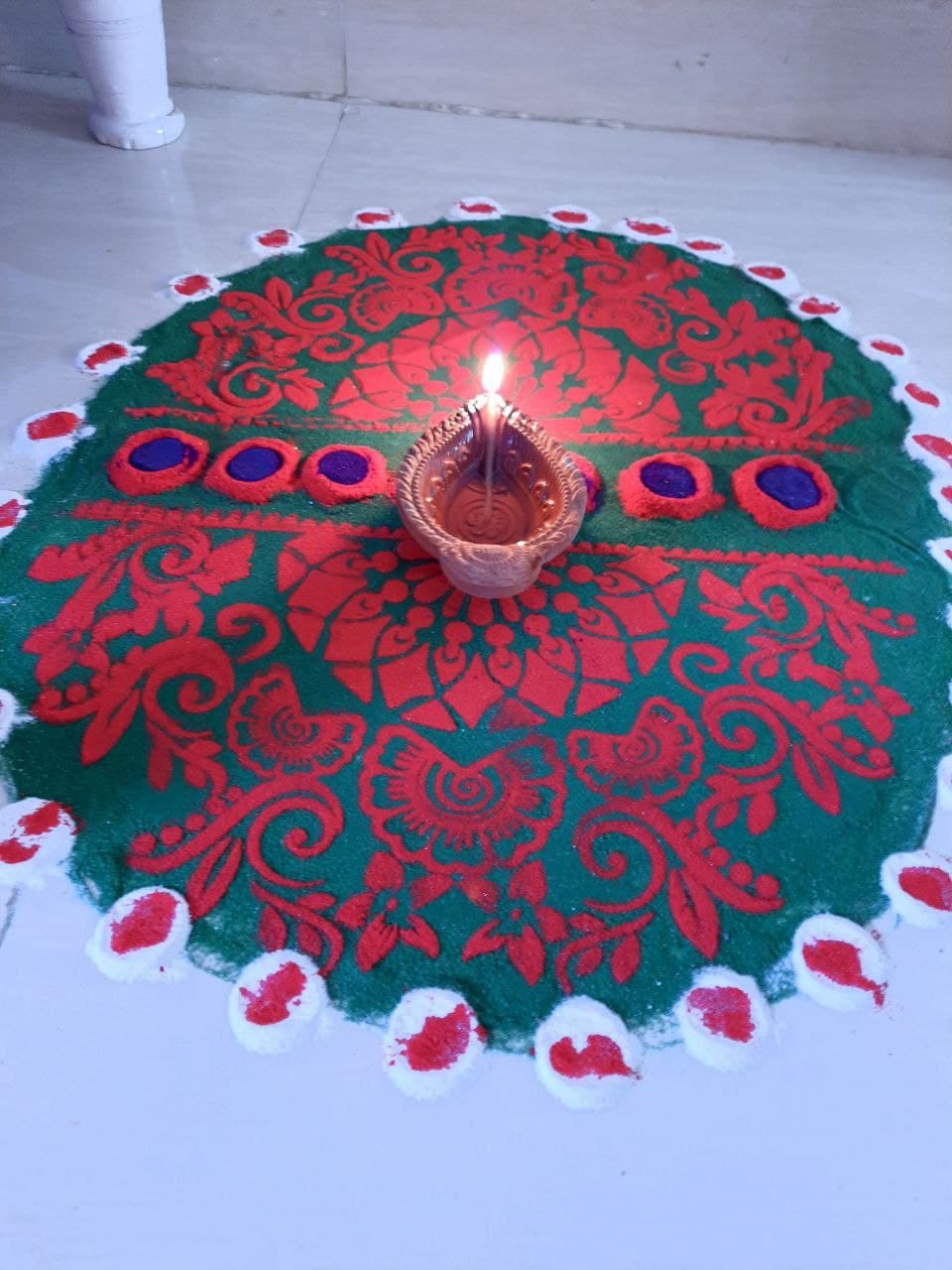
Diwali decorations with a diya at the centre. Photo: Jon Robson, CC BY 2.0

Patterns to know
The dot grid (pulli kolam). Dots are placed in a grid, then lines loop around them to reveal flowers, stars or lamps. Start with a simple 5x5 grid.
The lotus. The seat of Lakshmi and the most classic Diwali motif, drawn as concentric petals.
The diya. A single large lamp at the centre, flames radiating outward, often with "Shubh Diwali" written below.
The peacock. A festival favourite, its feathers made for coloured powder.
Geometric borders. Repeating triangles and squares along the doorway edge, the quickest way to dress an entrance.
How to make your first rangoli: a simple method
1. Choose your spot. A clean, swept doorstep or entrance corner. Wipe it dry; powder grips better on a dry surface.
2. Chalk the outline. Sketch your design lightly with chalk or a piece of white rangoli powder dribbled through your fingers. Beginners can use a small sieve for even dots.
3. Fill from the centre outwards. Take pinches of coloured powder and let them fall in a thin stream, guiding with your fingertips. Work one colour at a time.
4. Outline in white. A thin white border between colours makes every design look sharper.
5. Place the diyas. Finish with lamps on the petals or at the corners at dusk.
Stencils, available in every market before Diwali, are a perfectly respectable start, and children love them. What matters is the making, not the mastery.
Materials, traditional and modern
Traditionalists use rice flour, turmeric, kumkum, crushed dried petals and pulses. Modern kits add ready-made coloured powders in every shade; if you buy them, look for non-toxic, skin-safe colours, especially with children around. Flower petals from the day's puja, marigold, rose and chrysanthemum, make the softest and most fragrant rangoli of all, and return to the earth without waste.
A tradition that rewards beginners
Rangoli is redrawn every day in many homes, and that is the secret of it: it was never meant to be permanent. If a line wavers, sweep it smooth and begin again. The doorstep you decorate on Diwali morning joins a tradition millions of hands have kept alive for centuries, one pinch of colour at a time.
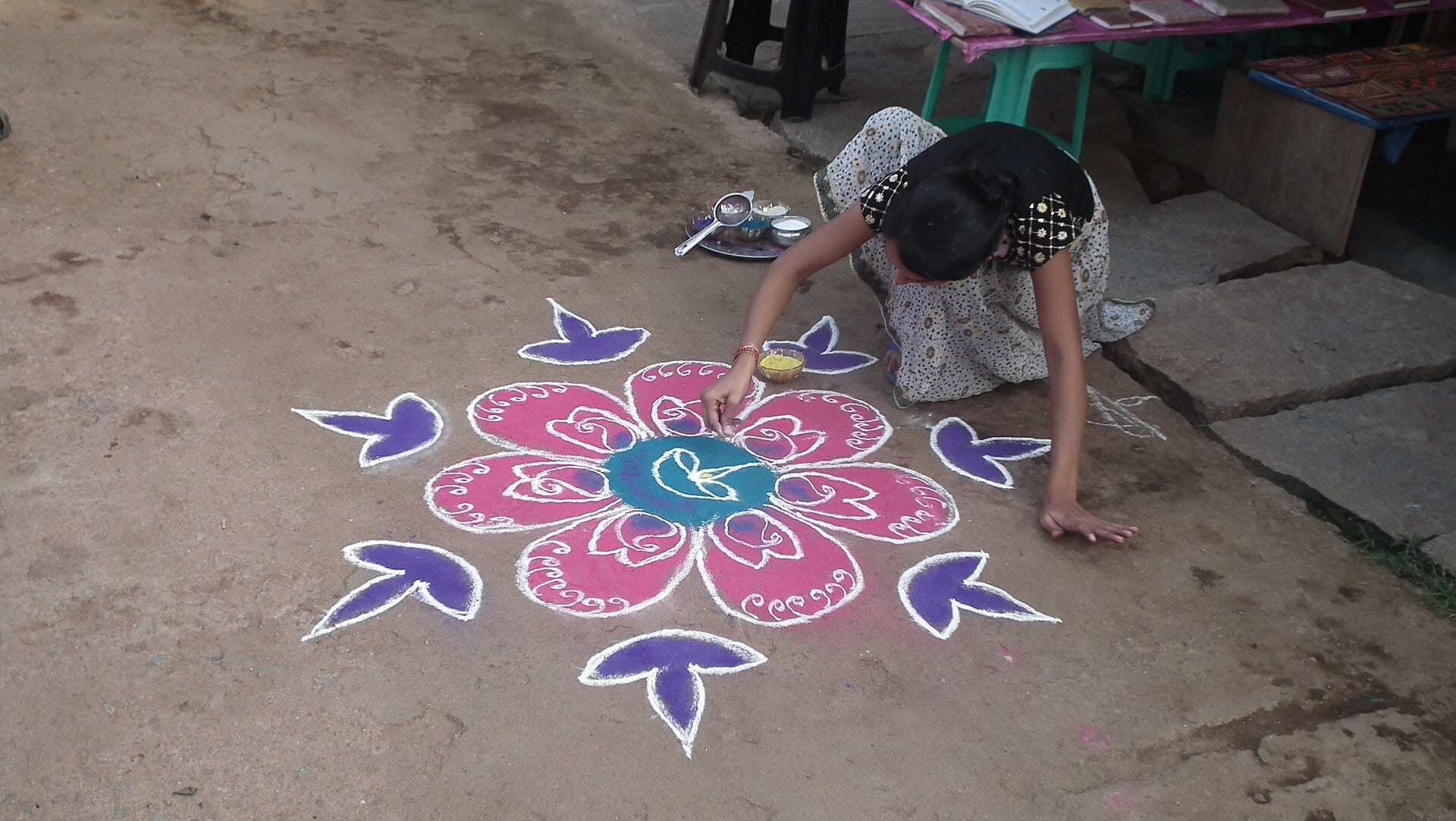
A colourful rangoli for Diwali. Photo: Wind Hashira, CC BY-SA 4.0
