

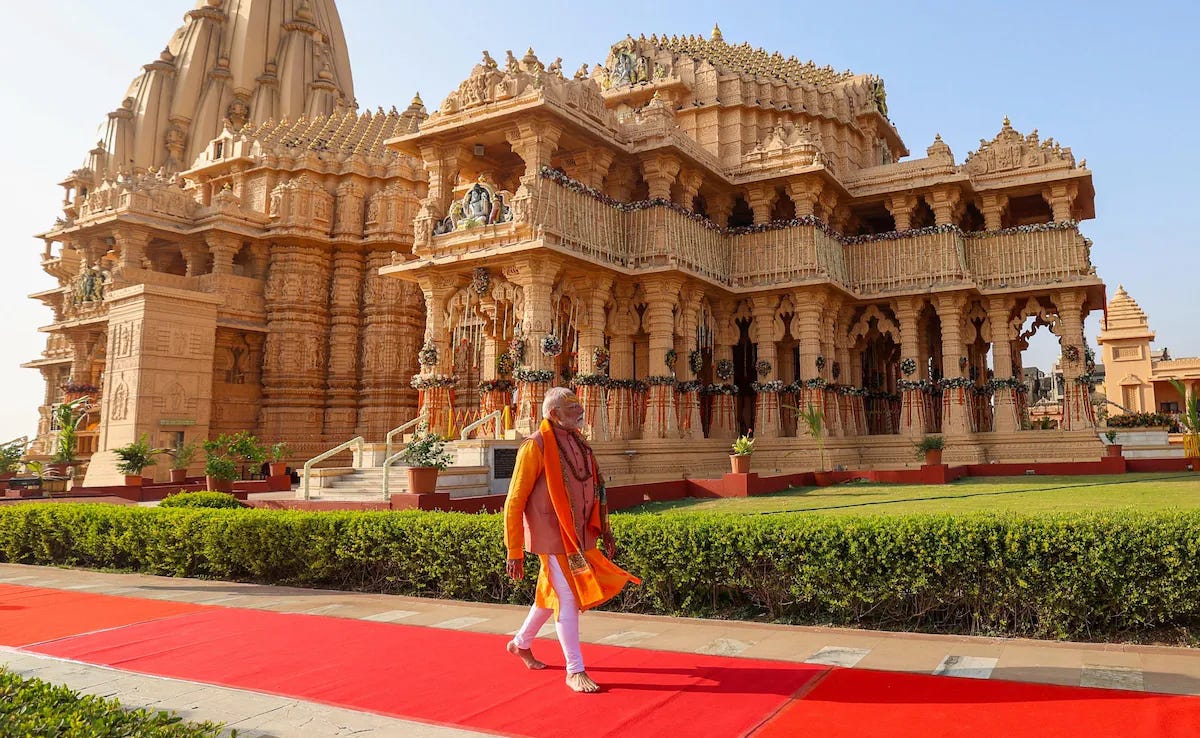
1) Where faith meets history
The Somnath Temple, located at Prabhas Patan (near Veraval) in Gujarat, is among the most revered pilgrimage sites in India. It is worshipped as the first among the 12 Jyotirlingas of Lord Shiva, making it not only a sacred temple but also a spiritual landmark in the religious geography of Hinduism.
Somnath is not remembered merely for its grandeur -it is remembered for its extraordinary resilience. Across centuries, the temple has seen destruction, reconstruction, invasion, restoration, and revival. Yet, its worship traditions have continued in one form or another - making it one of India’s strongest examples of faith that outlives time and trauma.
2) Spiritual roots and sacred geography
Somnath is situated on India’s western coast, where ancient belief associates the region with tirtha-kṣetra (sacred crossing places) - spiritual spaces believed to connect the human world with the divine.
A major spiritual reason for Somnath’s importance is that it houses a Jyotirlinga.
What is a Jyotirlinga?
A Jyotirlinga represents Lord Shiva as the “pillar of infinite light” - a cosmic form that symbolizes:
eternal consciousness
timeless truth
divine energy beyond form
In Shaivite tradition, visiting the Jyotirlingas is seen as a journey of inner purification, surrender, and spiritual awakening.
Somnath being regarded as the first among them elevates its status as a temple of primordial spiritual authority.
3) Somnath and the idea of Sanatana Dharma
Sanatana Dharma literally means the eternal way/order. It is not only a religious term - it represents a civilisational framework that includes:
dharma (ethical responsibility)
karma (action and consequence)
moksha (liberation)
devotion (bhakti)
knowledge (jnana)
spiritual discipline (sadhana)
Somnath reflects Sanatana Dharma in a powerful way:
✅ Even when structures were damaged, belief continued.
✅ Even when power shifted, worship endured.
✅ Even after repeated attacks, society rebuilt.
This continuity proves that Sanatana Dharma is not dependent solely on stone structures - it survives through:
collective memory
cultural identity
sacred tradition
lived devotion
That is why Somnath is often described as a symbol of Dharma’s resilience.
4) Historical timeline: A cycle of destruction and renewal
Somnath’s history reflects the broader reality of medieval India - where temples were often targeted because they were:
major pilgrimage centres
symbols of regional power
repositories of wealth & donations
cultural institutions
(A) The 1026 CE attack by Mahmud of Ghazni
The most widely remembered assault took place in 1026 CE, when Mahmud of Ghazni raided Somnath, plundered wealth, and damaged the shrine. This event became a turning point in Somnath’s civilisational memory, later remembered as an example of devotional resistance and cultural survival.
(B) Later medieval attacks and disruptions
Historical accounts commonly mention repeated disruptions under various rulers over centuries, reinforcing the theme:
Somnath was attacked repeatedly - but never erased.
(C) Continuity of worship: Ahilyabai Holkar (1782)
A major example of faith continuity is Queen Ahilyabai Holkar, who ensured worship survived by supporting temple-related restoration activity in the region (popularly remembered in 1782 traditions).
This reflects a key Hindu dharmic principle:
Even if a temple is broken, Dharma continues through seva (service) and bhakti (devotion).
5) Modern reconstruction: Somnath as a national cultural revival (1947–1951)
After Independence, Somnath became more than a temple rebuilding project - it became a statement of national self-respect.
Role of Sardar Vallabhbhai Patel
The reconstruction was initiated under the inspiration and leadership of Sardar Vallabhbhai Patel, who ordered and encouraged restoration efforts in November 1947, soon after Junagadh’s integration.
Public-funded rebuilding and Somnath Trust
The rebuilding work was supported through public participation and the establishment of a trust model, reinforcing that Somnath belongs to the people’s cultural consciousness, not only to institutions.
Consecration in 1951
The restored Somnath Temple was consecrated in 1951, and it emerged as a symbol of the idea that:
✅ “Reconstruction is stronger than destruction.”
This event represented a civilisational comeback rooted in cultural pride and spiritual confidence.
6) Architectural and artistic importance
The present-day Somnath temple is admired not only for devotion but also for its architecture and craftsmanship, reflecting revival of traditional Indian temple styles.
It is often associated with:
Māru-Gurjara (Solanki/Chalukya) style
stone-based traditional temple design principles
intricate carvings and sculptural storytelling
Temples like Somnath function as living museums of Indian civilisation - preserving:
art
symbolism
theology
community life
In Hindu tradition, a temple is not just a building. It is considered:
a sacred universe in stone (cosmic architecture)
a space where society gathers for dharma
a place where devotion becomes a shared culture
7) Somnath as a civilisational symbol beyond religion
Somnath is important not only for worshippers but for India’s civilisation because it represents:
A) Continuity of Indian identity
Somnath demonstrates that India’s civilisational identity is not fragile - it renews itself.
B) Cultural confidence and nation-building
The post-Independence rebuilding linked spiritual heritage to modern nationhood:
pride without hatred
memory without defeatism
rebuilding without fear
C) Inspiration for resilience
Somnath inspires the idea that setbacks can be transformed into strength - an idea deeply rooted in Indian philosophy.
8) Somnath in January 2026: National commemoration and renewed spotlight
In January 2026, Somnath witnessed major commemorations marking:
1000 years since the 1026 attack
75 years since the modern consecration in 1951
These were observed through the Somnath Swabhiman Parv (Jan 8–11, 2026), designed as a celebration of endurance and cultural self-respect.
9) PM Modi and Somnath: linking heritage, pride and public memory
PM Narendra Modi participated in events related to the commemoration and was reported to have joined the Shaurya Yatra, describing Somnath as a symbol of strength, resilience, and tradition.
This reflects a modern pattern where Somnath is seen as:
a sacred site
a cultural icon
a civilisational confidence marker
In the public narrative, Somnath is increasingly presented as a place that:
✅ honours history
✅ celebrates spiritual survival
✅ strengthens cultural continuity
10) Amit Shah’s statement and the larger message
Union Home Minister Amit Shah highlighted Somnath’s rebuilding as proof that Sanatana Dharma cannot be erased, framing the temple as a symbol of India’s enduring faith and civilisation.
This message aligns with Somnath’s historical theme:
attempts to destroy faith failed, because society rebuilt it again and again.
Why Somnath matters to India and Hindu civilisation
Somnath is not only a Jyotirlinga temple - it is a civilisational idea.
It represents:
Shiva-bhakti and spiritual energy
India’s memory of struggle and revival
the unbroken flow of Sanatana Dharma
the power of reconstruction over destruction
cultural continuity across a thousand years
Somnath stands today as a reminder that:
Faith is not just inherited. It is defended, renewed, and rebuilt - generation after generation.