
Temples Across India Close Doors as ‘Sutak Kaal’ Begins Ahead of Lunar Eclipse; To Reopen After Evening Rituals

Temples across India closed their doors on Tuesday as the ‘Sutak Kaal’ commenced ahead of the lunar eclipse, in accordance with long-standing Hindu traditions. From prominent pilgrimage centers to neighborhood shrines, religious institutions temporarily suspended darshan and ritual activities, with plans to reopen in the evening following the conclusion of the eclipse and subsequent purification ceremonies.
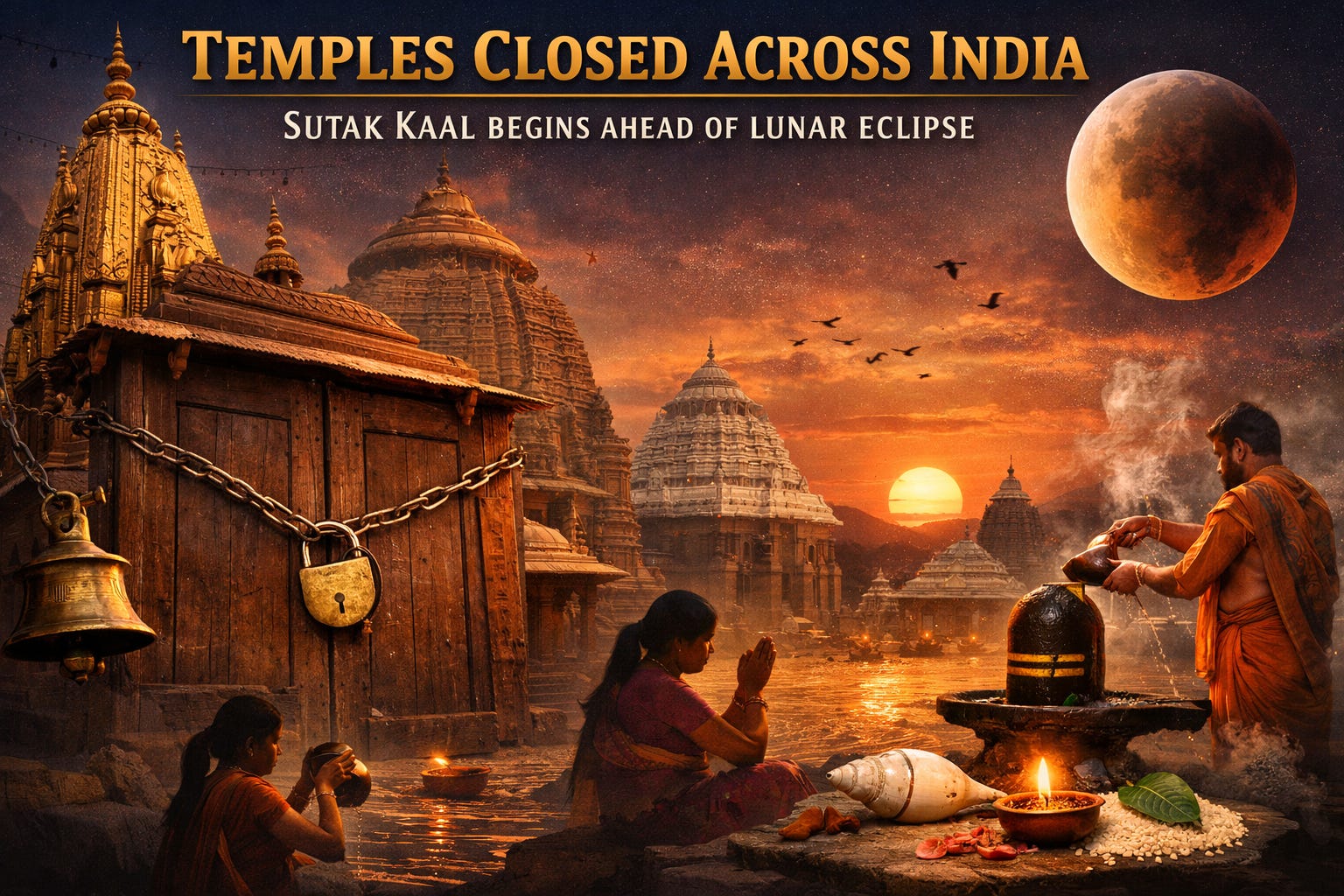
The observance reflects deeply rooted spiritual beliefs associated with celestial events in Hinduism, particularly eclipses, which are considered periods of heightened cosmic sensitivity.
Understanding Sutak Kaal
In Hindu tradition, Sutak Kaal refers to an inauspicious period that begins several hours before an eclipse. For a lunar eclipse, Sutak typically starts approximately nine hours prior to the event. During this time, religious and auspicious activities are avoided. Temples close their sanctums, daily rituals are paused, and devotees refrain from initiating significant undertakings.
The belief stems from ancient scriptures and astrological interpretations that view eclipses as moments when negative energies may be amplified. As a precaution, spiritual practices are either minimized or performed with specific guidelines.
While temples suspend public worship during Sutak Kaal, priests and temple authorities prepare for post-eclipse purification rituals that mark the restoration of normalcy.
Nationwide Temple Closures
Major temples across states including Uttar Pradesh, Tamil Nadu, Maharashtra, Gujarat, Karnataka, and West Bengal observed the closure.
In Varanasi, the Kashi Vishwanath Temple shut its sanctum as Sutak Kaal began, with officials announcing that the temple would reopen only after the eclipse concludes and purification rites are completed. Similar measures were implemented at other prominent shrines such as the Tirumala Tirupati Devasthanams in Andhra Pradesh, where darshan was suspended for several hours.
Temples in Mathura, Vrindavan, Haridwar, Ujjain, and other key religious centers also followed customary protocols. Smaller temples and local shrines across cities and villages adhered to the same practice, reflecting the widespread cultural significance of eclipse observances.
Authorities clarified that essential administrative functions continued, but no public prayers, offerings, or ceremonial activities were conducted during the restricted period.
Ritual Practices During an Eclipse
During a lunar eclipse, devotees traditionally engage in prayer, meditation, and chanting at home rather than visiting temples. Recitation of mantras, particularly those dedicated to Lord Vishnu or Lord Shiva, is considered spiritually beneficial during the eclipse window.
Many households observe dietary restrictions during Sutak Kaal. Food prepared before the onset of Sutak is either discarded or protected by placing sacred basil (Tulsi) leaves in it, which is believed to safeguard against negative effects. Cooking and eating are generally avoided during the eclipse period, except for children, the elderly, and those with medical conditions.
Pregnant women, according to traditional belief, are advised to remain indoors and avoid exposure to the eclipse. Though modern science does not support these concerns, the customs continue as part of cultural practice.
After the eclipse ends, devotees typically bathe, clean their homes, and perform purification rituals. Temples conduct elaborate cleansing ceremonies of the deity idols and sanctum premises before reopening for darshan.
The Lunar Eclipse: Astronomical Perspective
A lunar eclipse occurs when the Earth passes between the Sun and the Moon, casting a shadow on the Moon’s surface. Depending on alignment, it can be total, partial, or penumbral. Unlike solar eclipses, lunar eclipses are safe to view with the naked eye.
While science explains the phenomenon as a predictable celestial event governed by orbital mechanics, traditional Hindu cosmology associates eclipses with mythological narratives involving Rahu and Ketu—shadow planets in Vedic astrology believed to “swallow” the Moon temporarily.
This blending of astronomy and mythology continues to shape public observance patterns across India.
Post-Eclipse Reopening and Purification
Once the eclipse concludes in the evening, temples initiate shuddhi (purification) rituals. These may include ceremonial bathing (abhishekam) of the deity with sacred substances such as milk, curd, honey, and Ganga water, followed by chanting of Vedic hymns.
Temple premises are washed, and fresh offerings are prepared. Only after these rituals are completed do temples reopen their doors to devotees.
In several prominent temples, special evening aartis and extended darshan hours are scheduled to accommodate devotees who could not visit earlier in the day.
Cultural Continuity in a Modern Era
Despite advances in scientific understanding, eclipse-related traditions remain widely observed across India. For many devotees, the rituals are less about fear of inauspiciousness and more about preserving heritage and maintaining spiritual discipline.
Temple authorities emphasize that such closures are not reactions to superstition but adherence to age-old customs that have been followed for centuries. The coordinated observance across diverse regions underscores the enduring influence of shared religious rhythms in Indian society.
At the same time, some temples and spiritual organizations are using digital platforms to livestream post-eclipse rituals, enabling devotees to participate virtually.
A Reflection of Faith and Tradition
The temporary closure of temples during Sutak Kaal highlights the dynamic interplay between faith, tradition, and celestial events in India’s spiritual landscape. As evening approaches and the eclipse concludes, temple bells will ring once again, signaling not only the reopening of sanctums but also the continuity of rituals that have endured through generations.
For millions of devotees, the eclipse is not merely an astronomical event - it is a moment of reflection, discipline, and renewal, observed collectively across the nation.