

There is a certain moment that captures the transformation perfectly.
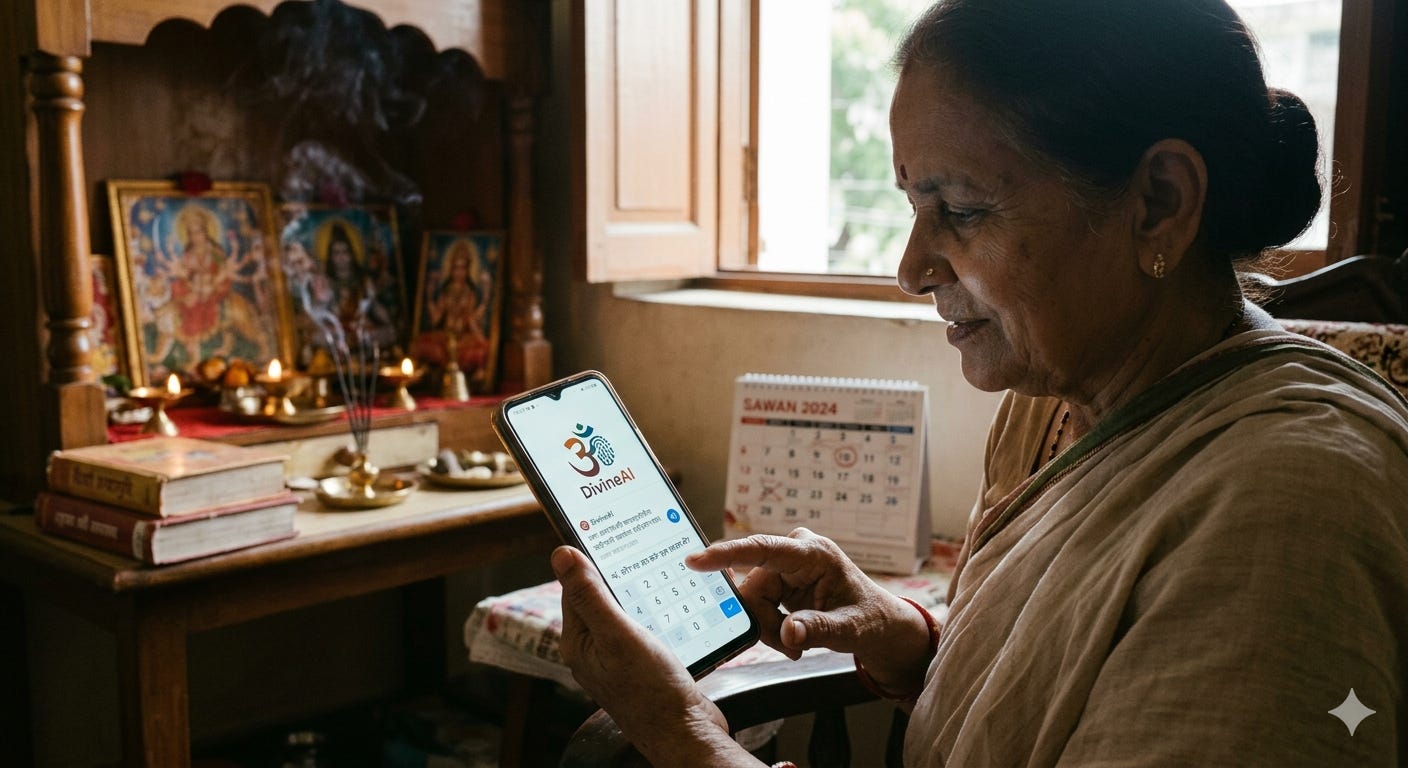
A 72-year-old grandmother in Patna, knees too worn for the long pilgrimage to Varanasi, opens her phone and watches the morning Ganga Aarti live. She types her question in Bhojpuri - “Maa, kaun sa vrat karoon is sawan mein?” — and within seconds, a verse from the Devi Bhagavatam appears on her screen, translated, contextualised, and spoken aloud. She doesn’t know what “AI” means. She just knows someone answered.
That someone is DivineAI.
And this scene, multiplying across a billion-strong nation of believers, is the story of our times.
India’s $58 Billion Faith Economy Finds Its Digital Dharma
India has always been a land where the sacred is inseparable from the everyday. The smell of incense at dawn, the ringing of temple bells, the whispered mantras before an exam - faith is not a Sunday ritual here. It is the operating system of daily life.
And now, that operating system is getting an upgrade.
India’s religious and spiritual market - encompassing temples, pilgrimages, astrology, rituals, devotional products, and spiritual retreats - is valued at over ₹40,000 crore ($4.8 billion) in the organised segment alone, and the broader faith economy sits at a staggering $58.56 billion. It is growing at a CAGR of 10%, and by 2028, the organised segment alone is expected to cross ₹65,000 crore.
From Mandirs to Mobile: The Four Forces Driving the Revolution
1. The Smartphone Devotee
India crossed 400 million rural smartphone users in 2025. The devotee who once walked barefoot to a temple now carries a temple in their pocket. With internet penetration crossing the billion-user mark, digital faith is no longer an urban elite phenomenon - it is pan-India, pan-age, pan-class.
Astrology apps alone have surged from 60 million users in 2020 to over 90 million by 2023, growing at 14% CAGR. Online astrology services are projected to be a $750 million market by 2025.
2. The Post-COVID Spiritual Surge
The pandemic did something paradoxical to faith: it took away temples but deepened spirituality. Millions who couldn’t attend rituals turned to apps, live-streams, and digital priests. Tirupati Devasthanam’s app saw a 400% surge in downloads for its live darshan feature during COVID-19. That hunger never went away.
The lockdowns proved something the sector long suspected: devotion does not require physical proximity. It requires intention - and the right platform.
3. The Young Bhakt
Here is the statistic that should silence every sceptic: spiritual tech startups generate nearly 70% of their revenues from users aged 25–35.
The same generation that streams Netflix also books online poojas. The same millennials who scroll Instagram also follow astrologers on YouTube. The same Gen-Z that orders food on Zomato also orders prasad from temples via apps. Spirituality has become, as one analyst noted, cool to post about - and platforms have intelligently monetised that cultural moment.
4. The NRI Devotee
For the 32 million Indians living abroad, the distance from home is also a distance from the divine. They miss the sound of temple bells. They miss the smell of agarbatti. They want their children to receive the sacred thread ceremony or the namkaran at the right muhurat, performed by the right pandit, in front of the right deity.
The faith-tech revolution is, in large part, a love letter to the diaspora — and platforms like DharmikVibes have been writing it in real-time.
Enter DharmikVibes: India’s Spiritual Super-App
If you want to understand where India’s spiritual-tech moment is headed, start with DharmikVibes.
What began as a platform for digital devotion has evolved into nothing less than a complete spiritual ecosystem — one that combines daily devotion, scriptural knowledge, astrology, guru connect, pilgrimage planning, and luxury yatra curation, all within a single trusted interface.
The platform is built for everyone: GenZ seekers asking existential questions, joint families planning their Char Dham yatra, NRIs in Singapore wanting a Satyanarayan Katha performed in their ancestral village, HNIs seeking private darshan at Kedarnath with a helicopter transfer and a Vedic scholar on call.
Key DharmikVibes offerings include:
Discover Nearby Temples — GPS-enabled temple discovery with historical context, dress codes, prasad information, queue wait times, and darshan timings in real-time
Find Pandits & Astro Gurus — A verified marketplace of pandits for rituals and astrologers for consultations, bookable by language, specialisation, and user rating
Plan Spiritual Travel — Curated pilgrimage packages, spiritual circuits, and guided yatra experiences across India, tailored to your preferences, timeline, and budget
Join Spiritual Communities — Connect with like-minded devotees, join satsangs, participate in dharmik discussions, and experience the warmth of sangha — now in digital form
Listen to Aarti, Bhajans & Kirtans — A rich devotional audio library for daily practice, festivals, and meditative listening
Elite Concierge Services — For HNIs, NRIs, senior citizens, and foreign seekers: private jets, luxury heritage hotels, VIP darshan passes at Kashi, Kedarnath, and Puri, private pooja arrangements with renowned pandits, and 24/7 WhatsApp spiritual concierge throughout the journey
This last category — the luxury spiritual experience — is a segment almost entirely created by DharmikVibes. It recognises what no one else dared to say aloud: that faith and luxury are not contradictions. A billionaire devotee does not want to stand in a three-hour queue. An elderly NRI couple does not want to navigate the crowds of Haridwar alone. They want the full spiritual experience — with the dignity they deserve.
DharmikGuide: Empowering the Spiritual Economy’s Frontline
If DharmikVibes is the devotee’s companion, DharmikGuide is the partner app that empowers those who serve the devotee — the pandits, the astrologers, the temple guides, the spiritual influencers, and the gig workers who form the backbone of India’s faith economy.
Think of it as the Swiggy or Dunzo of spiritual services — but built with cultural sensitivity, verified credentials, and a sacred purpose.
Through DharmikGuide, a pandit in Ujjain can list his services for a Navgraha pooja, receive bookings from families in Mumbai and Mauritius, track his income, build his reputation through verified reviews, and grow a practice that was once limited to word-of-mouth in his locality. A young temple guide in Hampi can offer multilingual walking tours, receive payment via UPI, and be discovered by international visitors through geo-location-based visibility.
The platform gives the spiritual economy’s informal workforce a formal home. It brings trust, transparency, and technology to a sector that has long operated on faith alone — in every sense of the word.
This is not small. India’s temple economy alone runs to ₹3,000 crore. Prominent temples like Tirupati receive annual donations exceeding ₹2,200 crore. The astrology market is estimated at ₹3,500 crore. The organised spirituality sector — Art of Living, ISKCON, Isha Foundation — generates ₹6,000 crore annually. The people who serve these ecosystems have, until now, had no digital infrastructure of their own. DharmikGuide changes that.
DivineAI: When Artificial Intelligence Meets Ancient Intelligence
Perhaps the most philosophically interesting — and most emotionally resonant — part of this revolution is the emergence of DivineAI: the use of artificial intelligence to make sacred knowledge accessible, personalised, and continuous.
DivineAI is not a gimmick. It is not a chatbot that replies “Jai Shree Ram” to every question. It is a thoughtfully built AI system trained on India’s deepest spiritual literature — the Bhagavad Gita, Upanishads, Puranas, Vedas — and capable of offering contextual, emotionally intelligent guidance in response to real questions from real seekers.
A devotee in Bengaluru can ask a question in Kannada and receive a verse-based reflection from the Bhagavad Gita in their preferred dialect — within seconds. A software engineer in Hyderabad, overwhelmed by professional stress, can ask the app what Krishna says about duty and find an answer that speaks directly to their situation. A student preparing for exams can ask for a muhurat or a mantra for focus and receive one rooted in authentic Vedic tradition.
Key DivineAI features include:
Daily Bhajans & Aartis — Curated devotional music for morning and evening practice
Vrat & Festival Alerts — Personalised reminders for pujas, kathas, vrats, and auspicious days
Ritual Knowledge Base powered by DharmikGuide — Learn customs, meanings, do’s and don’ts for every ritual, every festival, every occasion
AI Yatra Planner — Simply say “Plan my Char Dham in 7 days” or “Jyotirlinga darshan this weekend” and the AI creates a complete itinerary with darshan timings, ritual schedules, and travel arrangements
AI Astrology — Kundli analysis, muhurat selection, dosha remedies, and daily horoscope that blends classical Vedic wisdom with modern AI computation
Multi-language Voice Interface — Accessible in Hindi, Tamil, Telugu, Kannada, Marathi, Gujarati, and more
Senior-Friendly Design — Large fonts, simple navigation, voice-first interaction for elderly devotees
The concept of darshan — seeing and being seen by the divine — has always been the heart of Hindu devotion. DivineAI expands darshan beyond temple walls. With virtual reality-enabled temple environments, live-streamed rituals, and AI-guided worship sessions, devotees can experience the divine from anywhere in the world.
During the Maha Kumbh Mela — the largest human gathering on earth — AI-driven crowd management, virtual tours, real-time translation, and devotional guidance helped millions connect to the sacred event without being physically present. Technology, in that moment, was not a replacement for faith. It was its amplifier.
The Broader Ecosystem: A Revolution with Many Nodes
The digital dharma revolution extends well beyond any single platform.
AstroTalk, founded in 2017 by Puneet Gupta, is today India’s largest astrology platform with over 4.5 lakh daily users, 15,000 active astrologers, and revenues tracking toward ₹1,250 crore in FY25. Its profit more than tripled to ₹94 crore in FY24.
VAMA (Virtual Astrology & Mandir App) has partnered with 250+ temples and 300+ astrologers, joined ONDC, and raised investment from Wavemaker Partners, offering everything from e-poojas and e-darshans to Vedic astrology consultations and spiritual merchandise.
DevDham enables daily and live darshan, online poojas, and digital donations, having partnered with over 150 temples across 16 Indian states since its founding in 2020.
Utsav App has connected over 1 lakh active users across India to temple services in multiple languages, delivering prasad directly to devotees’ doors.
Melooha, founded by IIM Bangalore alumnus Vikram Labhe, uses 200+ proprietary AI algorithms and real astronomical data to deliver precision-based life guidance — spanning marriage, career, health, money, and parenting — rather than generic horoscopes.
Devaseva, India’s first dedicated faith-tech platform for virtual rituals, allows NRIs and devotees globally to participate in over 200,000 Vedic rituals online — from the Ganga Aarti to Navagraha poojas.
Scripture-based chatbots like GitaGPT, GitaSadhana built by developers like Vikas Sahu, attracted thousands of users within days of launch. Major organisations like the Isha Foundation have adopted AI to deliver the teachings of Sadhguru through modern applications. Robotic deity models are appearing in select temples, blending ancient worship with contemporary wonder.
Each of these represents a node in a vast, rapidly expanding network of digital dharma.
The Business of Belief: How Faith-Tech Makes Money
The monetisation models are as varied as the platforms themselves, and each reflects a deep understanding of the devotee’s relationship with money and faith.
Freemium is the dominant model: basic content - daily mantras, temple information, community access — is free. Premium tiers unlock exclusive darshans, private astrologer sessions, HD ritual streaming, and personalised guidance.
Subscription models work beautifully in this sector because spiritual practice is, by its nature, a recurring, daily activity. Platforms like 27Mantra offer monthly bhakti packs — curated playlists, daily affirmations, guided meditation — that believers return to every single day.
E-Commerce of spiritual merchandise is booming. From rudraksha beads to brass idols, from hand-woven temple silks to yantras and crystals, the market for sacred objects has moved online with remarkable success. ISKCON’s app reportedly derives 20% of its revenue from its digital store.
Donations via integrated UPI and card payments have democratised giving. A family in Toronto can now donate to a temple in Tirupati with the same ease as ordering dinner — and increasingly, they do.
Luxury Concierge — pioneered most ambitiously by DharmikVibes — taps a high-value segment willing to spend significantly for a curated, premium spiritual experience. Private helicopter transfers to Kedarnath, business class flights for overseas yatra groups, heritage palace stays between temple visits — these are real services with real demand.
Brand Sponsorships from companies like Dabur and Patanjali, who sponsor festival content, prayer playlists, and ritual guides, complete the commercial ecosystem.
The Questions We Must Ask
No transformation of this magnitude can proceed without honest inquiry.
Is digital darshan real darshan? Traditionalists will argue — not without basis — that the energy of a physical temple, the vibrations of a thousand voices chanting together, the fragrance of flowers offered to the deity, cannot be replicated on a screen. They are right. No platform claims otherwise. What they offer is not a replacement but an extension — a bridge for those who cannot be present, a daily touchpoint for those who are.
Can AI carry spiritual wisdom without reducing it? The risk of over-simplification is real. Ancient texts are not databases of answers. They are living traditions requiring interpretation, context, and the humility of a learner before a teacher. The best platforms understand this. DivineAI and similar tools are designed not to replace the guru but to democratise access to wisdom — to give the first-generation urbanite whose grandmother knew all the vrats by heart a digital equivalent of that grandmother’s guidance.
Who gets left behind? India’s digital divide, while narrowing, is not closed. The rural devotee, the elderly, the economically marginalised — their access to these platforms is improving but uneven. Senior-friendly design (a DivineAI priority), regional language support, and voice-first interfaces are all steps in the right direction. The work continues.
Whose spirituality is being digitised? The sector is, at present, heavily weighted toward Hindu traditions. The needs of India’s Muslim, Christian, Sikh, Buddhist, and Jain communities — 40% of the population — represent both an ethical obligation and a significant unexplored opportunity.
The Future: What Comes Next
The roadmap ahead is extraordinary.
Wearable integration is on the horizon. As AI continues to evolve, platforms like DivineAI could integrate with wearable devices to offer real-time emotional monitoring and spiritual feedback — a digital equivalent of the guru who knows when you need comfort before you ask for it.
Spatial and augmented reality will transform darshan. Imagine standing in your living room but experiencing the Sanctum Sanctorum of Somnath as if you are physically present — not through a screen but through spatial audio and AR immersion that makes the sacred tangible.
Hyperlocal spiritual discovery — knowing not just that a temple exists but which pandit there performs the best Rudrabhishek, which time of day the energy is most receptive, what the prasad is today — will become a standard feature.
AI-guided grief counselling and end-of-life rituals are areas where spiritual technology can offer profound human service — areas where the tradition is rich but the practitioners are few, and where a thoughtful AI can serve families in their most vulnerable moments.
Global expansion of Indian spiritual wisdom — the Bhagavad Gita’s guidance finding new seekers in Berlin, Buenos Aires, and Bangalore alike — is a cultural export opportunity that the platforms are beginning to recognise and pursue.
A Closing Reflection
The ancient rishis who composed the Upanishads did not have smartphones. But they had something these platforms aspire to channel: the understanding that the search for the divine is eternal, that the human hunger for meaning and connection is inexhaustible, and that wisdom, when freely shared, does not diminish — it multiplies.
India’s faith-tech revolution, at its best, is not about disruption. It is about devotion — the ancient, unstoppable, billion-hearted devotion of a people who have always found a way to keep the lamp burning, whatever darkness surrounds it.
DharmikVibes, DharmikGuide, and DivineAI are not replacing temples. They are building new ones — portable, accessible, intelligent, and alive with the same sacred purpose that has sustained this civilisation for five thousand years.
The divine, it turns out, is quite comfortable with an upgrade.
#SpiritualTech #DharmikVibes #DivineAI #DharmikGuide #FaithTech #DigitalIndia #Bhakti #HinduismInTheDigitalAge #AIAndSpirituality #IndiaStartups #YatraPlanning #VirtualDarshan #AstroTalk #TempleEconomy