
The Month the Calendar Slows Down
Four Sawan Somwars, Nag Panchami on a Monday, two eclipses and a Raksha Bandhan long weekend - August 2026, laid out for the devotee and the traveller.

There is a particular quality to a Monday in Shravan. The queue outside a Shiva temple starts forming before the sky is properly light. Someone is always carrying water — in a brass lota, a plastic bottle, a kanwar balanced across the shoulders - and the whole city seems to be walking in the same direction.
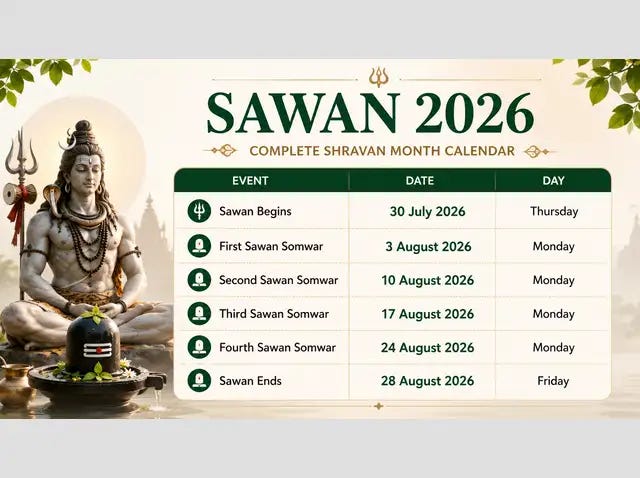
August 2026 holds four of those Mondays. It also holds something the calendar produces only occasionally: Nag Panchami falling on a Sawan Somwar. Serpent worship and Shiva worship landing on the same day, in the month that belongs to Mahadev.
If you observe Shravan, plan travel around it, or simply want to know why your neighbour has stopped eating grains on Mondays, here is the month laid out.
First, a word about which Shravan you are in
This trips up more people than anything else in the Hindu calendar, including families who have observed it their whole lives.
North India follows the Purnimanta calendar - the month ends at the full moon. Shravan runs 30 July to 28 August 2026.
Maharashtra, Gujarat, Karnataka, Andhra and the South follow Amanta - the month ends at the new moon. Shravan runs 13 August to 11 September 2026.
Same festival, same devotion, a fortnight apart. It is why a Gujarati family observes Nag Panchami around 1 September while a family in Varanasi observed it on 17 August. Neither is wrong. If you are planning a yatra with relatives from different regions, this is the first thing to settle — otherwise you will arrive for a festival that finished two weeks ago.
The Mondays
Sawan Somwar is the spine of the month. Four this year, in the North Indian reckoning:
3 August · 10 August · 17 August · 24 August
The vrat itself is simple, which is part of why it has survived so long. Bathe early. Take the sankalp facing east. Offer water, bel patra, dhatura and white flowers on the Shivling, chanting Om Namah Shivaya. Keep a phalahar fast - fruit and milk, no grains, and no salt if you are observing strictly. In the evening, Shiva Chalisa or a Rudrabhishek, aarti with a deepak, and then you eat.
Unmarried women often keep the Solah Somwar vrat - sixteen consecutive Mondays - for a good husband. Married women keep it for their family’s wellbeing. Neither requirement appears in any scripture; both have been carried for generations, which is its own kind of authority.
If you can hold one mantra through the month, make it the Mahamrityunjaya:
ॐ त्र्यम्बकं यजामहे सुगन्धिं पुष्टिवर्धनम् । उर्वारुकमिव बन्धनान्मृत्योर्मुक्षीय मामृतात् ॥
Eleven repetitions each Monday. A hundred and eight if the day allows.
Every date that matters in August
3 Aug, Mon - 1st Sawan Somwar. Shiva vrat and jalabhishek.
9 Aug, Sun - Kamika Ekadashi. Vishnu vrat; the fast breaks the next morning in the Parana muhurat, not at midnight.
11 Aug, Tue - Sawan Shivratri. Puja through four prahars of the night, jalabhishek at midnight. Distinct from Mahashivratri, and quieter - which many people prefer.
12 Aug, Wed - Hariyali Amavasya and a solar eclipse. Tree planting and pitru tarpan. Check local visibility before assuming sutak applies where you are; many temples close during those hours.
15 Aug, Sat - Hariyali Teej. Parvati–Shiva puja, green clothes, swings hung from trees. It shares the day with Independence Day this year.
17 Aug, Mon - Nag Panchami with the 3rd Sawan Somwar. The confluence. Milk offered at serpent images and anthills, on the day already sacred to the god who wears a serpent at his throat. Gujarat observes Nag Panchami around 1 September on the Amanta reckoning. Simha Sankranti also falls today.
23 Aug, Sun - Shravana Putrada Ekadashi. Observed for the wellbeing of children.
24 Aug, Mon - 4th Sawan Somwar. The last of the North Indian month.
26 Aug, Wed - Thiruvonam. Kerala’s Onam - pookalam at the threshold, Onasadya on a banana leaf. A harvest festival rather than a vrat, and a reminder of how many calendars run at once in this country.
28 Aug, Fri - Raksha Bandhan on Shravan Purnima. Also Narali Purnima on the west coast, Varalakshmi Vratam in the South, and a lunar eclipse. Tie the rakhi in the shubh muhurat, outside Bhadra.
Where to have darshan
Sawan belongs to Mahadev, so the Jyotirlingas carry the weight of the month.
Kashi Vishwanath, Varanasi. The holiest Sawan destination and, on Mondays, the most crowded place you will ever try to pray in. Lakhs of kanwariyas arrive with Ganga water. Book sugam darshan online, reach the ghats before four for Mangala Aarti, and add Kaal Bhairav. If you have any flexibility, go Tuesday to Thursday - the same temple, a fraction of the crush.
Mahakaleshwar, Ujjain. The Bhasma Aarti needs booking weeks ahead and is worth the trouble. On Sawan Mondays the Mahakal Sawari procession moves through the old city, which is a darshan in itself. Omkareshwar is 140 km away - two Jyotirlingas in two days.
Somnath, Gujarat. Because Gujarat’s Shravan starts on 13 August, the tirth peaks late August into September. The evening light-and-sound show after aarti is genuinely good. Pair it with Dwarka, 230 km up the coast, for Shiva and Krishna in one arc - specially in the run-up to Janmashtami.
Kedarnath. Open, but this is monsoon in the Garhwal Himalaya and landslides close the Gaurikund trek without warning. If you go, keep buffer days, register on the Char Dham portal, and watch the advisories. Mid-September to October is the safer window. Helicopter darshan exists if the trek is not realistic.
Vaishno Devi, Katra. The 13 km climb is easier in August mist than in June heat. Expect a crush around Raksha Bandhan weekend - book RFID yatra slips well ahead.
Mathura–Vrindavan. Not Shiva, but plan it now. Janmashtami falls on 4 September and Braj becomes impassable in the best way. Banke Bihari, Krishna Janmabhoomi and ISKCON all overflow; stays sell out weeks in advance. Arrive on the 2nd or 3rd, and keep Nandgaon and Barsana for the quieter day after.
What September is already asking of you
4 Sep - Krishna Janmashtami. Midnight janma utsav; Dahi Handi the next day.
13 Sep - Hartalika Teej. Nirjala vrat for Gauri–Shankar.
14 Sep - Ganesh Chaturthi. Ten days of Bappa begin.
25 Sep - Anant Chaturdashi. Visarjan.
If Janmashtami in Braj or Ganesh Chaturthi in Maharashtra is on your list, August is when you book. Not September.
Practical things, learned the hard way
Sawan Mondays multiply crowds everywhere Shiva is worshipped. Queues triple. Go pre-dawn, or go midweek.
The monsoon rules the hills. Rain covers, buffer days on any Kedarnath-belt route, and check IMD advisories before you commit to a date.
Book Bhasma Aarti and sugam darshan through official temple portals only. The touts outside every major tirth are selling something they cannot deliver.
Raksha Bandhan on 28 August is a long weekend. Trains and Katra hotels fill first - three weeks out is not early.
Both eclipses close temples during sutak hours. The 12th and the 28th. Confirm darshan timings before you travel, not after.
Why the month works
Shravan is not a festival. It is a discipline that happens to be beautiful - a month where a very large number of people voluntarily give something up, get up earlier than they want to, and walk somewhere carrying water.
The vrat is not difficult. The temples are not far. What Sawan asks is that you show up on a specific Monday, four times, when it would be easier not to.
That is most of what devotion has ever been.
DharmikVibes plans yatras end to end — darshan slots, stays, transport, pandit ji and rituals, from your doorstep to the sanctum and back. WhatsApp +91 92203 52244 or visit dharmikvibes.com.