


There is a tree in Sanatan Dharma before which generations have bowed their heads, offered water and lit lamps. Its roots are touched with reverence, its branches are regarded with devotion, and its presence is considered auspicious.
But have you ever wondered what makes the Peepal tree so sacred?
The answer is not merely found in popular beliefs or age-old customs. One of its most profound references comes directly from the Bhagavad Gita, where Bhagwan Shri Krishna Himself identifies this tree as a manifestation of His divine glory.
“अश्वत्थः सर्ववृक्षाणाम्”
Ashvatthah Sarva-Vrikshanam.
Among all trees, I am the Ashvattha.
Bhagavad Gita 10.26
These few words give the Peepal, known in Sanskrit as Ashvattha, a remarkable place in Sanatan Dharma. To understand its significance, however, one must look beyond the rituals performed beneath its branches and explore the wisdom preserved in our scriptures.
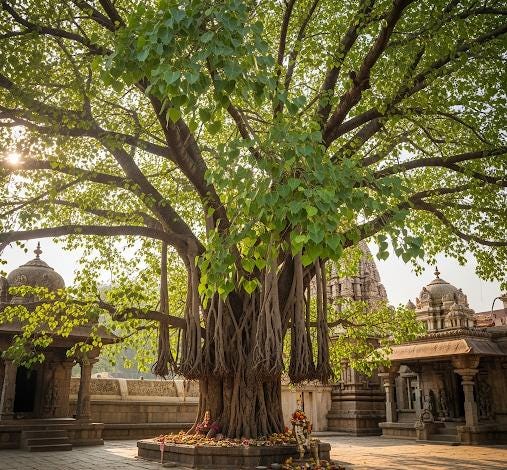
The Tree That Bhagwan Krishna Chose to Represent His Glory
In the tenth chapter of the Bhagavad Gita, Bhagwan Krishna reveals His Vibhutis, the extraordinary manifestations through which His divine splendour can be recognised in creation.
Among mountains, rivers, warriors and celestial beings, He identifies Himself with the Ashvattha among trees.
This is no ordinary mention.
The declaration invites us to recognise that the divine is not confined to temples, sacred images or places of pilgrimage. The splendour of the Supreme is also reflected in the natural world.
The Peepal therefore becomes more than an object of worship. It becomes a reminder of the divine presence that sustains creation.
The Mystery of the Tree Whose Roots Are Above
One of the most extraordinary descriptions of the Ashvattha appears in the fifteenth chapter of the Bhagavad Gita.
Bhagwan Krishna describes a cosmic tree whose roots are above and branches below.
“ऊर्ध्वमूलमधःशाखमश्वत्थं प्राहुरव्ययम्।”
Urdhva-mulam adhah-shakham ashvattham prahur avyayam.
Its roots are above and its branches below; such is the eternal Ashvattha.
Bhagavad Gita 15.1
What does this unusual description signify?
Here, Bhagwan is explaining Samsara, the cycle of worldly existence.
The roots represent the eternal source of creation, while the branches represent the manifested world in which living beings experience life, desires, actions and their consequences.
The tree is a profound philosophical representation, not simply a description of a physical Peepal.
In the following verses, Krishna explains how this cosmic tree is sustained by the three Gunas and how its roots extend through the world of human action.
The teaching ultimately directs the seeker towards detachment and the realisation of the Supreme.
This is perhaps one of the deepest reasons the Ashvattha occupies such an extraordinary place in Hindu spiritual thought.
Why Is the Peepal Associated With Brahma, Vishnu and Mahesh?
A widely followed traditional belief associates the Peepal tree with the Trimurti.
Its roots are associated with Brahma, the creator; its trunk with Bhagwan Vishnu, the preserver; and its branches with Mahadev Shiva, the transformer.
This symbolism reflects the three great functions through which the universe is understood in Hindu tradition: creation, preservation and dissolution.
It also conveys an important spiritual thought: the entire creation is governed by interconnected divine principles.
Thus, when devotees bow before the Peepal, they do so with reverence for the sacredness associated with its very existence.
Why Do Devotees Offer Water and Light a Diya Beneath It?
The rituals performed beneath the Peepal are not merely customs passed down without meaning. Each carries a spiritual sentiment.
Jal Arpan: Offering Water
Devotees traditionally offer water to the roots of the Peepal as an expression of Shraddha and gratitude.
Water sustains life, and offering it to a living tree reminds us that nature itself deserves reverence and protection.
Deepdaan: Offering Light
Lighting a diya beneath the tree represents the illumination of knowledge.
In Sanatan philosophy, Jnana removes the darkness of Avidya, ignorance. The flame becomes a reminder that spiritual life is ultimately a journey towards understanding and awakening.
Pradakshina: Circumambulation
Walking clockwise around the sacred tree is an expression of devotion.
In Hindu tradition, Pradakshina signifies placing the divine at the centre of one’s existence. It reminds the devotee to align thoughts, actions and conduct with Dharma.
What Our Ancestors Understood About Nature
There is another dimension to the sacredness of the Peepal that deserves our attention.
Sanatan Dharma never separated spirituality from the natural world.
Rivers were revered as mothers, mountains were associated with divine presence, animals held sacred significance, and trees were protected through religious traditions.
The Peepal stands among the finest examples of this understanding.
It provides shelter to birds, supports biodiversity and offers shade to countless living beings. Its sacred status has encouraged generations to preserve these trees and recognise their importance.
Our ancestors understood that nature was not merely something to be used. It was something to be respected, protected and revered.
The Wisdom Hidden Beneath Its Branches
Perhaps the greatest teaching of the Ashvattha is not about how many times one should walk around it or how many lamps should be lit beneath it.
It is about learning to recognise the divine beyond what the eyes can see.
When Bhagwan Shri Krishna declares Himself present in the Ashvattha, He gives us a way to contemplate the sacredness of creation itself.
The next time you stand beneath an ancient Peepal tree, remember that its significance is not limited to the rituals performed around it.
Its presence takes us back to the wisdom of the Bhagavad Gita, to the philosophy of Samsara and to the eternal relationship between the Supreme and His creation.
For Sanatan Dharma, the sacredness of the Peepal is a reminder that the divine is not merely worshipped within the walls of a temple; it is also recognised in the creation that surrounds us.