

What if a temple’s greatest mystery was not hidden beneath its foundations, but preserved in the rituals performed every single day?
What if the immense wealth offered by millions of devotees was connected to a divine loan taken thousands of years ago?
And what if the seven mountains surrounding one of India’s most visited pilgrimage sites were believed to represent the seven hoods of a celestial serpent?
Welcome to Tirumala- the sacred abode of Sri Venkateswara, popularly known as Tirupati Balaji.
For centuries, pilgrims have climbed its hills carrying prayers, promises, gratitude and questions. Some arrive seeking prosperity. Others come after overcoming life’s greatest difficulties. Yet, almost everyone leaves with a story.
But behind the familiar image of Lord Balaji lies a fascinating world of Puranic narratives, ancient traditions, remarkable history and spiritual symbolism.
Here are seven extraordinary aspects of Tirupati that reveal why this temple continues to captivate the imagination of millions.
Why Are the Seven Hills Considered the Body of Adishesha?
The first remarkable feature of Tirumala is its geography.
The temple stands on Venkatadri, the seventh of the seven sacred hills collectively known as Saptagiri.
But why seven hills?
According to Hindu tradition, these mountains represent the seven hoods of Adishesha, the divine serpent upon whom Lord Vishnu rests in the cosmic ocean.
The hills are traditionally known as:
Seshadri
Neeladri
Garudadri
Anjanadri
Vrishabhadri
Narayanadri
Venkatadri
This association transforms the geography of Tirumala into something deeply symbolic. The mountains are not merely a physical landscape; they are understood as part of the divine cosmic order.
The next time someone speaks of climbing the seven hills, remember that, in the sacred imagination of Vaishnava tradition, the journey is also an ascent towards the abode of Vishnu.
Did Lord Vishnu Really Take a Loan from Kubera?
Perhaps no other story associated with Tirupati is as fascinating as the divine loan of Lord Srinivasa.
According to the traditional Venkatachala Mahatmya narrative, Lord Vishnu descended to Earth as Srinivasa following His separation from Goddess Lakshmi.
He subsequently married Padmavati, the daughter of King Akasha Raja.
The wedding was no ordinary celebration. It was a celestial event, and the arrangements were described as magnificent.
For the wedding, Srinivasa is believed to have borrowed wealth from Kubera, the divine treasurer.
The traditional belief holds that this debt is to be repaid by the end of Kali Yuga.
This is one reason why offerings made by devotees at Tirumala carry such special significance.
But here is the more interesting question: Why would the Supreme Lord, the source of all wealth, need to borrow anything?
The story invites a deeper interpretation. It connects divine generosity with the devotion of humanity, turning the act of giving into a sacred relationship between the devotee and the Lord.
The next time you see the enormous offerings at Tirumala, remember the story that gives this tradition its distinctive identity.
Why Do Devotees Offer Their Hair to Lord Balaji?
Thousands of devotees voluntarily undergo tonsuring at Tirumala.
For many visitors, this is one of the most striking sights associated with the pilgrimage.
But why is hair offered to the Lord?
In the devotional tradition, the act is associated with surrender, humility and the abandonment of ego.
Hair is often connected with physical appearance, personal identity and beauty. Offering it before the deity becomes a symbolic expression of detachment from external identity.
It is not simply a ritual of giving something physical.
It is an act of placing one’s pride, attachment and individuality before the Divine.
This practice also reflects a larger principle of Sanatana Dharma: the most meaningful offering is not necessarily the most expensive one, but the one made with genuine devotion.
What Makes the Idol of Lord Venkateswara So Significant?
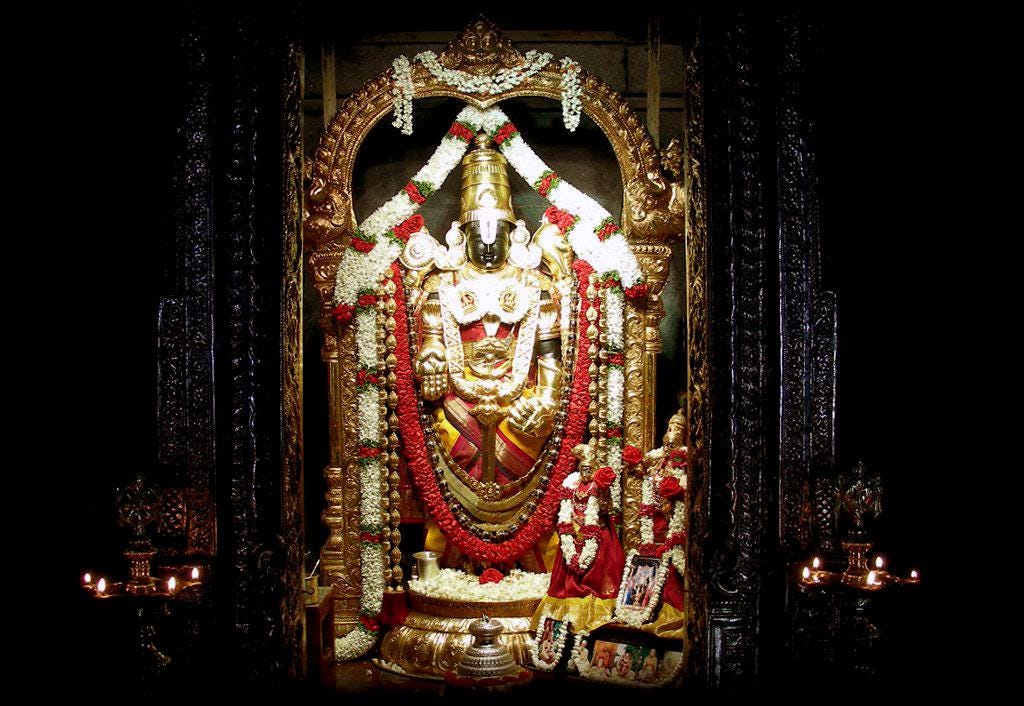
At the heart of the Tirumala temple lies the sacred image of Sri Venkateswara.
Unlike a conventional sculptural representation, the principal deity is traditionally worshipped as a Swayambhu murti – a self-manifested form of the Divine.
The deity is adorned with elaborate ornaments, sacred garments and floral decorations.
The image represents Lord Vishnu and carries profound importance within the Vaishnava tradition.
Devotees also associate several distinctive features of the deity’s adornment and worship with ancient temple traditions.
One should distinguish between established temple practices and popular claims about the idol. The sanctity of the murti does not depend upon sensational explanations; its theological significance comes from the living tradition of worship.
The sanctum itself is crowned by the golden Ananda Nilaya Vimanam, one of the most recognisable features of the temple.
Why Is Tirupati Known as Kaliyuga Vaikuntha?
In Hindu cosmology, time moves through four great ages: Satya, Treta, Dvapara and Kali.
The Kali Yuga, is traditionally described as a period in which spiritual discipline becomes increasingly difficult and human beings become more vulnerable to distraction and attachment.
Within this understanding, Lord Venkateswara is worshipped as the accessible manifestation of Lord Vishnu for the people of Kali Yuga.
This is why Tirumala is revered as Kaliyuga Vaikuntha – Vaikuntha on Earth.
The significance is not merely geographical.
It reflects a powerful spiritual idea: divine grace remains accessible even when the world appears increasingly distant from Dharma.
Perhaps this explains why millions chant the same name while climbing the hills:
Govinda! Govinda!
A simple name becomes an expression of faith, surrender and remembrance.
The Temple Ritual That Begins Before Sunrise
Long before the ordinary world awakens, the sacred daily routine of Tirumala begins.
One of the most recognisable rituals is Suprabhatam, the early morning hymn sung to awaken Lord Venkateswara.
The tradition is associated with the composition of Prativadi Bhayankaram Annan, a disciple in the Sri Vaishnava tradition.
The hymn begins:
Kaushalya Supraja Rama...
These opening words are familiar from the Ramayana tradition and form part of the celebrated Suprabhatam recitation.
The temple follows the Vaikhanasa Agama tradition, which governs its worship and ritual practices.
The daily sequence of services reflects a remarkable understanding of temple worship: the deity is treated with the reverence and care traditionally extended to an honoured divine presence.
The day concludes with Ekanta Seva, the final service before the temple closes for the night.
It is a tradition in which every part of the day is organised around the worship of the Divine.
The Ancient Kings Who Helped Build Tirumala’s Legacy
Tirupati is not only a sacred centre of Hindu worship. It is also a remarkable archive of Indian history.
Several South Indian dynasties contributed to the development of the temple and its institutions.
The Pallavas, Cholas, Pandyas and Vijayanagara rulers supported the temple through patronage, donations and construction.
Among the most celebrated royal patrons was Krishnadevaraya of the Vijayanagara Empire.
His association with Tirumala is remembered through inscriptions and historical records.
The temple’s architectural features, inscriptions and ceremonial traditions preserve evidence of centuries of religious and political patronage.
What makes this especially fascinating is the continuity of worship.
Political powers changed, kingdoms disappeared and historical periods passed, but Tirumala remained an important centre of devotion.
It is a living connection between India’s past and present.
The Question That Makes Tirupati More Than a Pilgrimage
Millions visit Tirumala every year.
Some wait for hours for a few moments of darshan. Some offer their wealth. Some shave their heads. Others walk barefoot up the hills, repeating the name of Govinda.
But what are they truly seeking?
Perhaps prosperity. Perhaps healing. Perhaps the fulfilment of a promise.
Yet, beneath these individual prayers lies something universal: the human desire to find meaning, reassurance and a connection with something greater than oneself.
That is the enduring significance of Tirupati.
The temple is not merely a place where people go to ask for blessings. It is a place where they learn to surrender, express gratitude and renew their faith.
And perhaps that is the greatest mystery of the Lord of Seven Hills: despite centuries of history, countless stories and millions of visitors, His devotees continue to return.
Govinda! Govinda!
Om Namo Venkatesaya.