

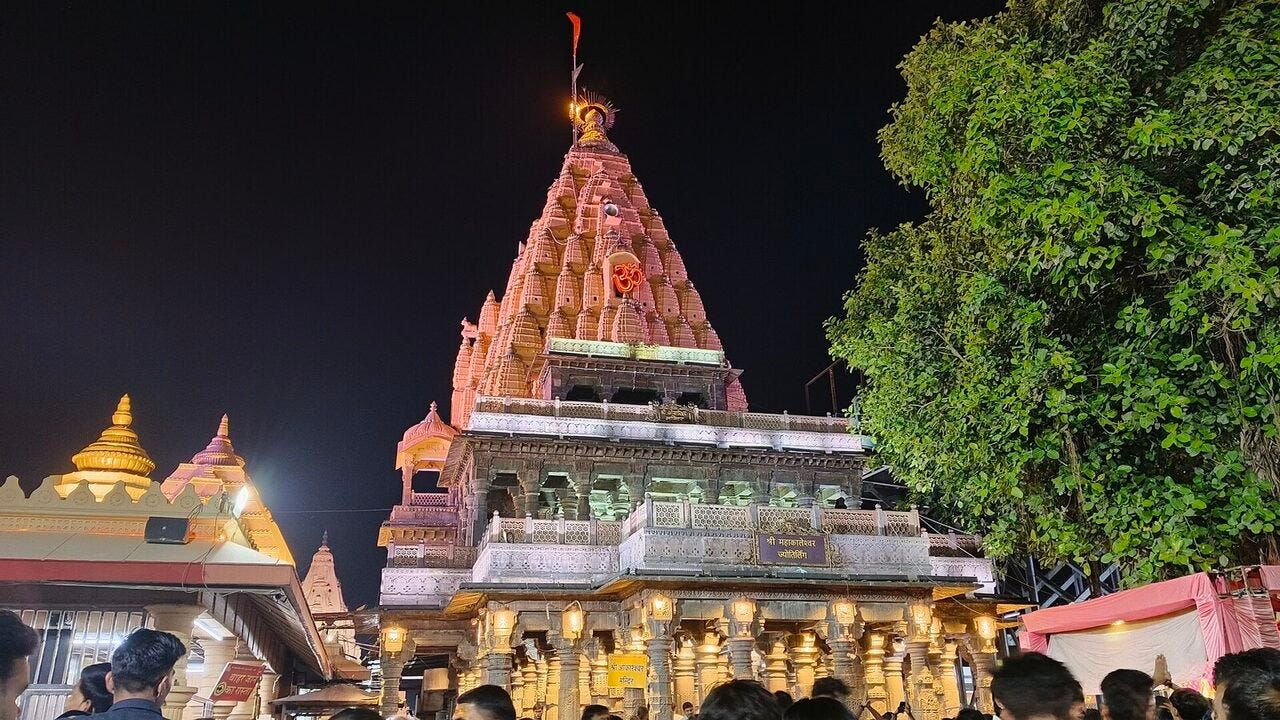
Mahakaleshwar Temple, Ujjain. Photo: Ashverse, CC BY-SA 4.0, via Wikimedia Commons
Jai Shree Mahakal.
Ujjain is not a city you visit for a single darshan. It is a city you stay in. It has been called Avantika and Ujjayini, it is mentioned by Kalidasa in the Meghaduta, and it is one of the four places where, in the Puranic story, drops of amrita fell during the churning of the ocean. Every twelve years it hosts the Simhastha Kumbh on the banks of the Shipra.
At the centre of it all is Shri Mahakaleshwar, one of the twelve Jyotirlingas. This guide is for families planning a first yatra to Ujjain: what to know about darshan, how the Bhasma Aarti booking works now, and how to give the city its time.
Who is Mahakal
Mahakaleshwar is the Jyotirlinga on the bank of the Shipra, where Shiva is worshipped as Mahakal, the Lord of Time. The temple’s official website describes it as the Jyotirlinga where Shiva is worshipped as the “King of Time”.
Two things set Mahakal apart for devotees.
First, the lingam faces south. The idol is described as Dakshinamurti, and the tantric Shivanetra tradition holds that this is found only at Mahakaleshwar among the twelve Jyotirlingas.
Second, this is where the Bhasma Aarti is performed, every day at 4:00 AM, the first aarti of the day. The sacred ash is a reminder of the cycle of life and death, which is why it belongs so naturally to the Lord of Time.
In the Puranic legend of King Chandrasena and the shepherd boy Shrikhar, Shiva appeared as Mahakal to protect his devotees in Ujjain, and agreed to stay in the city, blessing those who worship him here with freedom from the fear of death. That is the heart of why people come here with their parents and grandparents.
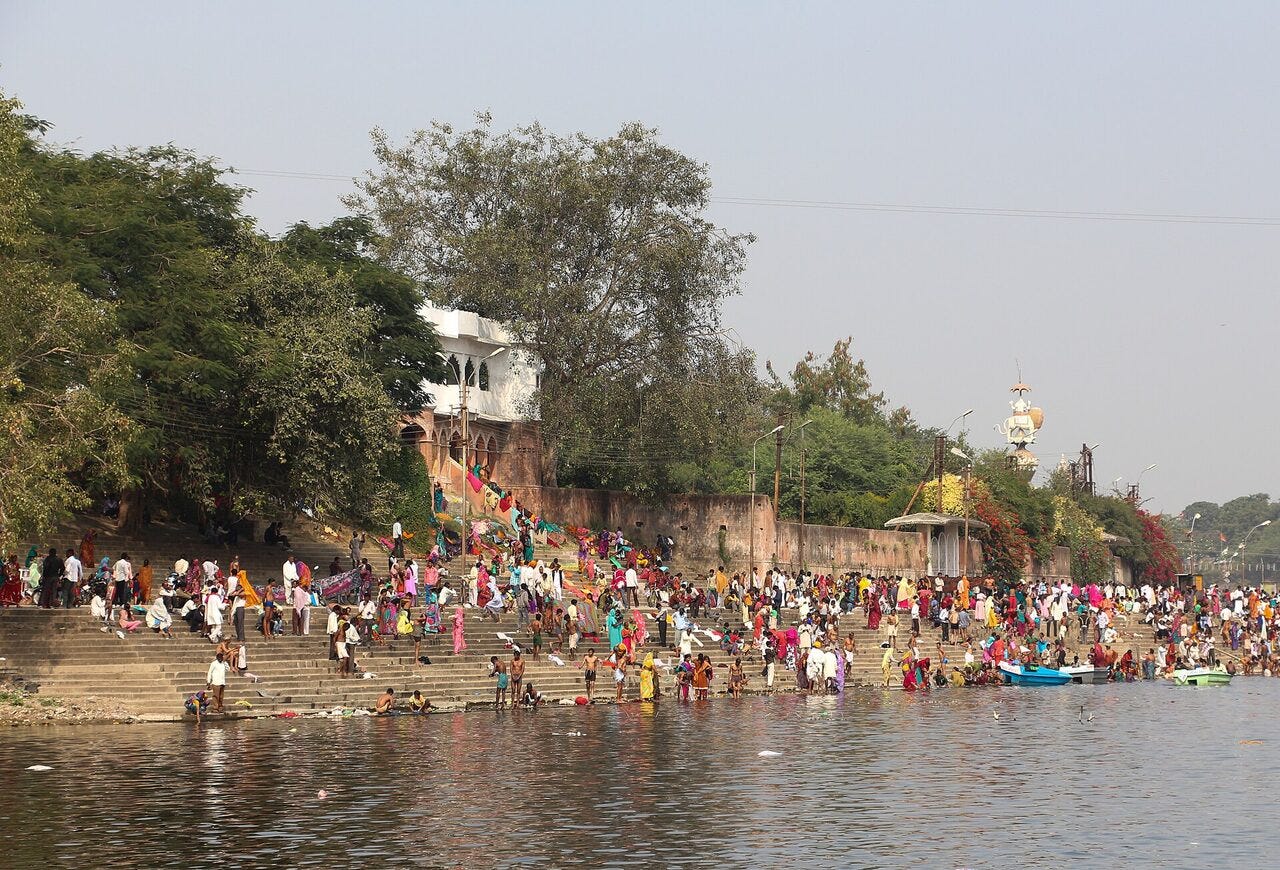
Devotees at Ram Ghat on the Shipra, Ujjain. Photo: Bernard Gagnon, CC BY-SA 3.0, via Wikimedia Commons
Bhasma Aarti: how booking works now
This changed in 2026, so read this part carefully. Please also check the official website before you plan, because the committee updates these rules from time to time.
The only official place to book is the temple’s own website: shrimahakaleshwar.mp.gov.in. The temple does not authorise outside agents or third-party sites to sell Bhasma Aarti entry. Please do not pay anyone else for a “confirmed” slot.
What was reported in April 2026 (Dainik Jagran English, 15 April 2026):
The offline permit counter was closed, and the roughly 300 permits that used to be given offline a day in advance were moved to an online “Tatkal” quota.
The Tatkal window opens one day before your date at 8:00 AM, at ₹200 per person, first come first served.
The regular advance booking period was cut from three months to one month. The portal opens for a month on the first of the previous month at 8:00 AM (for June, it opened on 1 May).
What the Times of India’s 2026 guide adds (1 May 2026):
You register with your email and mobile number, choose the date, enter your details and upload a valid government ID (Aadhaar or passport), and pay online. You then get a QR-code ticket.
Carry the same ID you used while booking.
The entry window is 1:00 AM to 3:00 AM, and the aarti runs from about 4:00 AM to 5:30 AM. Reach at least 30 to 40 minutes early. Late entry is usually denied once the ritual begins.
A note for transparency: the Times of India piece mentions a limited offline counter, while the Jagran report from two weeks earlier says offline permits were stopped. We are following the more specific and earlier-dated report that the committee closed the counter, but this is exactly the kind of point to confirm on the official site before your yatra, and we will update this post if it changes.
About dress. For Bhasma Aarti inside the sanctum, sources commonly mention a dhoti for men and a saree for women. At the same time, a temple priest quoted by Bhaskar English (August 2026) says there is no strict dress code that stops someone in a shirt or jeans from entering the temple for normal darshan. Our advice: wear clean, simple, traditional clothes, and follow the instructions on your booking confirmation.
Other darshan options
The official website lists a Sheeghra Darshan pass, a ticketed pass for quicker darshan without a long queue. It also lists online booking for Pujan and Abhishek.
For the evening and night aartis, according to the same April 2026 report:
Seated darshan during the Sandhya (evening) and Shayan (night) aartis is ₹250 per person.
Chalit Darshan (moving darshan) remains free.
Bookings for the Sandhya aarti open at 12:00 PM, with entry until 6:00 PM. For Shayan aarti, bookings open at 4:00 PM, with entry until 10:00 PM.
Ticket amounts and timings can change. Use the official website as the final word.
Mahakal Lok
On 11 October 2022, Phase I of the Mahakal Lok project, including a 900-metre corridor, was dedicated to the nation (Indian Express, PM’s website). The temple’s website describes it as an extension of the Mahakaleshwar temple, meant to restore the Mahakal Van, with 108 pillars, murals and statues along the way.
At Rudrasagar Lake in the same complex, the official site lists a water-screen projection and fountain show every day at 8 PM. For families with children and elders, this is a gentle way to end a day that began at 3 AM.
The temple committee also runs an Annakshetra, which offers free bhojan-prasad to devotees, and two Atithi Niwas guest houses near the temple (booking opens on the official site).
Beyond the temple: a calm yatra of Ujjain
Give Ujjain at least two full days. Here is how families often use them.
Morning at Ram Ghat. The ghats of the Shipra are where the city bathes and prays. In the early morning it is quiet, and a walk along the river tells you more about Ujjain than any guidebook.
Harsiddhi Mata Temple. The Mahakaleshwar website lists Harsiddhi among the main places of attraction near the temple. It houses the ancient idols of three forms of Ganesh, believed to be one of the Shasht Vinayaks established by Goddess Sita.
The Vedh Shala (Jantar Mantar). Commissioned by Maharaja Jai Singh II of Jaipur, this observatory is a reminder that Ujjain was also a city of time in the astronomical sense.
Mahakal Sawari. If your yatra falls in the months of Shravan and Bhadrapada, you may see the grand procession in which Baba Mahakal is carried through the city in a palanquin.
Planning the days
A simple rhythm that works well for most families:
Day 0: Reach Ujjain by afternoon. Rest. Walk near the temple lanes in the evening.
Day 1 (before dawn): Bhasma Aarti if you have a booking. Rest in the late morning. Visit Ram Ghat and Harsiddhi in the evening, and Mahakal Lok.
Day 2: A slower darshan (Sheeghra or Chalit), a meal at the Annakshetra, the Vedh Shala, and the Shayan Aarti if your family likes the night aarti.
Some other practical points:
Book Bhasma Aarti first, and plan everything else around its date.
Keep your ID ready, the same one used in the booking.
Stay close to the temple. A 1 AM entry window feels very different from 2 km away.
Peak festival days (Mahashivratri, the month of Shravan) bring very large crowds. Choose a quieter week if you are going with elderly parents or small children.
Looking ahead: Simhastha 2028
The Simhastha Kumbh in Ujjain has been announced for 27 March to 27 May 2028, as reported by Webdunia (July 2025). The Madhya Pradesh budget for 2025 earmarked around ₹2,000 crore for preparations in Ujjain, according to IANS. If you hope to attend, 2028 is a year to start planning early.
A closing thought
People often say they came to Ujjain for the Bhasma Aarti, and left remembering the quiet of the ghat at dawn, or the way their father sat for an hour in front of the temple after darshan, saying nothing. Leave room in your yatra for that hour.
If you would like help planning an Ujjain yatra for your family, write to us at dharmikyatra@dharmikvibes.com.
Jai Shree Mahakal.