
Uttar Pradesh: The Living Spiritual Map of Bharat
A Comprehensive Hindu Pilgrimage Narrative

By DharmikGuide by DharmikVibes
Uttar Pradesh exists beyond the limits of cartography. It is not only land measured by rivers, districts, and roads, but a civilisational continuum where spirituality, philosophy, memory, and daily life have always overlapped. In this region, faith is not preserved in monuments alone; faith is actively practised, debated, questioned, and lived.
Unlike many parts of the world where spiritual history belongs to the past, Uttar Pradesh functions in the present tense of dharma. Sacred fires burn continuously, pilgrimage routes remain active, oral traditions are still transmitted, and rituals described thousands of years ago continue without interruption. Continuity, not revival, defines the spiritual identity of this land.
Understanding Uttar Pradesh as a Spiritual Geography
In the Indic worldview, geography has always carried meaning. Rivers are not water bodies alone; they are mothers and teachers. Forests are not empty spaces; they are places of tapasya. Cities are not centres of power alone; they are repositories of knowledge and liberation.
Uttar Pradesh reflects this worldview at an unmatched scale.
Spiritual geography here is shaped by:
Ancient scriptures (Vedas, Upanishads, Itihasa, Puranas)
Continuous ritual practice across millennia
Pilgrim movement forming living pathways
Teacher–disciple lineages rooted in place
Festivals aligned with cosmic and seasonal rhythms
Pilgrimage in Uttar Pradesh is never accidental. Movement between places has always been intentional, designed to transform the seeker internally while traversing the external landscape.
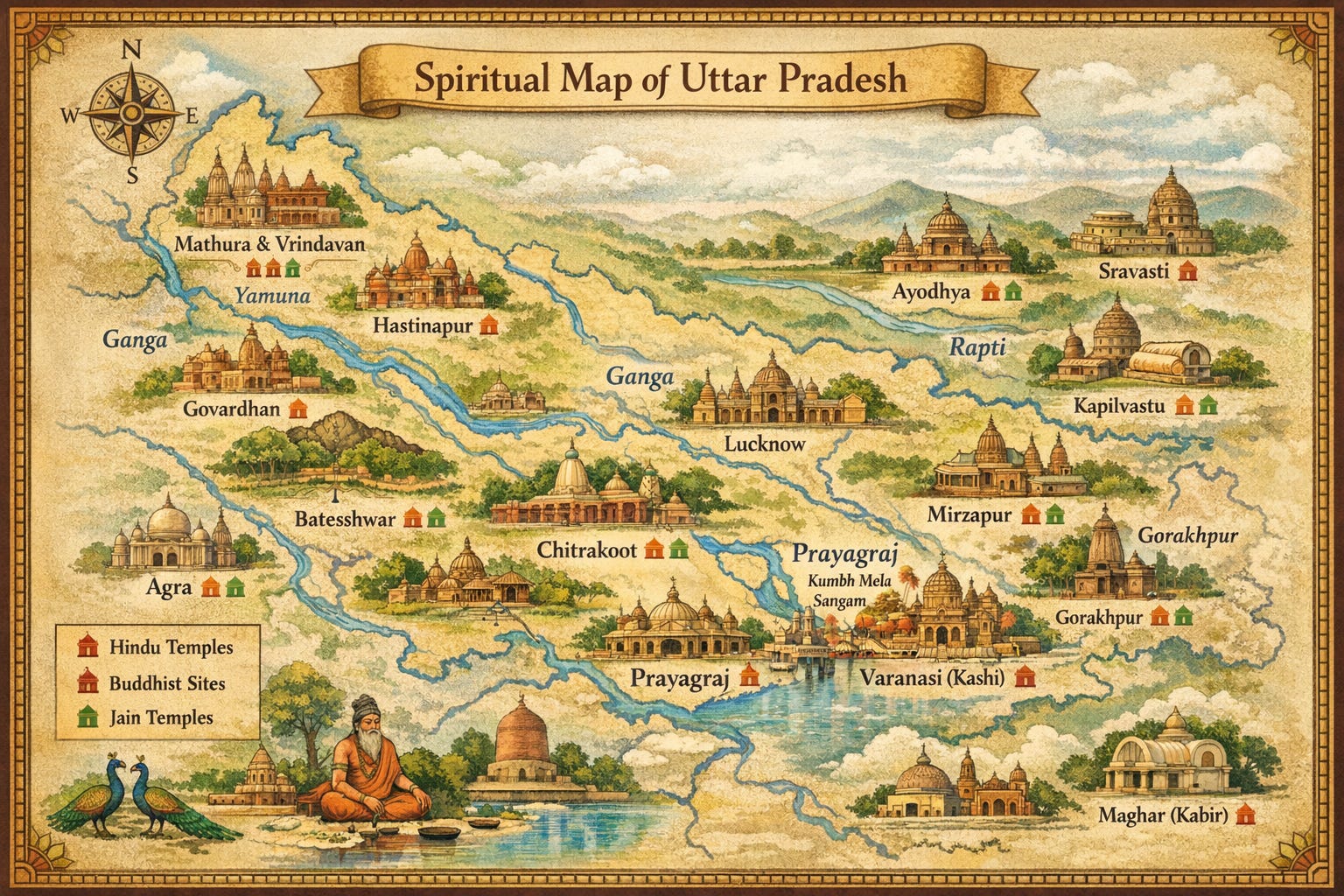
The Ganga as the Axis of Sacred Life
At the heart of Uttar Pradesh flows the Ganga - not merely as a river, but as a civilisational principle. Entire spiritual systems have evolved along her banks, shaping how liberation, duty, devotion, and knowledge are understood.
The river creates a moksha corridor, anchored by three defining centres:
Kashi (liberation)
Sarnath (awakening)
Prayagraj (cosmic convergence)
Kashi: Where Time Dissolves
Kashi, also known as Varanasi, is regarded as the oldest continuously living spiritual city in the world. Tradition holds that Kashi exists outside ordinary time - never created and never destroyed.
Key Spiritual Characteristics of Kashi
Considered a direct abode of Lord Shiva
Central to the concept of moksha (liberation)
A city where life and death coexist openly
Sacred anchors of Kashi include:
Kashi Vishwanath Jyotirlinga – symbol of cosmic consciousness
Manikarnika Ghat – uninterrupted cremation, liberation rites
Dashashwamedh Ghat – collective devotion through daily Ganga Aarti
Assi Ghat – dawn rituals, yoga, Vedic chanting
Kalabhairava Temple – guardian of sacred Kashi
Kashi does not hide impermanence. Cremation grounds exist at the city’s core, reminding every visitor that liberation is not postponed until after life but contemplated during it. Acceptance, not denial, defines the spiritual temperament of Kashi.
Sarnath: The Geography of Compassionate Teaching
Just outside Kashi lies Sarnath, where Lord Buddha delivered the first sermon after enlightenment. The Dhamek Stupa marks the turning of the Wheel of Dharma, where inner realisation transformed into compassionate instruction.
Significance of Sarnath
Foundation of Buddhist monastic tradition
Emphasis on awareness, ethics, and middle path
Continuation of philosophical dialogue within Uttar Pradesh
The presence of Sarnath alongside Shaiva Kashi illustrates an essential truth: Uttar Pradesh has always allowed multiple spiritual answers to coexist, mature, and interact without erasing one another.
Prayagraj: Where the Visible Meets the Invisible
Prayagraj stands at the sacred Triveni Sangam, where:
Ganga (action)
Yamuna (devotion)
Saraswati (knowledge, unseen)
merge into one.
Pilgrimage here honours not only what is visible, but what is believed to flow invisibly. The act of bathing at the Sangam represents surrender to both known and unknown forces shaping human destiny.
Sacred Elements of Prayagraj
Triveni Sangam
Akshayavat (immortal banyan tree)
Bharadwaj Ashram
Kumbh Mela sacred geometry
The Kumbh Mela is not merely a gathering. It is a demonstration of sacred time, when cosmic alignments are believed to accelerate spiritual transformation.
Ayodhya: Dharma Lived Through Restraint
Ayodhya represents a shift from liberation to ethical living. As the birthplace of Shri Ram, Ayodhya embodies maryada - righteousness expressed through restraint, duty, and sacrifice.
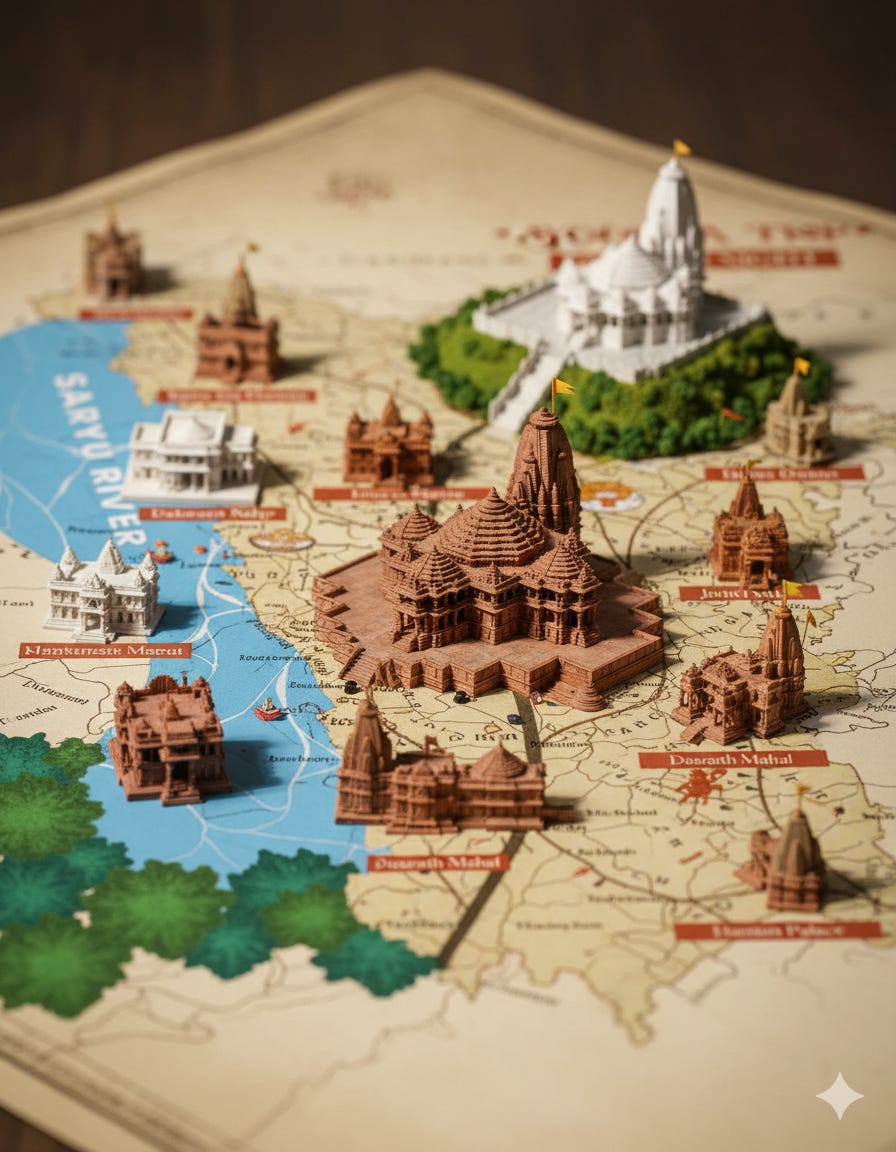
Spiritual Identity of Ayodhya
Centre of Ram Bhakti
Geography shaped by Ramayan narrative
Emphasis on ideal human conduct
Key sacred sites include:
Ram Janmabhoomi Mandir
Hanuman Garhi
Kanak Bhawan
Sarayu River ghats
Guptar Ghat
Ayodhya’s rhythm is gentle, reflective, and disciplined. Devotion here emphasises gratitude and responsibility rather than intensity.
Chitrakoot: Forests as Teachers
From Ayodhya, the Ramayan unfolds into Chitrakoot, where civilisation recedes and nature instructs. Chitrakoot is not defined by monumental temples but by paths, hills, and rivers.
Core Spiritual Elements
Kamadgiri Parikrama
Mandakini River
Bharat Milap Sthal
Sati Anusuya Ashram
Spiritual progress here is circular, not linear. Walking replaces proclamation. Silence replaces instruction.
Braj: Where Devotion Becomes Love
The Braj region expresses Bhakti in its most intimate form. Where Ram teaches discipline, Krishna teaches surrender through love.
Mathura and Vrindavan
Krishna Janmabhoomi
Dwarkadheesh Temple
Banke Bihari Temple
Radha Raman Temple
ISKCON Vrindavan
Nidhivan and Seva Kunj
Devotion here is emotional, musical, and spontaneous. Time dissolves. Structure softens. God is treated not as distant, but as always present and personal.
Govardhan and the Lesson of Humility
Govardhan Parikrama reinforces a core Krishna teaching:
Faith over fear
Humility over power
Nature as divine shelter
Circumambulation becomes embodied theology.
The Buddhist Dhamma Path: Silence as Instruction
The Buddhist pilgrimage route through Uttar Pradesh remains one of the most complete in the world.
Key centres include:
Sarnath – first sermon
Shravasti – Jetavana Monastery
Kushinagar – Mahaparinirvana
The reclining Buddha at Kushinagar does not promise salvation. He demonstrates acceptance. Impermanence is not feared; it is understood.
Nath, Yogi & Ascetic Traditions
Beyond temples lies the inward path of yogis and ascetics.
Gorakhpur and the Nath Lineage
Gorakhnath Math
Nath yoga traditions
Influence on Hatha Yoga
Emphasis on discipline and self-mastery
Nearby districts preserve forest hermitages where tapasya continues away from public view.
Sant and Nirgun Bhakti Traditions
The Sant tradition, including Sant Kabir, emerged as a corrective to excess ritualism.
Key centres
Maghar (Sant Kabir Nagar)
Kabir Chaura (Varanasi)
Core teachings emphasise:
Inner truth
Ethical living
Direct experience over symbolism
District-Level Living Spiritual Ecosystems
Every district of Uttar Pradesh contributes uniquely:
Mirzapur – Shakti worship
Sitapur – Naimisharanya influence
Gonda & Basti – regional temple cultures
Rae Bareli & Sultanpur – village pilgrimage networks
Spiritual life here is decentralised, inherited, and continuous.
DharmikGuide by DharmikVibes: Restoring Context
DharmikGuide exists to reconnect pilgrims with:
Authentic rituals
Local custodians
Living traditions
Responsible sacred travel
The purpose is not speed, but depth and continuity.
Uttar Pradesh is not a destination.
Uttar Pradesh is a dharma mandala - always unfolding, always alive.
Every river bend teaches.
Every bell remembers.
Every footstep participates.
DharmikGuide by DharmikVibes invites seekers to enter this mandala consciously, respectfully, and completely - ensuring that Bharat’s spiritual heart continues to beat without interruption.
Seasonal Yatra Cycles: Time as a Spiritual Dimension
In Uttar Pradesh, spirituality is not only mapped across space; it is always organised through time. Pilgrimage here follows seasonal rhythms that align human movement with cosmic, agricultural, and ritual cycles. Sacred geography becomes fully intelligible only when viewed through the lens of the Indic sacred calendar.
Every season activates specific tirthas, rituals, and pilgrim flows.
Seasonal spiritual rhythms include:
Chaitra–Vaishakh (spring): Ram Navami in Ayodhya, forest yatras in Chitrakoot
Shravan (monsoon): Shaiva pilgrimages to Kashi, regional Shiva temples, Kanwar traditions
Kartika (autumn): Deepdan at ghats, Vrindavan parikramas, river rituals
Magh (winter): Prayagraj Magh Mela, Kalpavas traditions
Pilgrimage is therefore never random. Movement occurs when the land itself is considered spiritually receptive. Rivers swell, forests renew, and rituals intensify in accordance with cosmic order (rita).
Festivals as Living Theology
Festivals in Uttar Pradesh are not commemorations; they are reenactments of cosmic principles. Each festival temporarily transforms geography into a ritual field, where villages, cities, rivers, and forests become active participants.
Major Spiritual Festivals and Their Landscapes
Ram Navami – Ayodhya
Celebrates divine birth and righteous order
Entire city functions as a ritual mandala
Janmashtami – Mathura & Vrindavan
Night-long vigils, kirtans, and temple processions
Bhakti expressed through emotion and collective joy
Dev Deepawali – Kashi
Ghats illuminated in honour of divine descent
River worship reaches its symbolic peak
Kumbh & Magh Mela – Prayagraj
Ascetic congregations, Kalpavas
Sacred discourse, renunciation, and renewal
Festivals always renew sacred memory. They ensure that theology remains embodied, not abstract.
Rivers Beyond the Ganga: Supporting Sacred Networks
While the Ganga anchors Uttar Pradesh’s spiritual identity, supporting rivers shape regional pilgrimage ecosystems.
Sacred rivers include:
Yamuna – Braj region, Krishna leela geography
Sarayu – Ayodhya, Ram bhakti rituals
Mandakini – Chitrakoot, forest tapasya
Ghaghara & Rapti – regional temple cultures
These rivers do not compete with the Ganga; they extend her spiritual influence, allowing multiple devotional temperaments to flourish.
Village Temples and Gram Devta Traditions
Beyond renowned pilgrimage centres lies the true scale of Uttar Pradesh’s spirituality - its villages. Thousands of small temples, shrines, sacred groves, and ritual spaces anchor spiritual life at the local level.
Characteristics of Village Spirituality
Oral transmission over written scripture
Seasonal fairs (melas) tied to agriculture
Hereditary priests and caretakers
Collective participation rather than individualised worship
Gram devta worship preserves the earliest layer of Sanatan Dharma - one rooted in land, protection, fertility, and gratitude.
Temple Economies and Sacred Livelihoods
Spirituality in Uttar Pradesh has always sustained livelihoods. Temple towns function as sacred economies, supporting priests, artisans, musicians, flower sellers, boatmen, scribes, and cooks.
Living Temple Ecosystems Support:
Purohits and ritual specialists
Bhajan singers and storytellers
Craft communities (brass, stone, wood, cloth)
Pilgrim hospitality networks
Devotion and livelihood are never separated. Work itself becomes a form of seva.
Craft as Devotion
Artistic traditions across Uttar Pradesh are inseparable from spiritual life.
Sacred crafts include:
Temple brassware and ritual vessels
Handwoven textiles for deity adornment
Terracotta icons and votive offerings
Manuscript illumination and script copying
Craft communities do not merely produce objects; they preserve sacred aesthetics, ensuring that beauty remains aligned with meaning.
Education, Knowledge, and Transmission
Uttar Pradesh has always been a centre of learning - formal and informal.
Knowledge Systems Preserved Include:
Sanskrit pathshalas and gurukuls
Buddhist monastic education
Oral kathas and pravachans
Commentarial traditions
Knowledge transmission here is not industrial. It is relational, passed through proximity, repetition, and lived example.
Ascetics, Renunciants, and the Edge of Society
A defining feature of Uttar Pradesh’s spiritual landscape is the visible presence of renunciants. Sadhus, monks, yogis, and wandering seekers occupy the margins — physically and socially - yet remain central to the spiritual imagination.
They represent:
Withdrawal from accumulation
Experimentation with discipline
Embodied philosophy
Society supports them not because they are useful, but because they remind civilisation of its ultimate goals.
Pilgrimage as Inner Transformation
In Uttar Pradesh, pilgrimage is never tourism. It is a deliberate spiritual technology designed to:
Remove habitual comfort
Introduce physical effort
Encourage reflection through repetition
Walking, bathing, fasting, chanting - these practices slowly realign the pilgrim’s inner rhythm with the land’s spiritual cadence.
Modernity and the Challenge of Continuity
Modern infrastructure, urbanisation, and mass travel have transformed access to sacred sites. While accessibility has increased, context has often diminished.
Challenges include:
Speed replacing patience
Photography replacing presence
Consumption replacing participation
Preserving Uttar Pradesh’s spiritual integrity requires intentional stewardship.
DharmikGuide by DharmikVibes: Stewardship, Not Promotion
DharmikGuide operates on a single principle: sacred geography must remain intelligible.
It focuses on:
Authentic ritual access
Knowledgeable local custodians
Context-rich pilgrimage design
Sustainable community participation
The aim is continuity, not scale.
Uttar Pradesh as a Dharma Mandala
When viewed as a whole, Uttar Pradesh forms a dharma mandala - a spiritual field where:
Rivers function as arteries
Temples act as nodes
Forests provide retreat
Cities preserve memory
Villages ensure continuity
This mandala has always evolved without breaking.
Uttar Pradesh has never demanded belief.
It has always offered experience.
It does not impose answers.
It provides paths refined over millennia.
Every step here participates in something larger than the individual - a civilisation continuously remembering itself.
DharmikGuide by DharmikVibes exists to ensure that this remembering continues - carefully, respectfully, and without dilution - so that Uttar Pradesh remains not a relic of the past, but the living spiritual heart of Bharat. 🙏
Districts as Living Spiritual Units, Not Administrative Divisions
In Uttar Pradesh, districts are often misunderstood as modern bureaucratic boundaries. Spiritually, however, each district functions as a living unit of practice, shaped by rivers, temples, seasonal rituals, forests, fairs, and inherited memory. Administrative borders may shift, but spiritual influence never obeys paperwork.
Every district holds a distinct temperament. Some are introspective and ascetic, others celebratory and musical. Some preserve ancient silence, others thrive on ritual intensity. Together, they form a mosaic where no single place carries the full meaning alone.
Understanding Uttar Pradesh requires recognising that pilgrimage does not move randomly. Pilgrims circulate between districts in patterns shaped over centuries - often following rivers, forest belts, or mythic routes rather than roads.
Varanasi District: The Axis of Liberation
Varanasi district functions as the spiritual axis of the state. It draws seekers at every stage of life - students, householders, renunciants, and the dying - because it addresses the ultimate question: What remains when everything ends?
Here, spiritual life is not compartmentalised. Sanskrit learning occurs beside cremation grounds. Temple bells ring while funeral chants rise. The city never resolves this paradox because it does not need to. Acceptance itself becomes instruction.
The presence of Sarnath within the same district reinforces Kashi’s philosophical depth. Awareness and liberation exist side by side, reminding the seeker that compassion and transcendence are not separate goals.
Ayodhya District: Ethical Geography
Ayodhya district holds a quieter authority. Its power lies not in intensity but in moral gravity. The city teaches that divinity expressed through restraint shapes society more enduringly than power expressed through conquest.
Pilgrims here often move slowly, reflectively. The Sarayu River does not rush. Temples invite humility rather than spectacle. Ayodhya’s spiritual influence extends deep into surrounding villages, where Ramayan kathas, seasonal fairs, and domestic rituals continue without institutional oversight.
Ayodhya demonstrates how values are sustained geographically - not through enforcement, but through repetition and example.
Chitrakoot District: Forest Memory and Renunciation
Chitrakoot district preserves one of the oldest spiritual intuitions of Bharat: that wisdom often emerges away from civilisation. Its hills, forests, and rivers have always attracted renunciants, sages, and those in transition.
Unlike temple-centric regions, Chitrakoot emphasises movement through landscape. Parikrama replaces congregation. Natural landmarks replace architecture. Spiritual effort becomes embodied in walking, fasting, and silence.
This district teaches that spiritual depth does not require grandeur - only sincerity and endurance.
Mathura District: Birthplace of Emotional Devotion
Mathura district holds the intensity of origin. As the birthplace of Shri Krishna, it anchors a devotional universe that extends far beyond geography. Pilgrims arrive not to seek answers, but to enter relationship.
Here, devotion is expressive. Temples resound with music. Rituals overflow into streets. Emotion is not controlled; it is offered.
Mathura’s influence spreads into surrounding districts, shaping the entire Braj region into a unified devotional field where love itself becomes discipline.
Vrindavan and Govardhan: Sacred Play and Surrender
Though administratively linked to Mathura, Vrindavan and Govardhan function spiritually as a world apart. Time behaves differently here. Daily schedules bend to devotional mood. Pilgrims often lose urgency, discovering that surrender requires release from structure.
Govardhan Parikrama, repeated countless times by devotees, embodies an insight central to Bhakti: that faith, humility, and persistence outweigh spectacle.
This region teaches not how to control devotion, but how to allow devotion to reshape the self.
Prayagraj District: Confluence of Paths
Prayagraj district always operates as a meeting point - of rivers, traditions, and seekers. It does not privilege one spiritual temperament over another. Ascetics, householders, philosophers, and pilgrims converge here without hierarchy.
The practice of Kalpavas during Magh Mela reflects a core Indic insight: that temporary withdrawal can renew permanent engagement with life. Pilgrims live simply on the riverbanks, suspending ordinary routines to reorient priorities.
Prayagraj teaches balance - between withdrawal and return.
Mirzapur District: Shakti and Sacred Terrain
Mirzapur district draws its spiritual power from terrain itself. Hills, forests, and riverbanks support Shakti worship that emphasises protection, endurance, and energy.
Vindhyavasini Devi represents a tradition older than temples - one that recognises feminine power as foundational to life and civilisation. Pilgrimage here often involves physical exertion, reinforcing the idea that strength and devotion are inseparable.
Gorakhpur District: Discipline and Inner Authority
Gorakhpur district preserves the Nath yogic lineage, where spirituality is approached as methodical self-mastery. Gorakhnath Math remains a centre where discipline, bodily awareness, and mental control are treated as sacred technologies.
The influence of this district extends across eastern Uttar Pradesh, shaping attitudes toward yoga, asceticism, and spiritual responsibility.
Shravasti and Kushinagar: Quiet Instruction
Shravasti and Kushinagar districts speak softly. Their ruins do not shout history; they whisper continuity. Monastic life here emphasised restraint, discipline, and community - values that remain embedded in the land’s atmosphere.
Pilgrims often report a distinct stillness in these regions, a slowing of internal dialogue. Instruction occurs without words.
Sant Kabir Nagar: Inner Truth Over Display
Sant Kabir Nagar district preserves a tradition that challenges excess without rejecting devotion. Kabir’s teachings remind seekers that ritual must serve transformation, not replace it.
Maghar stands as a powerful symbol - demonstrating that liberation is not bound to geography alone, but to awareness cultivated within it.
Festivals as District-Level Renewal
Each district maintains its own festival calendar, ensuring that spiritual memory renews locally rather than centrally.
These festivals:
Reaffirm community bonds
Transmit stories across generations
Align agricultural cycles with spiritual meaning
Spiritual life here remains participatory, not performative.
Pilgrim Psychology: Why Seekers Return
Pilgrims do not visit Uttar Pradesh once. They return repeatedly. The land does not exhaust itself because it does not offer closure. Each journey reveals a different layer - shaped by age, intention, and inner readiness.
Return itself becomes part of the practice.
Continuity Through Imperfection
Uttar Pradesh has never been pristine. It has always been crowded, noisy, contradictory, and demanding. Its power lies not in perfection, but in persistence.
Spirituality here survives because it adapts without abandoning core principles.
Stewardship as Responsibility
Preserving this spiritual ecosystem requires humility. Development must proceed without flattening context. Access must expand without erasing depth.
DharmikGuide by DharmikVibes approaches stewardship as a shared responsibility - between pilgrims, communities, and custodians.
Uttar Pradesh does not conclude.
It continues.
It always has.
Rivers shift, cities grow, languages change - yet the essential questions remain, carried by footsteps, chants, and silence.
To walk here is to join a conversation older than history, one that never ends but always evolves.
DharmikGuide by DharmikVibes exists to ensure that this conversation remains audible, meaningful, and alive - not frozen in memory, but carried forward with care.
Sacred Food, Prasadam, and the Spiritual Ecology of Nourishment
In Uttar Pradesh, food has always been more than sustenance. It functions as ritual, offering, and social glue, linking temples, pilgrims, householders, and ascetics into a shared spiritual economy. Prasadam is not symbolic charity; it is theology made edible.
Every major tirtha in the state sustains a distinctive food culture shaped by local crops, seasonal availability, and ritual prescription. In Kashi, simple satvik meals reflect renunciation and impermanence. In Braj, sweets, milk-based offerings, and seasonal fruits express abundance, affection, and joy. In forest regions like Chitrakoot, food remains austere, aligned with tapasya rather than indulgence.
Prasadam traditions serve several spiritual functions simultaneously:
They dissolve social hierarchy through shared eating
They ritualise gratitude toward land and labour
They bind the pilgrim physically to the sacred place
Langar-like community feeding, temple kitchens, seasonal bhandaras, and household offerings together ensure that no pilgrimage is detached from nourishment, and no nourishment is detached from meaning.
Craft, Temple Aesthetics, and the Continuity of Sacred Beauty
The visual language of Uttar Pradesh’s spirituality has always been maintained through craft. Temples do not appear spontaneously; they are dressed, adorned, repaired, and renewed daily by human hands trained through generations.
Stone carving, brass casting, woodwork, textile weaving, flower garland making, and manuscript preparation form the aesthetic backbone of the spiritual ecosystem. These crafts are never decorative alone. Each carries symbolic grammar - proportions, motifs, colours, materials - refined through centuries of use.
Temple artisans rarely sign their work. Their identity is absorbed into continuity. Skill is passed from parent to child, apprentice to master, often without formal documentation. Knowledge survives through repetition, correction, and ritual context rather than manuals.
This anonymity is not loss. It is civilisational humility, where preservation outweighs personal recognition.
Sound, Silence, and the Sacred Use of Voice
Uttar Pradesh’s spiritual landscape is defined as much by sound as by sight. Bells, conch shells, mantras, bhajans, and chants structure daily life, marking transitions between mundane and sacred time.
In Kashi, the soundscape is dense - overlapping chants, funeral hymns, aartis, and debate. In Buddhist regions, sound thins, giving way to measured chanting and long silence. In Braj, music dominates, with devotional singing dissolving boundaries between performer and listener.
Silence itself holds ritual weight. Forest hermitages, ruined monasteries, early morning ghats, and late-night temple interiors offer spaces where absence of sound becomes instruction. Uttar Pradesh understands silence not as emptiness, but as presence without articulation.
Pilgrim Conduct: Ethics of Sacred Movement
Pilgrimage in Uttar Pradesh has always carried implicit ethical expectations. Movement through sacred space demands restraint, humility, patience, and respect. Traditional pilgrim conduct was shaped by oral instruction rather than signage.
Key ethical principles include:
Walking where possible, rather than rushing
Avoiding disruption of rituals not one’s own
Accepting discomfort as part of transformation
Offering gratitude to custodians, not entitlement
When these principles erode, pilgrimage becomes consumption. When preserved, pilgrimage remains inner discipline expressed externally.
Restoring pilgrim ethics is as important as restoring temples.
Women, Householders, and Invisible Custodianship
Spiritual narratives often foreground ascetics and kings, yet Uttar Pradesh’s continuity rests heavily on householders, particularly women. Daily puja, seasonal fasts, festival preparation, oral storytelling, and domestic transmission of values sustain spiritual life far from institutional centres.
Household shrines, vrata observances, lullabies, and kitchen rituals form an unbroken pedagogical system. Children absorb dharma not through doctrine, but through participation.
This domestic spirituality ensures resilience. When empires fall and temples decay, household practice persists.
Crisis, Adaptation, and Spiritual Resilience
Uttar Pradesh has endured invasions, political upheaval, ecological stress, and social change. Its spiritual systems survived not by rigidity, but by adaptive resilience.
Rituals simplified when resources declined. Oral traditions intensified when texts were lost. Forest shrines replaced temples when cities became unstable. Pilgrimage routes shifted without erasing purpose.
This adaptability explains why the spiritual map remains intact despite centuries of disruption. Continuity here is functional, not fossilised.
The Modern Seeker and the Risk of Fragmentation
Contemporary seekers arrive with curiosity but often without context. Digital information accelerates access but fragments understanding. Sacred sites risk becoming isolated experiences rather than integrated journeys.
Without narrative coherence, the land loses intelligibility. Temples become stops, not stages of transformation.
Rebuilding coherence requires:
Contextual storytelling
Slower, intention-driven movement
Respect for local rhythm
Willingness to learn before consuming
Spiritual depth cannot be downloaded. It must be entered.
DharmikGuide by DharmikVibes: A Framework for Continuity
DharmikGuide exists not to invent new traditions, but to re-weave existing ones. It functions as connective tissue between places, people, practices, and meaning.
Its role is to:
Restore narrative continuity across geography
Empower local custodians rather than replace them
Enable pilgrims to move with awareness
Preserve spiritual integrity while allowing access
The goal is stewardship, not scale.
Uttar Pradesh as a Civilisational Responsibility
Uttar Pradesh does not belong only to those who live there. It belongs to the civilisation that shaped it and continues to draw from it. With belonging comes responsibility.
Preserving sacred geography requires:
Patience over speed
Context over convenience
Respect over entitlement
Future generations will inherit not only temples and rivers, but the quality of attention with which they were treated.
The Mandala That Never Closes
Uttar Pradesh is not a chapter in history.
It is a continuing sentence.
Its rivers keep teaching.
Its forests keep withdrawing.
Its cities keep remembering.
Its villages keep practising.
This land has always asked the same questions and offered many paths toward response. It has never demanded agreement - only participation.
To walk here consciously is to join a civilisational rhythm far older than individual belief and far larger than personal identity.
DharmikGuide by DharmikVibes stands as a quiet facilitator of this rhythm - ensuring that Uttar Pradesh remains not an archive of the sacred, but its most enduring living expression.