

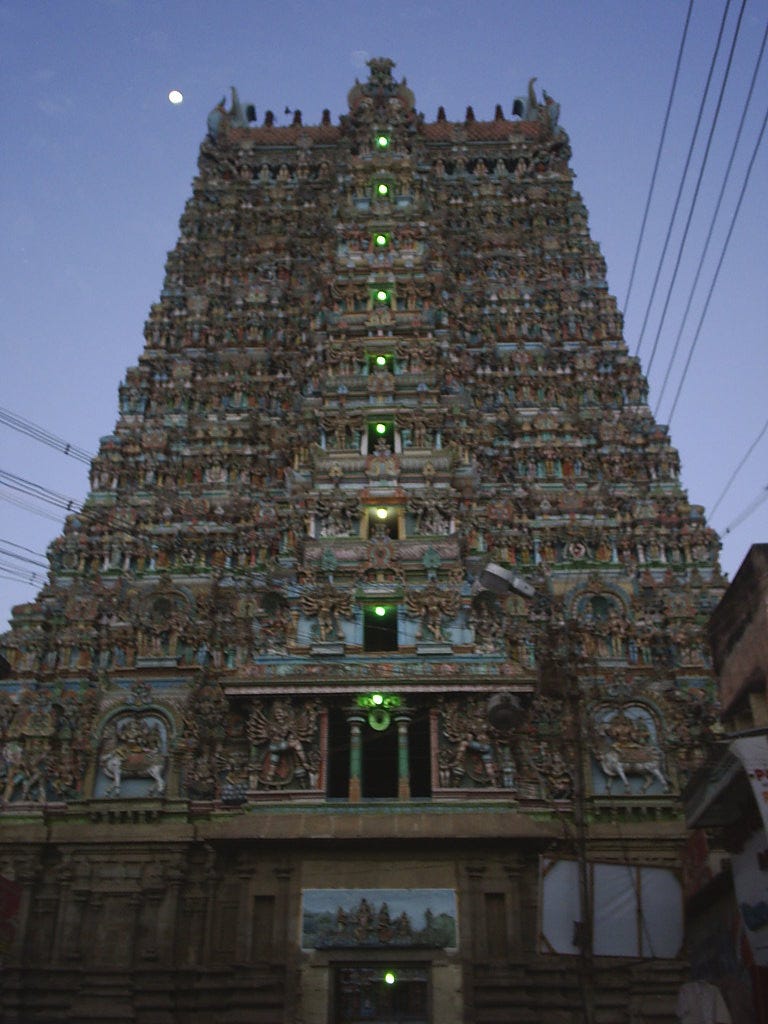
Photo: Karthik.raman at English Wikipedia, public domain, via Wikimedia Commons
A Hindu temple is not a museum with rituals in it. It is a living home of a deity, and visitors, including non-Hindus, are welcome at most temples as long as the customs of the house are respected. If you are travelling in India or visiting a temple in your own city for the first time, this guide covers what actually happens at the door and inside, so nothing feels confusing.
Before you go
Every temple sets its own rules, and they can be stricter than you expect. Two well-known examples: Tirumala Tirupati asks pilgrims to wear traditional dress (dhoti or kurta-pyjama for men, saree or salwar kameez with dupatta for women), and Swaminarayan Akshardham in Delhi does not allow phones, cameras or bags inside at all. Check the specific temple's visitor page before you leave your hotel, and carry a small bag you can fold into a pocket if needed.
Dress modestly, remove your shoes
The baseline everywhere: cover shoulders and knees, avoid shorts and sleeveless tops, and dress as you would for a formal family occasion. You will remove your shoes before entering; every temple has a designated shoe stand, usually free or for a token amount. Socks are fine. Floors can be warm in the afternoon sun, so mornings and evenings are kinder.
What darshan actually is
Darshan means seeing the deity and, in the tradition, being seen back. You will join a queue that leads past the garbhagriha, the inner sanctum where the murti (the consecrated image) resides. A few points of grace here:
Fold your hands or keep them still; do not point your feet toward the deity when sitting.
Do not touch the murti or the offerings around it.
The queue moves steadily; you may get only a few seconds in front of the sanctum, and that is normal.
Only priests enter the innermost sanctum in most temples.
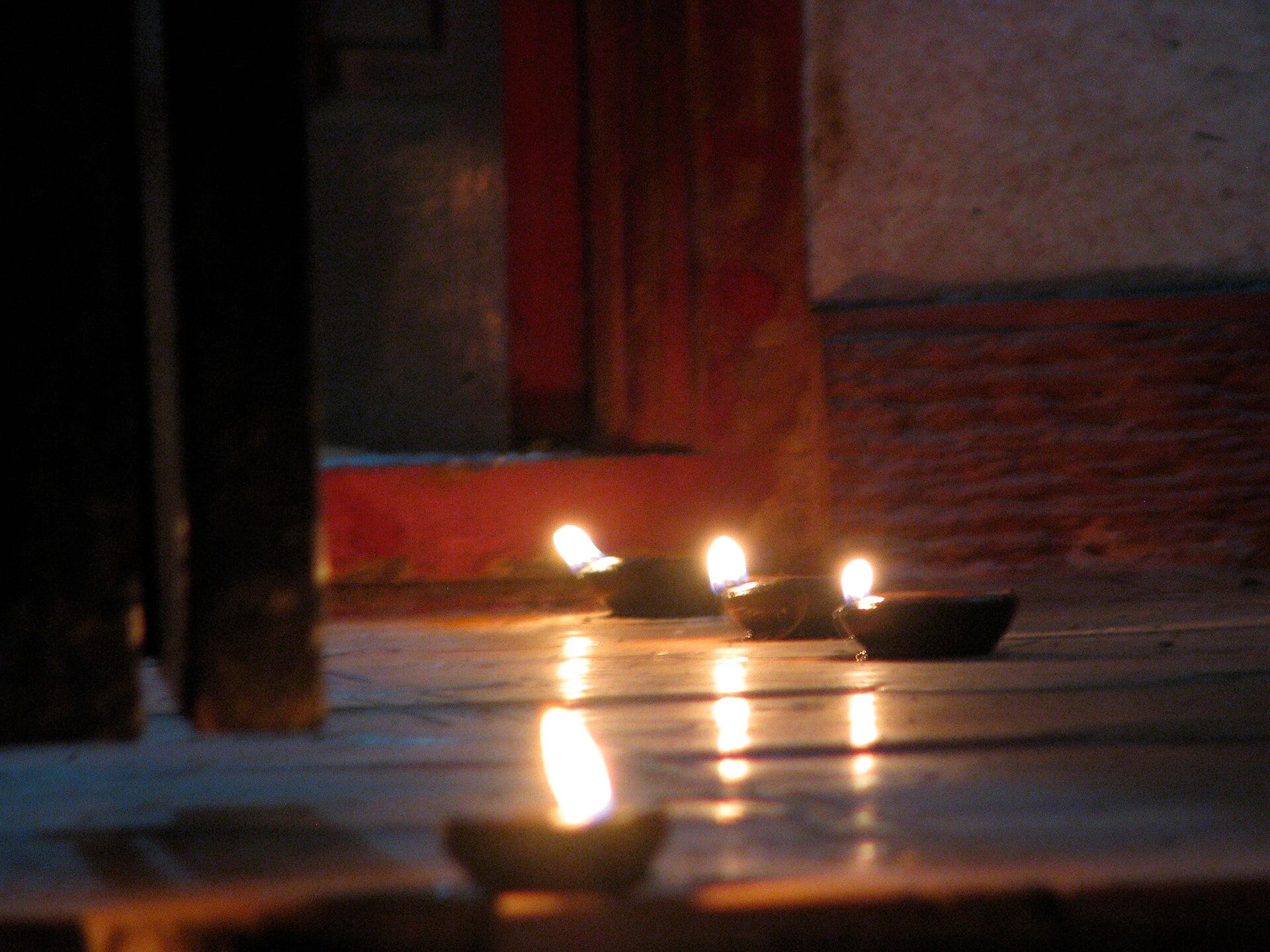
Photo: McKay Savage from London, UK, CC BY 2.0, via Wikimedia Commons
Pradakshina, prasad and the priest
Many visitors walk a slow clockwise circle around the sanctum after darshan; this is pradakshina, always clockwise, keeping the deity on your right. A priest may offer you a tilak (a mark on the forehead), holy water (tirtha) cupped into your right palm, or prasad, food offered to the deity and then shared. Accept all of these with your right hand. A small dakshina, an offering of money to the priest or the donation box, is customary but modest; ten or twenty rupees is perfectly acceptable.
Photography and phones
Rules vary widely and are strictly enforced. Many temples ban photography inside entirely; most ban it in the sanctum. Assume no photos inside unless a sign or a guard clearly says otherwise, and silence your phone before entering.
Time your visit with aarti
The most moving moment for a first visit is aarti, the ceremony of lamps, usually held at dawn and around sunset. Lamps are circled before the deity while bells ring and devotees sing. Our piece Why We Circle the Flame explains what the ritual means, which will make watching it far richer.
A note on entry restrictions
A small number of temples, among them Puri's Jagannath Temple and Kerala's Guruvayur, restrict entry into the temple to Hindus by long-standing custom. Most temples across India and abroad welcome all respectful visitors, and large temple towns like Varanasi, Madurai, Mathura and Haridwar are used to international guests. When in doubt, ask at the gate; temple staff answer this question kindly and often.
Come with patience and bare feet, and a temple will show you what devotion looks like when it is a daily habit rather than an occasion. At DharmikVibes, our vision is to enable every seeker, from any country, to experience these sacred spaces with understanding and confidence.
Sources
Offerings, dakshina and prasad
Carry small change and a few notes for offerings; temples usually have a hundi (offering box) and official counters for archana tickets and prasad. Buy archana or special darshan tickets only from the temple's own counter or official website, and keep the receipt. Dakshina to a priest who has performed a seva for you is a personal gesture; there is no fixed rate, and no genuine priest will demand a figure. Prasad received at the sanctum is taken with the right hand, often over a cloth or the left palm, and shared, never wasted.
Visiting with children and elders
Temples reward a little planning. Fix a meeting point in case anyone wanders in the crowd. Keep children close in queue lines where the press of people can surprise them. For elders, ask at the entrance about wheelchair access or a shorter darshan line; most large temples have some provision, but it is rarely signposted well. Mornings are kinder for both groups: shorter queues, cooler stone underfoot, and a calmer sanctum.
Photography and phones
Rules differ sharply by temple. Many allow photos in the outer courtyards but strictly prohibit them inside the sanctum; some prohibit phones altogether and provide lockers. Look for the signboards at the entrance, and when in doubt, put the phone away before the inner doorway. No photograph is worth the discomfort of being stopped mid-darshan, or the disrespect of pointing a camera at someone else's prayer.