

Once every twelve years, a planet decides the geography of faith.
When Brihaspati - Jupiter, the guru of the gods - enters Simha Rashi, the sign of the lion, the Godavari at Nashik is said to turn to nectar. This is not a date chosen by a committee or a tourism board. It is a muhurta written into the sky, the same alignment that, according to the legend of the Samudra Manthan, once let drops of amrit fall to earth at four sacred places. Nashik was one of them. And so, when the planets return to their appointed positions, millions return with them.
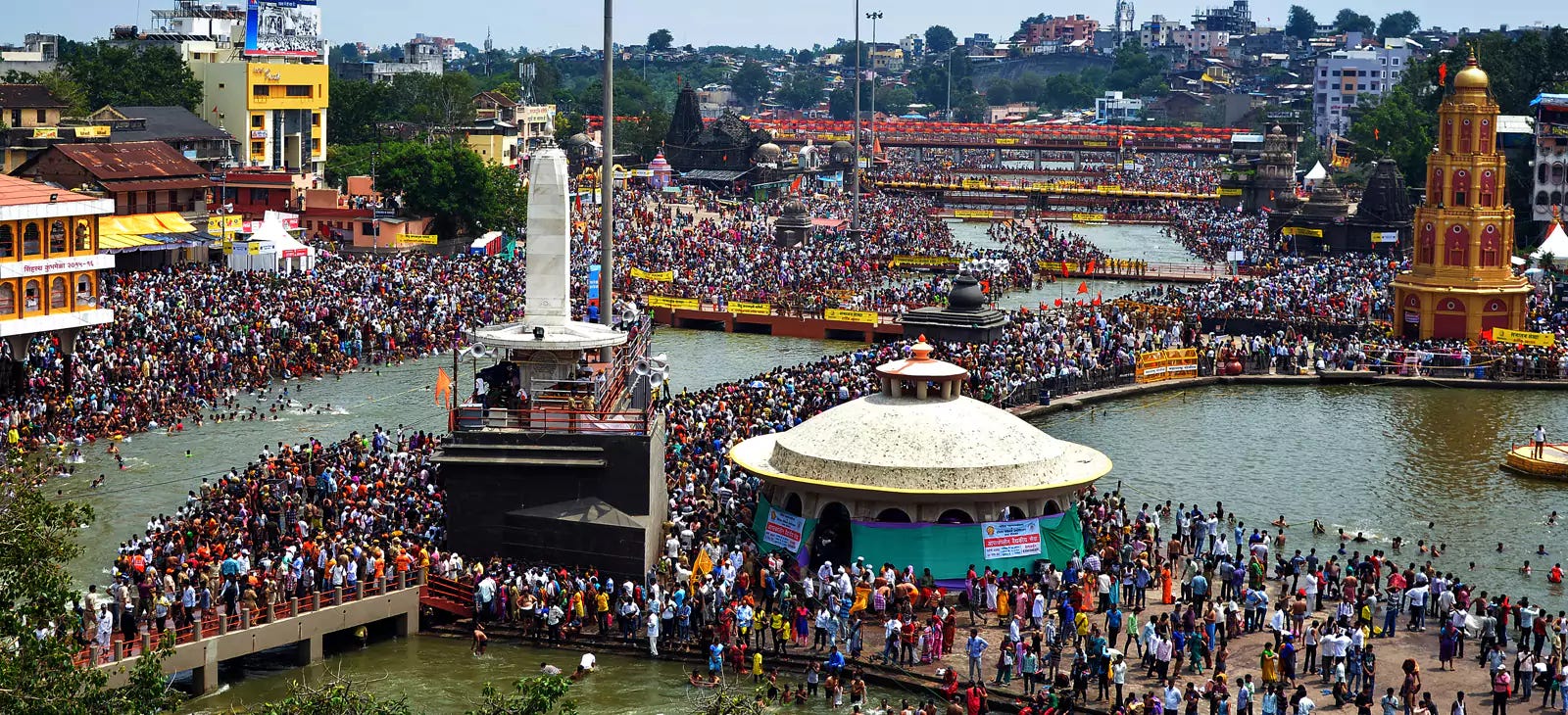
This is the Simhastha — the Nashik–Trimbakeshwar Kumbh — and in 2027 it will gather a scale of humanity that is difficult to hold in the mind.
A pilgrimage written in two scripts
Most people speak of “the Nashik Kumbh” as a single event. It is closer to two pilgrimages braided together.
About thirty kilometres apart, two sacred geographies will come alive at once. At Nashik, on the ghats of Panchavati, the Vaishnava akharas — devotees of Vishnu — descend into the Ramkund, the same waters where Lord Rama is believed to have bathed during his exile. At Trimbakeshwar, where the Godavari is born from the Kushavarta Kund, the Shaiva akharas gather beneath one of the twelve Jyotirlingas of Mahadev. Two traditions, two rivers of people, one cosmic appointment.
The rhythm is long. The Simhastha does not begin and end in a weekend. It opens with the Dhwajarohan, the ceremonial hoisting of the flag, in late October 2026, and it will not formally close until the flag is lowered in the monsoon of 2028 — nearly twenty-one months of sacred time. Within that long arc, the great royal baths, the Shahi Snans, fall across August and September 2027, when the Naga sadhus process to the water in a spectacle that has not broken its thread in centuries.
The figure now being spoken of for this Simhastha is staggering: close to twenty crore pilgrims, saints and seekers over the cycle. Twenty crore. It is among the largest peaceful human gatherings the world has ever attempted.
And here is the quiet truth hidden inside that number: twenty crore people will not simply visit Nashik. They will move through a region. What they leave behind — or fail to leave behind — may matter more than the bath itself.
The question that begins after the last pilgrim goes home
There is a familiar way to think about a Kumbh, and it is the language of crowd management. How many will come. How will they be moved. How will the ghats hold, the roads clear, the water stay clean. These are real and serious questions, and the people who answer them carry an extraordinary weight.
But there is a second question, less often asked, and it is the more interesting one.
What remains when the crowd disperses?
A Kumbh that is only managed is a Kumbh that ends. The tents come down, the temporary city dissolves back into fields, and the region waits another twelve years. But a Kumbh that is built around — one treated as the founding moment of an ecosystem rather than a one-time surge — can leave behind something that compounds long after the last devotee has dried their feet and gone home.
This is the shift worth naming. From crowd management to ecosystem building. From pilgrimage to destination development. From tradition to technology-enabled experience. Each of these is a sentence about the same idea: that a once-in-twelve-years event can become the foundation of a year-round sacred geography.
The corridor
Geography is generous to Maharashtra here.
A pilgrim drawn to the Godavari for the Simhastha is already within reach of some of the most resonant destinations in the country. Shirdi sits a short journey away, holding its own steady stream of the faithful through every month of every year. Trimbakeshwar is not only a Kumbh site but a permanent Jyotirlinga pilgrimage. The Sahyadris, the wine country around Nashik, the older temple towns and the river itself — all of it lies along the same threads of road and rail that the Kumbh will, for a season, flood with people.
When twenty crore visitors pass through, even a small fraction who stay an extra day, or who return in a quieter month, can reshape the economics of an entire region. This is the spillover that turns an event into an inheritance. The Simhastha need not be a spike on a chart. It can be the moment a year-round spiritual tourism corridor across Maharashtra is finally built — one where the infrastructure, the hospitality, the guides and the stories created for 2027 keep working in 2028, 2029, and the long ordinary years that follow.
The corridor is the difference between a flood and a river. A flood leaves silt and memory. A river feeds a valley for generations.
The pilgrim is changing
Something is shifting in who comes to the water, and it is easy to miss.
For a long time, the assumption was that pilgrimage belonged to the old and the dutiful — a thing one did near the end of a life, or because a family expected it. That assumption is quietly collapsing. A new generation is arriving at these journeys not out of obligation but out of choice — looking for meaning, for rootedness, for an encounter with something older and steadier than the scroll of a phone.
For this generation, the Kumbh is not only a religious gathering. It is a place where culture, technology, entrepreneurship and identity meet. It is, in the truest sense, a platform — for innovation, for cultural confidence, for a kind of nation-building that happens not through slogans but through the simple act of a young Indian deciding that this story is theirs to carry forward.
If the Simhastha is designed with these seekers in mind — if it speaks their language without losing its own — it will not merely survive the generational handover. It will be renewed by it.
Tradition, carried by technology
None of this asks the Kumbh to become less sacred. It asks the experience of it to become less brittle.
A devotee travelling to the Godavari today should not have to navigate the journey blind — uncertain of the bathing dates, the safe routes, the right ghat, the trustworthy place to stay, the verified guide, the puja done correctly rather than hurriedly. Technology, used well, is not a contamination of devotion. It is the quiet hand that removes friction so the sacred moment can actually be felt. A well-built digital layer can hold the schedule, the geography, the language, the logistics — so that the pilgrim is free to do the one thing they came twelve years to do: stand in the water and let a lifetime of weight dissolve.
Done at scale, this is its own kind of seva. To carry a hundred million people gently is no smaller an act of devotion than to carry one.
The road has already begun
The planets are not in a hurry, but we should be. The flag rises in late 2026. The great baths fall in 2027. The corridor — if it is to exist at all — is being decided now, in 2026, in the choices made long before the first akhara reaches the river.
The scale is immense. So is the opportunity. The Simhastha 2027 is not only twenty crore footsteps toward the Godavari. It is a chance to build something that outlasts every one of them — a living corridor of faith across Maharashtra, warm in the ordinary months, ready for the extraordinary ones.
When Jupiter leaves Leo and the crowds go home, the question will not be how many came. It will be what we chose to leave behind.
At DharmikVibes, we believe a pilgrimage does not end at the water’s edge. If Simhastha 2027 is on your heart, let us help you walk it well - with verified dates, trusted guides, and journeys crafted with the care this moment deserves.
We do not organise yatras. We craft sacred journeys.
Har Har Mahadev.