

There is something extraordinary about the darshan of Shri Banke Bihari Ji in Vrindavan. Just when a devotee becomes absorbed in looking at the beautiful form of Thakur Ji, the curtain closes. A few moments later, it opens again, allowing another glimpse of the deity.
This happens repeatedly during darshan. For someone visiting the temple for the first time, it may seem unusual. But for devotees familiar with the traditions of Braj, this is an expression of a very special relationship between the Lord and His devotees.
To understand Banke Bihari Temple, one must understand the spirit of Vrindavan, where Krishna is worshipped not only as the Supreme Lord but also as the beloved child, friend and eternal companion of His devotees.
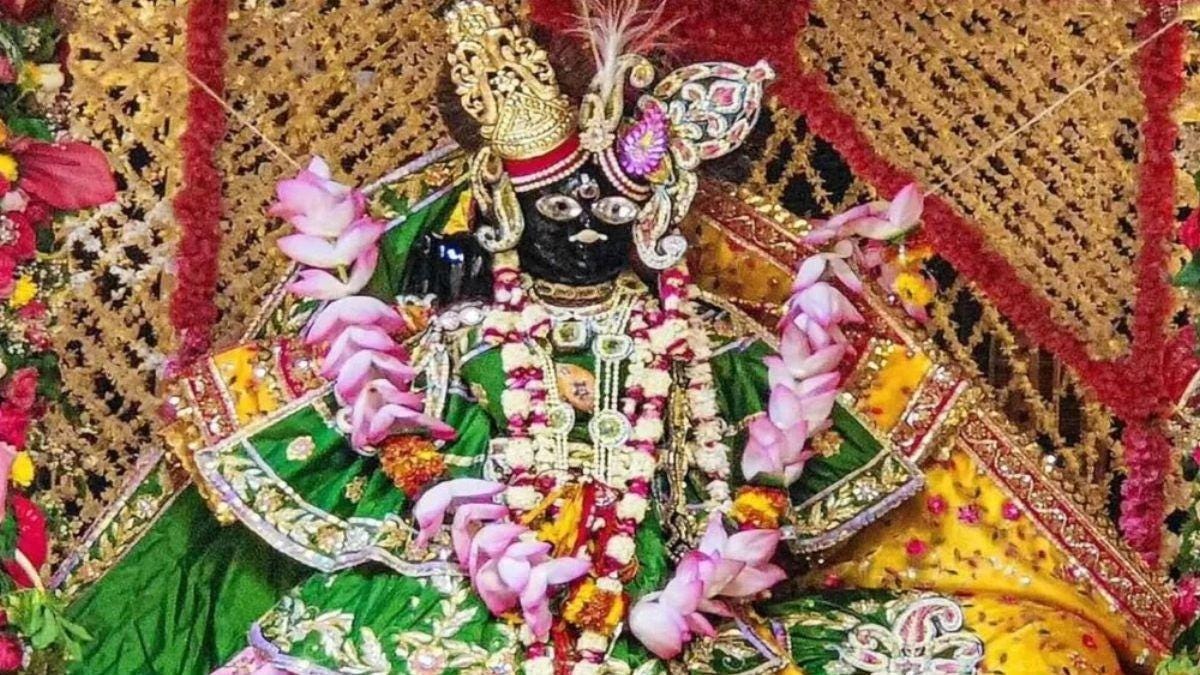
The Divine Appearance of Shri Banke Bihari Ji
The history of Shri Banke Bihari Ji is closely associated with Swami Haridas Ji, the great saint, musician and Krishna devotee of the 16th century.
According to the traditional account preserved by the temple, Swami Haridas Ji worshipped Radha and Krishna with immense devotion at Nidhivan in Vrindavan. Pleased with his devotion, Radha and Krishna appeared before him in their combined divine form.
At the request of devotees, this divine form manifested as Shri Banke Bihari Ji.
The deity was initially worshipped at Nidhivan. Later, a temple was established to provide a dedicated place for devotees to offer their prayers.
The name Banke Bihari itself describes the beautiful form of Krishna. ‘Banke’ refers to His gracefully bent posture, while ‘Bihari’ refers to the one who enjoys divine pastimes.
His threefold-bent form is one of the most recognisable representations of Krishna in the devotional traditions of Braj.
Why Does the Curtain Close During Darshan?
Among all the traditions of Banke Bihari Temple, the repeated closing of the curtain is perhaps the most distinctive.
According to the temple’s traditional belief, the beauty of Banke Bihari Ji’s eyes is so captivating that a devotee may become completely absorbed in His divine presence. The curtain is therefore opened and closed at intervals.
This tradition is not simply a matter of temple arrangement. It reflects the intimate devotional relationship that devotees experience with Thakur Ji.
In the devotional culture of Vrindavan, Krishna is approached with affection and familiarity. Devotees sing to Him, speak to Him and lovingly participate in His daily worship.
Every glimpse of Banke Bihari Ji becomes an opportunity to experience that relationship.
Why Is There No Daily Mangala Aarti?
Another unusual tradition at Banke Bihari Temple is the absence of daily Mangala Aarti.
In most Krishna temples, Mangala Aarti is performed early in the morning to awaken and worship the deity. However, the tradition at Banke Bihari Temple is different.
Here, Thakur Ji is worshipped with the affection given to a beloved child. The temple tradition considers His rest important, and therefore daily early morning Mangala Aarti is not performed.
It is conducted only once a year, on Janmashtami.
This practice reflects the distinctive style of seva followed at the temple, where the deity’s daily routine is treated with the same tenderness and care that a family gives to its child.
The Spirit of Madhurya Bhakti in Vrindavan
To understand the devotion at Banke Bihari Temple, it is important to understand Madhurya Bhava.
In the Bhakti tradition, Madhurya Bhava refers to approaching the Divine through the language of intimate, loving devotion. In Vrindavan, this devotion is expressed through the love of the Gopis, the affection of Yashoda Maiya and the companionship of Krishna’s friends.
This is why Krishna worship in Braj feels so personal. He is not distant from His devotees. He is the centre of their everyday lives, celebrations, songs and prayers.
The traditions of Banke Bihari Temple beautifully reflect this devotional approach.
A Visit to Banke Bihari Temple
A visit to Vrindavan is incomplete without seeking the blessings of Shri Banke Bihari Ji.
The temple is situated in the heart of Vrindavan and attracts devotees throughout the year. Visitors can also explore Nidhivan, Shri Radha Raman Temple and other sacred places associated with Krishna’s divine pastimes.
Before visiting, it is advisable to check the temple’s seasonal darshan timings, as the schedule changes between summer and winter.
The narrow lanes around the temple, the continuous chanting of Radhe Radhe and the devotion of thousands of pilgrims create an atmosphere that is distinctly Braj.
The Blessing of One Glimpse
The beauty of Banke Bihari Temple lies not only in its history or its unique rituals, but in the devotion that brings people here generation after generation.
A curtain opens. A devotee catches a glimpse of Thakur Ji. The curtain closes again, but the longing to see Him remains.
Perhaps this is one of the most beautiful expressions of Bhakti: the desire to remain connected with the Divine, even after the moment of darshan has passed.
In Vrindavan, devotion is not measured by how long one stands before the deity, but by the love and faith one carries in the heart.
And for every devotee who visits, the prayer remains the same:
May Shri Banke Bihari Ji bless us with His loving darshan and keep us connected to His divine grace.
Jai Shri Banke Bihari Lal! Radhe Radhe!