


Photo: Wiki-uk, CC BY-SA 3.0, via Wikimedia Commons (the Surya Namaskar sculpture at Delhi airport's Terminal 3)
Count the beads on a japa mala and you will reach 108. Ask a yoga teacher how many surya namaskars are done on a special day: 108. Listen to the names of a deity in an ashtottara: 108 names. The number follows anyone who spends time around Hindu, Buddhist or Jain practice. But why this number, and what are you actually counting when you count to 108?
The mala: where most people meet 108
A traditional japa mala has 108 beads plus one extra bead, the meru or guru bead, which marks the start and end of a round and is never crossed. The practice is simple: hold the mala in your right hand, move one bead per repetition of your mantra, and when you reach the meru, turn the mala around rather than crossing it. One full round, 108 repetitions, is considered one complete sitting of japa.
Materials carry their own traditions: rudraksha for Shiva, tulsi for Vishnu, sandalwood or crystal for general practice. The count, however, stays the same.
Where the number comes from
No single text says "this is why 108". Instead, several independent traditions keep arriving at the same number, which is part of why it feels so woven in:
12 rashis x 9 grahas = 108. The twelve signs and the nine grahas of Jyotisha combine into 108, the full matrix of the sky.
27 nakshatras x 4 padas = 108. Each lunar mansion divides into four quarters, again totalling 108.
The Upanishads. The traditional canon is often listed as 108 Upanishads.
Letters and energy. The Sanskrit alphabet has 54 letters; doubled as Shiva and Shakti, the pair makes 108.
The body. In Ayurvedic and yogic anatomy there are said to be 108 marma points, and the heart lotus is described with 108 nadis converging on it.
You will also hear an astronomical version: the Sun's diameter multiplied by 108 is roughly its distance from Earth, and the same for the Moon. This is approximately true, and best held as a poetic coincidence the tradition loves, not a measurement the ancients made.
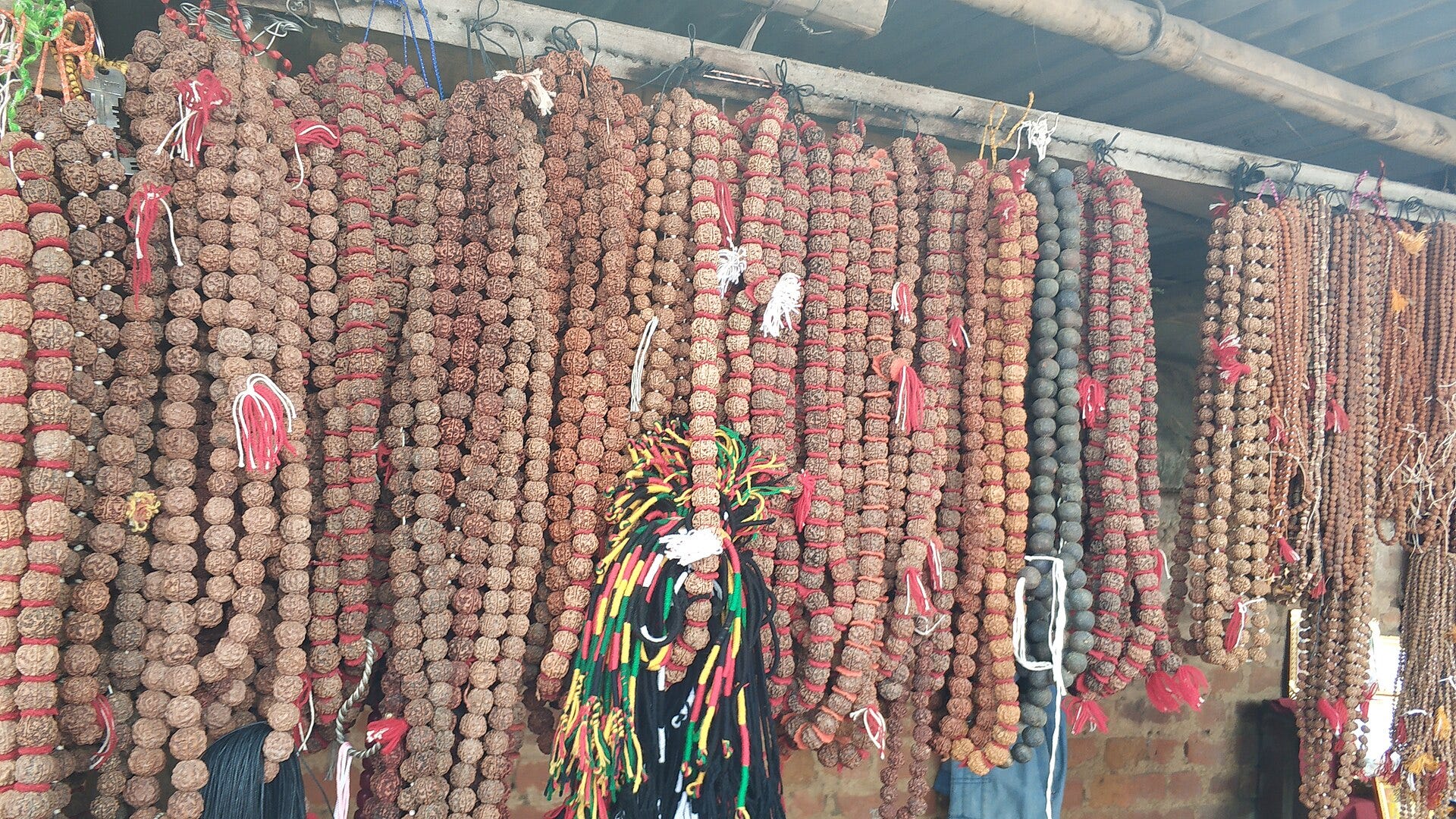
Photo: Janak Bhatta, CC BY-SA 4.0, via Wikimedia Commons
108 in worship
Once you see the pattern, it is everywhere in practice:
Ashtottara shatanamavali: the 108-name litany of a deity, chanted in homes and temples. Every major deity has one.
Archana with 108 offerings: 108 lotuses, 108 bilva leaves, 108 lamps on special vrats.
108 surya namaskars: practised on occasions like Ratha Saptami or the change of seasons as a tapas of stamina and focus.
Pilgrimage lists: the 108 Divya Desams of the Vaishnava tradition, the temples most loved by the Alvar saints.
What the counting does
Teachers often point out something practical beneath the symbolism. 108 repetitions take long enough, usually 10 to 15 minutes, that the mind settles whether it wants to or not. The mala removes the need to count, the count removes the need to decide when to stop, and what remains is the mantra itself. In that sense the number is a container: large enough to mean something, small enough to do daily.
Starting a simple practice
Choose one mantra and keep it. Om Namah Shivaya, Om Namo Narayanaya, the Gayatri, or a name of your ishta devata all work.
Do one mala a day rather than five on Sundays. The tradition values regularity over volume.
Sit in the same spot and rough time each day; the habit anchors faster.
Do not cross the meru bead. Turn around. Treat it as a small bow to the teacher within the practice.
Whether you read 108 as cosmic arithmetic or as the perfect size for a daily ritual, the invitation is the same: sit down, start at the first bead, and let the counting carry you somewhere quieter. At DharmikVibes, our vision is to enable practices like these to feel accessible to every seeker, on any schedule.