

Every Diwali season, alongside the shopping searches and the date checks, people type the same handful of questions into Google: why do we celebrate Diwali, why do we light lamps, why do we make rangoli, why is Lakshmi puja on this night, and why the oil bath? When Google's India team shared the country's top Diwali "why" questions in 2023, these were the ones on the list, and they are lovely questions, because each one opens a door into the festival's heart.
Diwali in 2026 falls on Sunday, 8 November, with the festival period running from Dhanteras on Friday, 6 November to Bhai Dooj on Wednesday, 11 November. Here are honest answers to those five questions.
1. Why do we celebrate Diwali?
There is no single answer, and that is the beauty of it. India celebrates one festival of light for many reasons, carried by different communities in different ways.
The best-known story is the return of Lord Ram to Ayodhya after fourteen years of exile and his victory over Ravana. The people of Ayodhya lit rows of earthen lamps to welcome him home, and "Deepavali", a row of lamps, became Diwali. In much of South India, the festival marks Lord Krishna's victory over the demon Narakasura, which is why the main celebration there falls on Narak Chaturdashi morning rather than the Amavasya night. In Bengal and the east, the same night belongs to Maa Kali, worshipped as Kali Puja. For Jains, Diwali marks the nirvana of Lord Mahavira. For Sikhs, it is Bandi Chhor Divas, the day Guru Hargobind ji was released from imprisonment at Gwalior and returned to Amritsar, where the Golden Temple glows with lamps to this day.
Woven through all of these is a seasonal truth: Diwali arrives at the end of the monsoon harvest and the start of a new financial year for many trading communities. Old account books are closed, new ones are opened, and prosperity itself is worshipped in the form of Goddess Lakshmi.
2. Why do we light lamps?
The diya is the festival's grammar. On the simplest level, lamps push back the darkest night of the month: Diwali falls on Amavasya, the new-moon night of the Kartik month, when the sky is at its blackest. Lighting a lamp became the natural way to say that light wins over darkness, knowledge over ignorance, and hope over despair.
Tradition gives the lamp more specific duties. Lamps in doorways and windows welcome Goddess Lakshmi, who is said to visit homes that are clean and bright. On Dhanteras evening, many families light a Yama Deepam, a lamp placed facing south for Lord Yama, praying for the protection of the family. And the tradition reaches its grandest form a fortnight later at Dev Deepawali in Varanasi, when the ghats of the Ganga are lit with lamps said to welcome the gods themselves. A small clay diya, a cotton wick, a spoonful of oil or ghee: the technology has not changed in centuries because it does not need to.
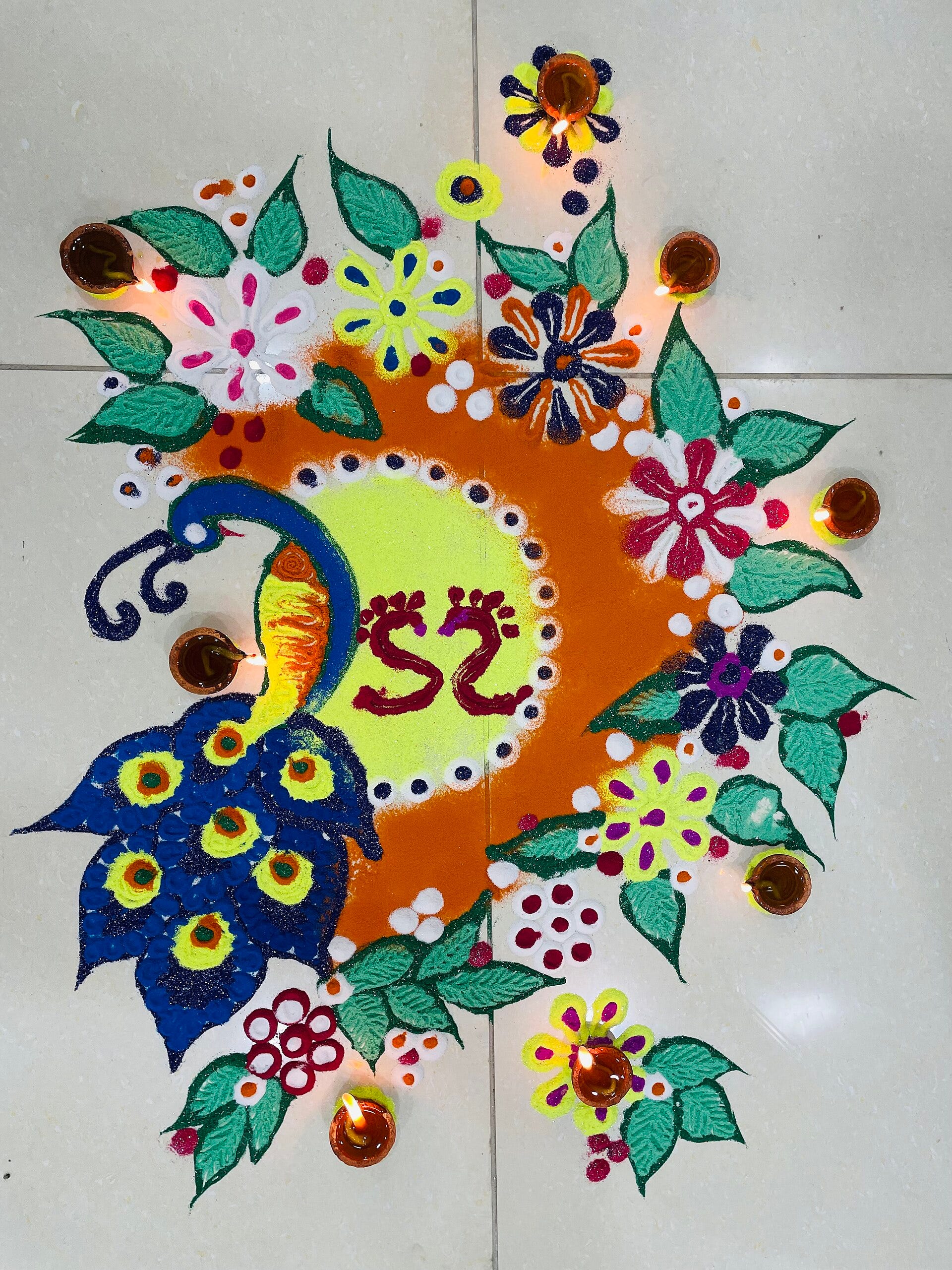
A rangoli made during Diwali celebrations. Photo: AjayDas, CC BY-SA 4.0

3. Why do we make rangoli?
Walk through any Indian neighbourhood in Diwali week and you will see doorways blooming with colour: rice flour, coloured powders, flower petals and diyas arranged in geometric patterns. This is rangoli in the north, kolam in Tamil Nadu, muggu in Andhra and Telangana, alpana in Bengal.
Rangoli is a welcome mat for the Divine. The patterns are drawn at the threshold, the meeting point of home and world, to invite Goddess Lakshmi and guests in with auspiciousness. Many designs include tiny footprints, marking Lakshmi's steps into the house. There is also an older, quieter wisdom in the materials: rice flour rangoli feeds ants and birds, a small daily act of generosity woven into beauty. Whatever the region, the idea is the same. A home that takes the trouble to make something beautiful at its doorstep is a home ready to receive grace.
4. Why is Lakshmi puja done on Diwali night?
Diwali night is Amavasya, and tradition holds that Goddess Lakshmi, the deity of wealth and wellbeing, roams the earth on this night and blesses homes that are clean, lit and awake. Families therefore clean for days beforehand, light lamps at dusk, and perform Lakshmi puja during Pradosh Kaal, the early-evening window after sunset.
The puja usually includes Lord Ganesha, worshipped first as the remover of obstacles, and in many homes Lord Kuber, the treasurer of the gods. Business families open new account books, called chopda in Gujarat and Rajasthan, and write the first auspicious entries of the year. For 2026, Drik Panchang lists the Lakshmi Puja muhurat for New Delhi on Sunday, 8 November from 5:54 PM to 7:50 PM (Pradosh Kaal 5:31 PM to 8:09 PM), with Amavasya Tithi running from 11:27 AM on 8 November to 12:31 PM on 9 November. Timings vary by city, so checking the panchang for your own location is always wise.
5. Why the oil bath on Diwali?
In much of India, especially the south and Maharashtra, Diwali morning begins before sunrise with Abhyanga Snan: a warm bath after massaging the body with sesame oil. The custom is tied to the Narakasura story. Tradition says Krishna defeated the demon at dawn, and the bath symbolises washing away the old year's fatigue, impurities and negativity.
Elders often apply a small dot of oil to the head of every family member, and new clothes are worn afterwards. Ayurveda, India's traditional wellness system, also recommends oil massage in this season as the weather turns dry and cold, which is one reason the custom settled so comfortably into Diwali's calendar. Whether you read it as ritual or as seasonal self-care, the message is gentle: begin the festival clean, rested and renewed.
Diwali 2026 at a glance (New Delhi timings)
Thu 5 Nov: Govatsa Dwadashi (festivities begin in Maharashtra)
Fri 6 Nov: Dhanteras; puja muhurat 6:02 PM to 7:57 PM, Yama Deepam evening
Sat 7 Nov: Narak Chaturdashi / Choti Diwali; oil bath before sunrise
Sun 8 Nov: Diwali, Lakshmi Puja; muhurat 5:54 PM to 7:50 PM
Tue 10 Nov: Govardhan Puja, Annakut, Gujarati New Year
Wed 11 Nov: Bhai Dooj, celebrating brothers and sisters
Five questions, one festival. However your family answers them, in Ayodhya's lamps, Bengal's Kali, Amritsar's Golden Temple or a quiet diya at your own door, Diwali keeps asking the same thing of all of us: make light, and share it.
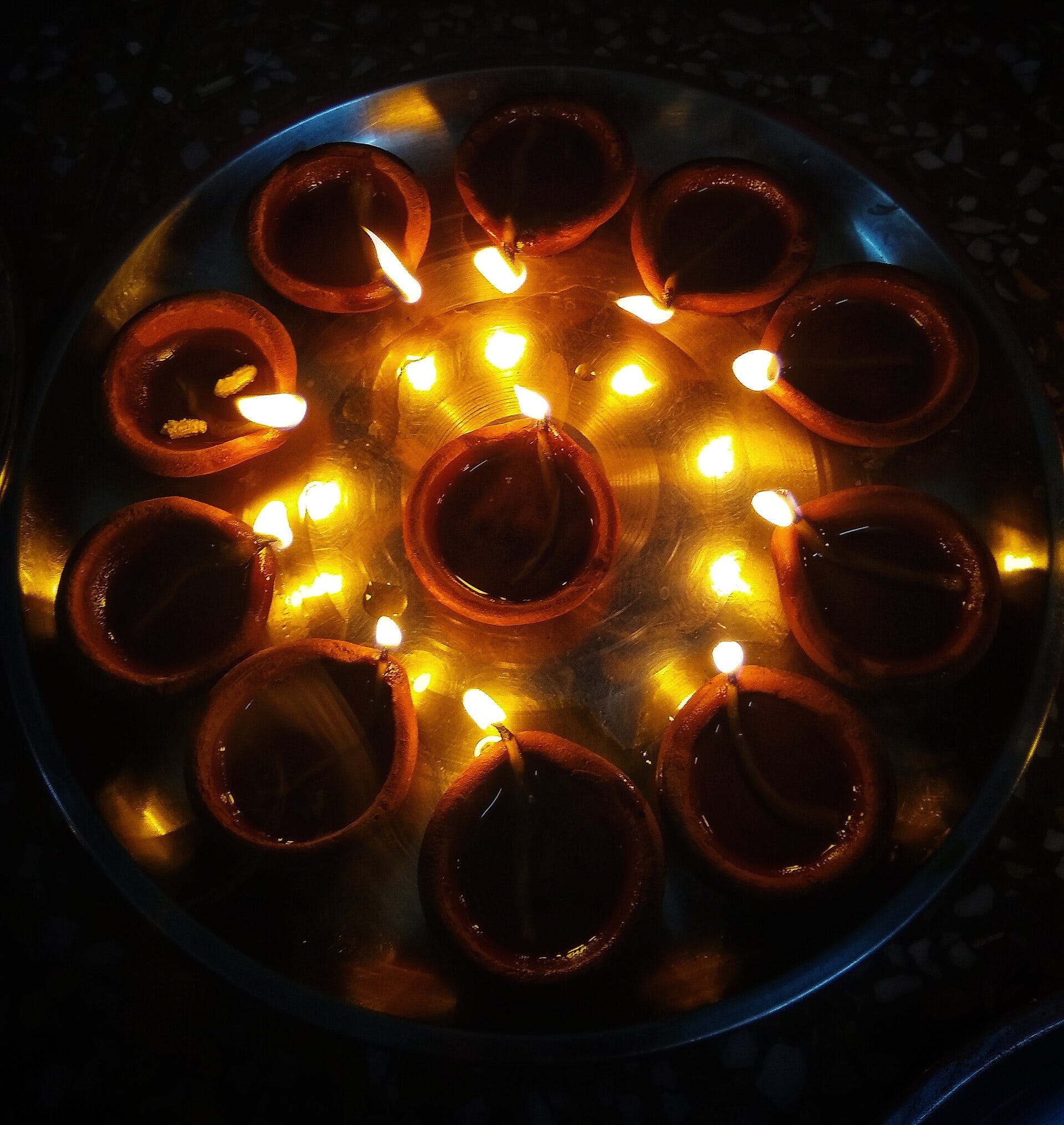
Diyas lit for Diwali. Photo: Alokjain19883105, CC BY-SA 4.0
