


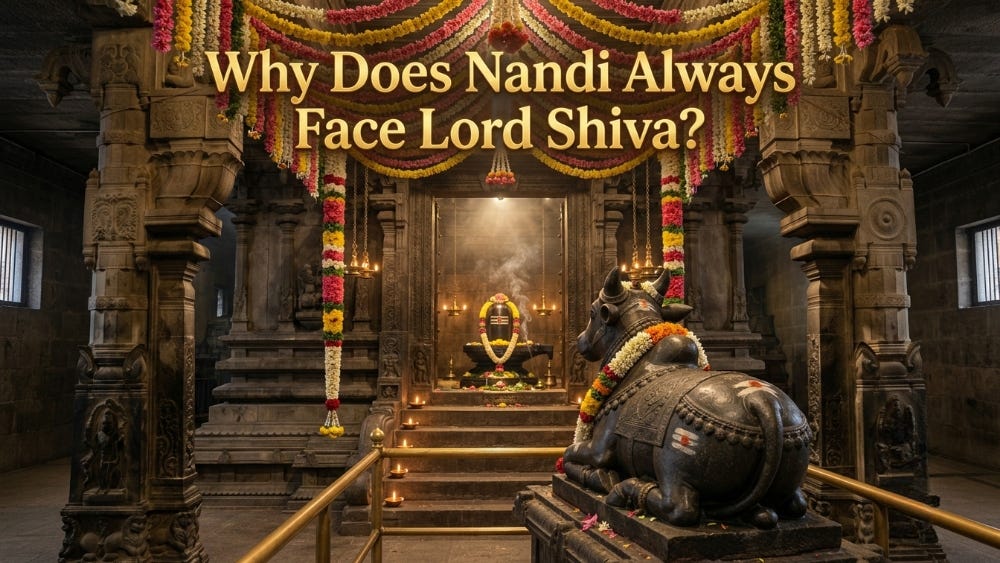
Whenever we enter a Shiva temple, there is something we almost always notice: Nandi, seated quietly in front of the Shiva Lingam, with his gaze fixed on Lord Shiva.
But have you ever wondered why Nandi always faces Mahadev? Why does he occupy such a special place in almost every Shiva temple? And why do devotees whisper their prayers into his ears?
Behind this familiar temple tradition lies a beautiful story of devotion, faith and an eternal bond between Lord Shiva and his greatest devotee.
Who Is Nandi and How Did He Become Lord Shiva’s Devotee?
Nandi, also known as Nandikeshwara, is the sacred bull and divine vehicle (vahana) of Lord Shiva. He is also regarded as one of Shiva’s foremost devotees.
According to traditional Hindu accounts, Nandi was born to Sage Shilada, who performed intense penance seeking a child blessed with divine qualities.
His prayers were answered, and Nandi was born with a deep spiritual connection to Lord Shiva. As he grew older, his devotion became the centre of his life.
Pleased with Nandi’s dedication, Lord Shiva blessed him with a special place in his divine presence. Nandi became not only his vahana but also his devoted companion and guardian.
This is why Nandi holds such an important position in Shaivite tradition.
Why Does Nandi Always Face the Shiva Lingam?
There is a reason why Nandi is traditionally placed directly opposite the Shiva Lingam.
In Shiva temples, Nandi is usually seated in a dedicated pavilion called the Nandi Mandapa, facing the main shrine. His unwavering gaze towards Lord Shiva represents complete devotion and constant remembrance of the divine.
Nandi does not turn away or seek anything for himself. His presence reminds devotees that true devotion comes from faith, patience and surrender.
The arrangement also carries a spiritual message: just as Nandi remains focused on Mahadev, a devotee should approach the divine with a sincere and undistracted heart.
Why Do Devotees Whisper Their Wishes into Nandi’s Ears?
One of the most beautiful traditions followed in many Shiva temples is whispering a prayer or wish into Nandi’s ear.
Devotees believe that Nandi carries their sincere prayers to Lord Shiva. Since he is always close to Mahadev, he is regarded in popular devotional tradition as a messenger between the devotee and the divine.
This practice is an expression of faith rather than a formal requirement of Shiva worship. Customs may differ across temples, but the sentiment remains the same: devotees approach Nandi with trust and devotion before seeking Mahadev’s blessings.
What Does Nandi Teach Us About Devotion?
Nandi’s presence is not simply a part of temple architecture. His story offers lessons that remain meaningful in everyday life.
Faith: Nandi’s devotion reminds us to remain connected to the divine, even during difficult times.
Patience: His calm and seated posture represents steadiness and the importance of waiting with faith.
Selfless service: Despite his special place beside Lord Shiva, Nandi is remembered for his humility and dedication rather than personal recognition.
These qualities make Nandi an enduring symbol of devotion for millions of Shiva devotees.
A Tradition That Speaks Without Words
The next time you visit a Shiva temple, pause for a moment before Nandi.
Look at the direction of his gaze. Notice his calm posture and the devotion represented by his presence.
For generations, Nandi has stood as a reminder that devotion does not always need words or grand gestures. Sometimes, it is simply about faith, patience and keeping the divine at the centre of our lives.
Perhaps that is the most beautiful lesson Nandi offers every devotee: to remain as devoted to Mahadev as he has always been.
Har Har Mahadev!