

There are twelve months in the Hindu calendar, each carrying its own religious significance. Yet, when Bhagwan Shri Krishna describes His divine manifestations in the Bhagavad Gita, He makes a rather extraordinary declaration:
मासानां मार्गशीर्षोऽहम्।
Maasaanam Margashirshoham.
“Among the months, I am Margashirsha.”
This statement appears in the tenth chapter of the Bhagavad Gita, Vibhuti Yoga. But why did Shri Krishna choose Margashirsha? What distinguishes this particular month from the other eleven?
To understand this, we must look at the ancient understanding of time, nature and divine manifestation.
The Month That Represents the Finest Expression of Nature
In Vibhuti Yoga, Shri Krishna explains that the finest and most extraordinary manifestations in creation reflect His divine glory.
He identifies Himself with the splendour of the Sun, the greatness of the Himalayas, the sacredness of the Ganga and, remarkably, Margashirsha among the months.
This is an important distinction. Shri Krishna is not simply recommending a favourable month for religious activities. He is revealing that the excellence found in creation is a reflection of the Supreme.
Traditionally associated with the beginning of the winter season, Margashirsha represents a period of nourishment, agricultural abundance and natural tranquillity.
Its significance is also reflected in ancient Indian seasonal traditions, where the relationship between nature, human life and spiritual discipline was deeply recognised.
What Is the Connection Between Margashirsha and the Gopis of Vrindavan?
One of the most fascinating references associated with this season appears in the tenth Skandha of the Shrimad Bhagavata Mahapurana.
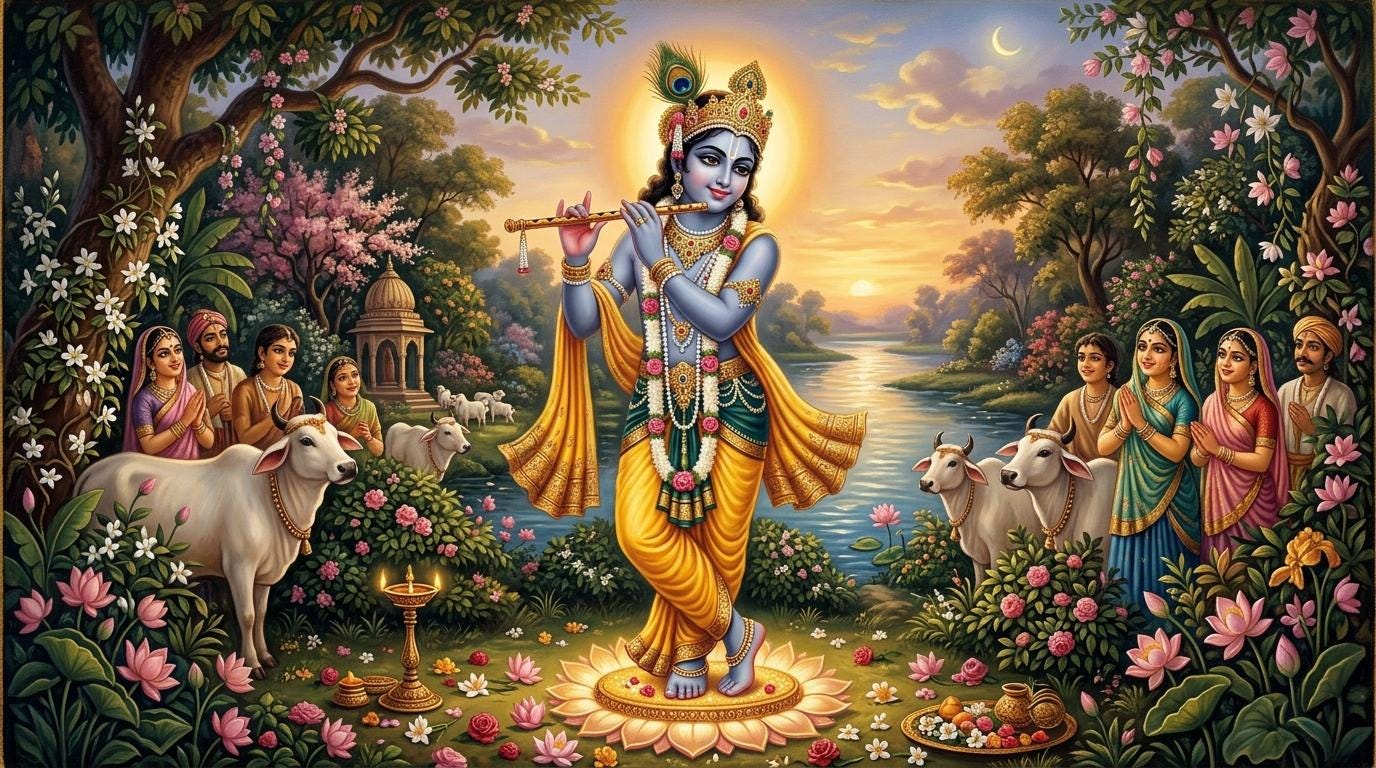
The Gopis of Vraja undertook the Katyayani Vrata during Hemanta Ritu, worshipping Goddess Katyayani with a particular prayer concerning Shri Krishna.
Their observance is described in the Bhagavata Purana, particularly in its twenty-second chapter.
The episode is significant because it reveals an extraordinary dimension of Bhakti.
The Gopis were not seeking royal possessions, social recognition or worldly prosperity. Their devotion was centred upon Shri Krishna Himself.
Their vrata demonstrates how a religious observance can become an expression of complete spiritual longing.
Why Is Margashirsha Associated With Snana, Daan and Japa?
Ancient Hindu traditions place considerable importance on three practices during sacred periods:
Snana: Sacred bathing, representing purification and discipline.
Daan: Charity, particularly the giving of food, clothing and essential provisions.
Japa: Repetition of the Divine Name, cultivating concentration and remembrance.
These are not isolated religious activities. Together, they address three aspects of human life: the body, one’s relationship with society and the mind.
This is why the traditional observances of Margashirsha emphasise both spiritual discipline and compassion.
How Should Devotees Welcome This Month?
Devotees may observe Margashirsha by reciting the Bhagavad Gita, worshipping Shri Vishnu, offering Tulsi leaves to Shri Krishna, performing charity and chanting the divine name.
A particularly meaningful practice is to read Bhagavad Gita 10.35 and reflect upon the significance of Shri Krishna’s declaration.
After all, the purpose of a sacred month is not merely to perform more rituals, but to bring greater awareness into everyday life.
A Thought to Carry Through Margashirsha
There is something profound in the fact that Shri Krishna identifies Himself with time itself.
We often measure time through months, seasons and years. But the Bhagavad Gita invites us to recognise that the Divine is present within the very order of creation.
Margashirsha therefore offers more than an auspicious period for worship. It reminds us that every passing moment can become sacred when lived with awareness, righteousness and devotion.
Perhaps the greatest way to honour Margashirsha is not simply to observe the month, but to understand the wisdom behind Krishna’s declaration.