

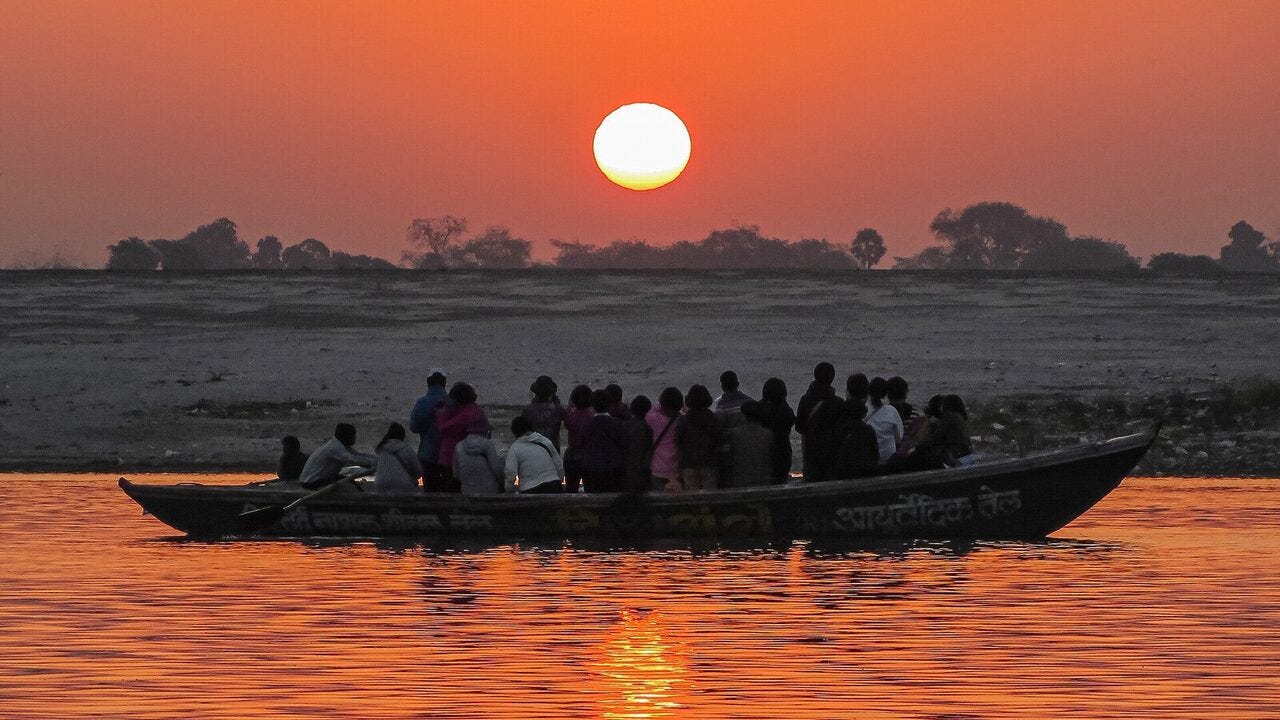
Sunrise on the Ganga at Varanasi. Photo: Jay.Jarosz, CC BY-SA 4.0, via Wikimedia Commons
Har Har Mahadev.
Ask a devotee why Kashi belongs to Shiva, and you rarely get a date or a document. You get a story. Sometimes you get silence, and then a single line: “Because he lives here.”
This post is for those who want the stories behind that line. It is not a history lesson. It is an attempt to explain, in plain words, what devotees mean when they say Kashi is Shiva’s own city.
The column of light
Kashi Vishwanath is one of the twelve Jyotirlingas, the shrines said to be the most sacred abodes of Shiva. The word jyotirlinga means a lingam of light.
The story behind it goes like this. Brahma, the creator, and Vishnu, the preserver, once argued over which of them was greater. Shiva appeared between them as an endless column of light, with no beginning and no end. To find its source, Vishnu took the form of a boar and dug down into the earth. Brahma took the form of a swan and flew upward to find the top.
Neither could find the end. Vishnu came back and admitted he could not. Brahma claimed that he had found the top, and he lied. Shiva punished the lie, and Vishnu, who had been honest, was to be worshipped alongside Shiva for all time. This image of Shiva rising as a pillar of light is known as the Lingodbhava.
According to Wikipedia’s article on the Kashi Vishwanath Temple, it is believed that Varanasi is the first Jyotirlinga to have manifested in this way.
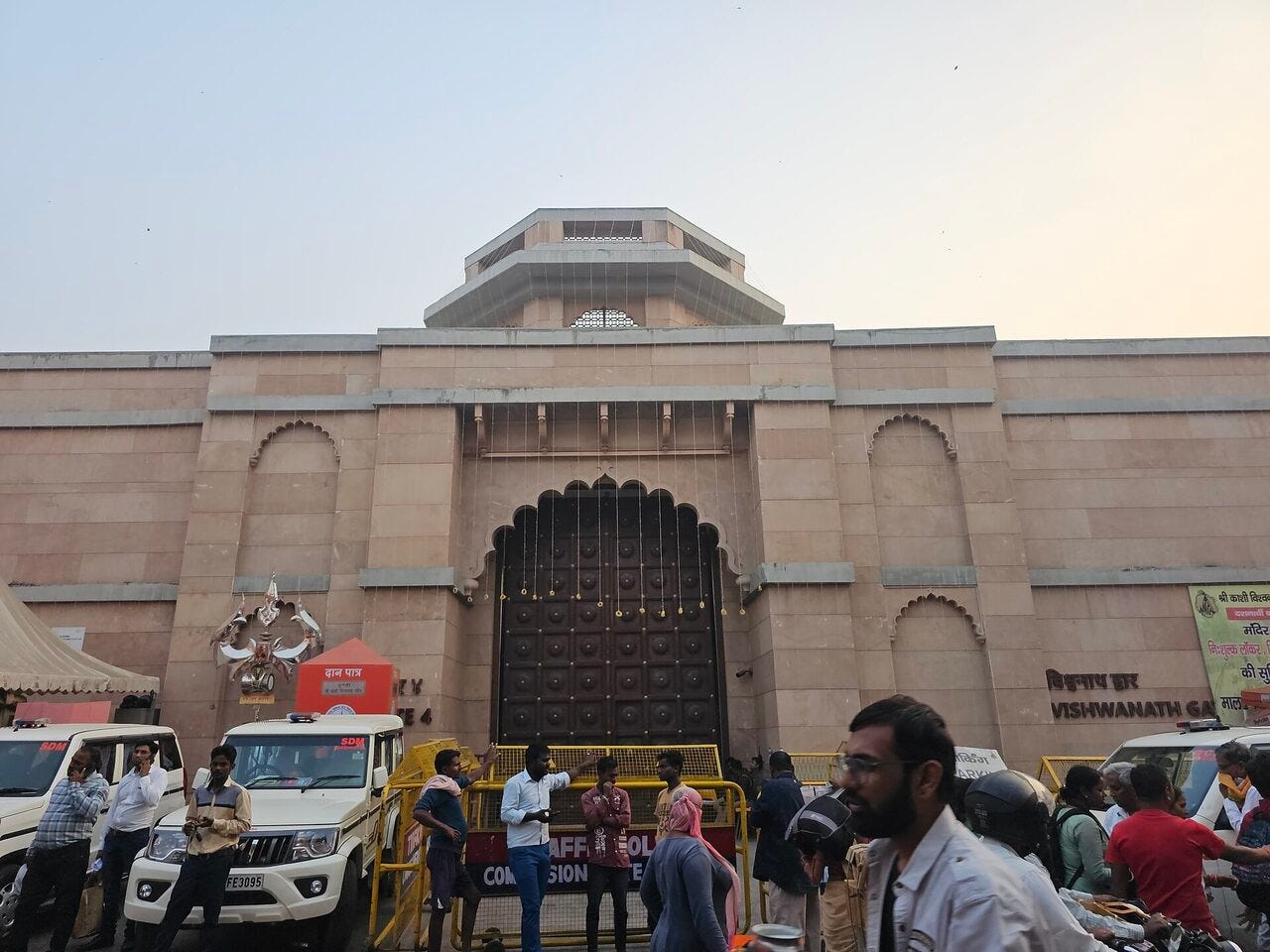
The gateway leading to the Shri Kashi Vishwanath Temple in Varanasi. Photo: Gannu03, CC BY-SA 4.0, via Wikimedia Commons
Vishweshwara: the king of Kashi
The deity of Kashi is Vishwanath, also called Vishweshwara. Both names mean “Lord of the Universe”. The scriptures describe him as the king over all the other deities and all the inhabitants of the city, and over the Panchkoshi, the sacred circuit around Varanasi that spreads over about 50 miles.
This is an important point. In Kashi, Shiva is not only a god visited in a temple. He is understood as the ruler of the whole city, the one to whom the place itself belongs.
The Kashi Khanda
The Skanda Purana has a whole section devoted to the city, called the Kashi Khanda. According to the Wikipedia summary, it lists a total of 1,099 temples, of which 513 were devoted to the worship of Shiva. The Brahmavaivarta Purana also has a portion about the city, known as the Kashi Rahasya.
It is worth pausing on that. A city that has an entire chapter of a Purana written about it, with its temples counted, was already understood as a sacred place a very long time ago.
Why people speak of moksha in Kashi
You will often hear that a visit to Kashi, with a bath in the Ganga, is a step on the path to moksha, liberation. Wikipedia’s entry on the temple notes that Hindus from all over the world try to visit at least once in their lifetime, and that there is a tradition of giving up at least one desire after the visit.
That last tradition is a quiet one. It does not ask you to buy anything or to perform anything. It asks you to leave something behind in the city. Many families say the thing they gave up was something they were holding on to for years.
The temple today
The lingam in the sanctum is about 60 centimetres tall and 90 centimetres in circumference, placed on a silver altar. The present temple was built in 1780 by Maharani Ahilyabai Holkar of Indore. In 1835, Maharaja Ranjit Singh donated about one tonne of gold to plate its domes, and it is known as the Golden Temple. On 13 December 2021, the Kashi Vishwanath Dham corridor, connecting the temple to the Ganga, was inaugurated. Since 1983, the temple has been managed by a board of trustees set up by the Government of Uttar Pradesh.
A great many people come to Kashi. According to the Uttar Pradesh government, as reported by the Economic Times in January 2026, Varanasi recorded a record 7.26 crore visitors in 2025.
What this means for your own yatra
You do not need to know all of this to feel something in Kashi. But the stories give the city a shape.
When you walk down to the Ganga, you are walking to the river that the old texts place at the heart of the city.
When you stand in the queue for darshan, you are standing in the oldest living tradition of the city’s worship.
When you watch the evening aarti, you are watching a ritual that has been repeated daily, every evening, for generations.
If you are going with parents or grandparents, ask them to tell the story of the column of light on the way. Children remember stories they hear at the place where they happened.
A closing thought
Kashi is described in many ways: ancient, crowded, loud, restful, endless. The devotee’s description is the simplest. It is the city of Shiva, and everyone is a guest in it.
If you would like to plan a Kashi yatra with your family, write to us at dharmikyatra@dharmikvibes.com.
Har Har Mahadev.