

For decades, a familiar assumption shaped India’s cultural conversations: that modern life, urban ambition, and global exposure would gradually pull young people away from religion and traditional practices. Yet across India today-especially in pilgrimage towns and spiritual congregations - a visibly different story is unfolding. Increasingly, young Indians are not just observing rituals from a distance, but actively participating, asking questions, spending time with saints, and exploring the philosophical core of Sanatan Dharma.
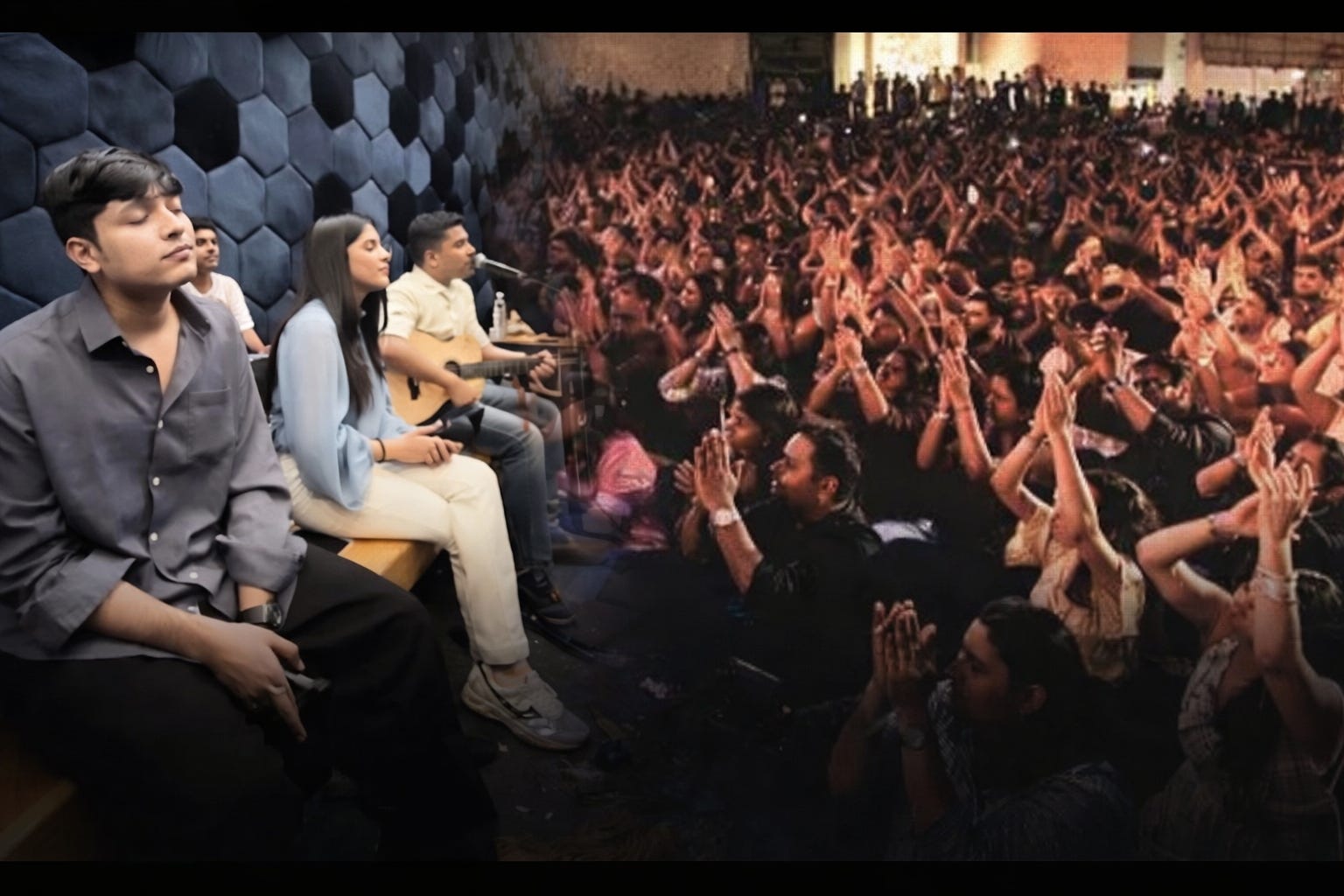
One of the strongest signals of this shift can be seen at major religious gatherings like the Magh Mela in Prayagraj, where youth presence has grown noticeably. The banks of the Sangam-where the Ganga, Yamuna, and mythical Saraswati are believed to meet-are witnessing a new generation arriving not only for tradition, but for meaning. From early morning dips and temple visits to long evenings of kirtan and discourse, the new face of devotion in India is young, curious, and deeply engaged.
A New Wave at the Sangam: The Youth Presence is Real
The Magh Mela has historically been associated with elderly pilgrims, ascetics, and families following long-held customs. But now, along the same riverfront, it is common to spot groups of college students, young professionals, and first-time visitors-many of whom travel without parents or elders, making the journey by choice rather than obligation.
This rising youth participation is not merely symbolic. Several spiritual leaders at such gatherings have noted that a significant portion of attendees belong to the younger demographic, and many of them stay for days instead of treating it as a quick visit. In the temporary city of tents and camps, youngsters are seen attending sessions of Ram Katha, Bhagwat Katha, satsangs, and discussions on the Bhagavad Gita. Many take part in meditation circles, volunteer activities, and even community kitchens (bhandaras), discovering spirituality through both reflection and service.
Not Just Ritual - A Search for Meaning
What makes this trend distinct is that young devotees are not always coming primarily for ritualistic devotion. A large part of their interest seems to be philosophical and personal: a desire to understand life beyond the surface goals of career and consumption.
Today’s youth are growing up in an era of constant comparison, limitless choices, and extreme mental fatigue. Success is visible everywhere, but peace often feels nowhere. Social media creates a paradox: people are connected all the time, but feel lonely more often. Many are achieving faster than previous generations, yet remain anxious about the future.
In that emotional climate, Sanatan Dharma is increasingly being discovered as something deeper than religion - a system of thought that addresses the most human questions:
Why am I here?
What does a meaningful life look like?
How do I handle loss, fear, and uncertainty?
Can ambition and inner peace coexist?
The answers offered by India’s spiritual traditions are not always immediate solutions, but they provide frameworks - through dharma, karma, bhakti, and jnana - for navigating life’s complexity.
Spirituality is Becoming “Experiential” Again
One key reason for this revival is that spirituality today is not limited to scriptures or inherited beliefs - it has become increasingly experiential. Young people want to feel something real. They are drawn to environments where silence, chanting, devotion, and community create a powerful atmosphere.
At gatherings like the Magh Mela, thousands collectively chanting “Har Har Mahadev” or listening to a discourse under the open sky creates an emotional intensity that simply cannot be replicated online. For many youth, the experience becomes transformative not because someone convinced them intellectually, but because the environment touched something deep inside them.
Even practices like:
pranayama
meditation
naam japa
morning aarti
bhajan-kirtan
are being embraced as mental and emotional tools. In many ways, young India is rediscovering what older traditions always knew: spiritual practice is also psychological hygiene.
The Quiet Rebellion Against a Material-Only Life
Modernity promised comfort and convenience. It delivered both. Yet it also brought a silent emptiness - an over-focus on achievement, constant productivity pressure, and an idea that success equals happiness.
For many young Indians, returning to Sanatan Dharma is a form of quiet rebellion: a refusal to accept that life is only about earning, consuming, and performing. Instead, they are increasingly drawn to ideas like:
Seva (service) instead of self-obsession
Simplicity instead of excess
Discipline instead of distraction
Inner growth instead of external validation
This doesn’t mean youth are rejecting modernity. Rather, they are trying to balance the outer world with an inner anchor.
The Role of Big Cultural Moments and National Momentum
Recent years have seen several high-visibility religious and cultural events that contributed to renewed interest - both by making traditions more accessible and by placing them back in mainstream public life. Events like the Maha Kumbh, large temple celebrations, televised kathas, and mass devotional gatherings have created a sense of collective participation.
For youth, cultural identity is not a fixed inheritance anymore - it’s something they actively explore. Many are driven by a desire to understand their roots authentically, rather than accept simplified versions of tradition.
This is also why a lot of younger devotees approach Dharma with questions. They are less likely to accept blind belief and more likely to ask:
What is the logic behind rituals?
What does karma really mean?
What is the difference between religion and spirituality?
Why does Dharma include so many paths?
Sanatan Dharma, by its nature, can hold these questions. It offers multiple approaches - bhakti, yoga, tantra, jnana - making it uniquely compatible with modern plural thinking.
Technology is Amplifying Devotion, Not Replacing It
A surprising factor in this revival is technology. Many assume the internet reduces spirituality. But for Indian youth, digital tools often act as gateways. Short clips of spiritual teachings, podcasts, Gita explanations, bhajan reels, and livestreamed aartis are introducing Dharma to people who might never have approached a traditional guru or temple.
Young audiences today can listen to:
a discourse during a commute
a bhajan while studying
a guided meditation before sleep
This availability makes spirituality portable and personal. But importantly, digital exposure often becomes a first step. Once curiosity is sparked online, many seek deeper experiences offline - visiting temples, attending kathas, or traveling to spiritual gatherings like the Magh Mela.
In other words, the internet has not replaced tradition; it has made entry easier.
The Attraction of Saints, Seers, and Simpler Lives
Another major draw is the presence of saints and seers who represent a life beyond ordinary competition. In an era where everyone seems to chase something, the calm discipline of ascetics becomes powerful.
For a young mind stressed by uncertainty, meeting someone who appears peaceful, grounded, and detached from material pressure feels inspiring. Spiritual leaders at these events often speak in modern, relatable language - connecting ancient wisdom to today’s issues like stress, relationships, addiction to screens, anxiety, and self-doubt.
Youth aren’t just drawn to miracles. They are drawn to clarity.
A Positive Cultural Shift - But Not Without Challenges
While this growing interest is hopeful, it also raises important responsibilities.
A revival of spirituality must avoid becoming mere trend-following or social media performance. Dharma cannot be reduced to slogans, emotional highs, or blind identity pride. The strength of Sanatan Dharma lies in its depth: its ethics, its emphasis on self-control, compassion, and inner transformation.
Young seekers will benefit most when spiritual exploration includes:
understanding, not superstition
discipline, not shortcuts
humility, not superiority
compassion, not division
If guided well, this revival can create a generation that is both modern and rooted—ambitious and peaceful.
The Road Ahead: What This Means for India
The rising presence of Gen Z at spiritual gatherings is not just a religious development - it is a social one. It suggests that young India is searching for stability in a world of speed. It reflects a desire for identity in an era of confusion. And most importantly, it highlights that ancient wisdom still has relevance when life becomes overwhelming.
Sanatan Dharma is not a single institution; it is a civilizational framework. Its flexibility allows it to meet people at different stages - whether someone comes for devotion, philosophy, healing, or community.
Perhaps this is why the young are returning. Not because they are escaping the modern world, but because they are learning that without inner grounding, modern success feels hollow.
At places like the Sangam, amid chants and cold waters and saffron tents, a quiet truth is becoming visible: the roots are still alive - and the next generation is beginning to hold them again.