


Why May 11, 2026 is one of the most significant dates in our civilisational calendar - and what it means for every yatri and every Bharatvasi
Har Har Mahadev.
There are temples you visit. And then there is Somnath - which visits you. Which keeps returning, lifetime after lifetime, in the collective memory of a civilisation that simply refuses to forget.
This week, a quiet but seismic milestone is being marked on the Saurashtra coast. May 11, 2026 carries the weight of two timelines folding into each other:
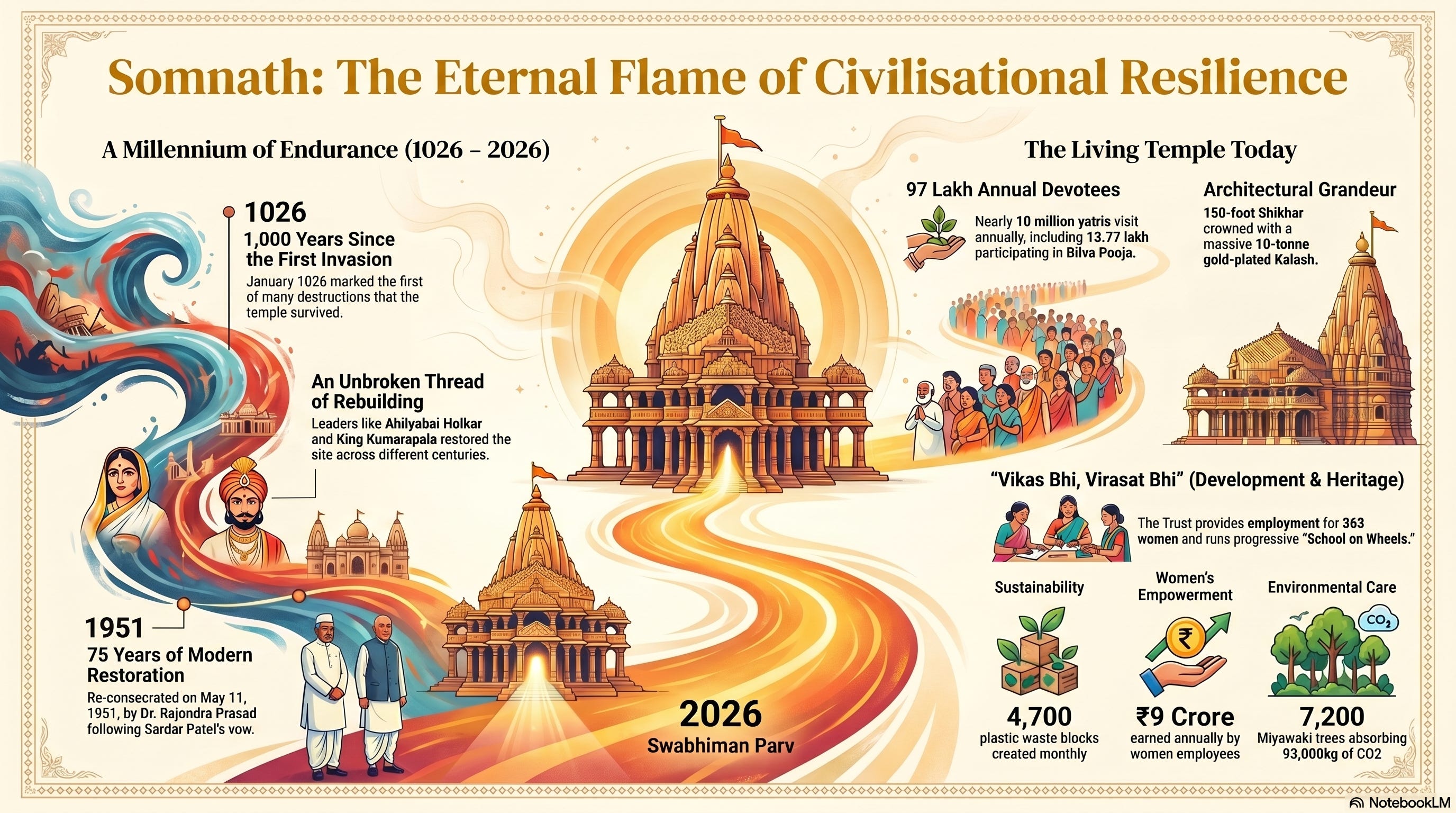
1000 years since the first recorded invasion of Somnath in January 1026
75 years since the temple was ceremonially reopened on May 11, 1951 by India’s first President, Dr. Rajendra Prasad
To commemorate both, Prime Minister Narendra Modi - who also serves as Chairman of the Somnath Trust - is visiting the temple on May 11. The year-long observance is being called the Somnath Swabhiman Parv - the festival of self-respect, of dignity, of swabhiman that no invader was ever able to break.
If you have been waiting for a sign to plan that long-pending Jyotirlinga Yatra, this is it.


Why Somnath Stands First Among the Twelve Jyotirlingas
Somnath is not just a Jyotirlinga. It is the first - the Aadi Jyotirlinga.
The Dwadasha Jyotirlinga Stotram, recited by devotees across India for centuries, opens with Somnath. Not by accident. The Shiva Purana places its origin at the feet of Chandra, the Moon God, who worshipped Lord Shiva at this very shore at Prabhas Patan to be relieved of a curse - and was granted the radiance we still see in the night sky.
The site is sacred to three streams of devotion at once:
Shaivism - as the foremost Jyotirlinga of Lord Shiva
Vaishnavism - through the deep association with Lord Krishna, whose mortal lila is believed to have ended near Bhalka Tirth, just a short walk from Somnath
Shakta tradition - through the worship of the Devi who completes the trinity of presence here
This triple sanctity is rare. It is why the temple has been called Prabhas Tirth - the place of luminance - long before the word “pilgrimage” entered modern vocabulary.
A Thousand Years of Destruction. A Thousand Years of Rebuilding.
Here is the part of Somnath’s story that should be taught in every Indian school, but isn’t told nearly enough.
In January 1026, the temple faced its first recorded attack. From the 11th to the 18th century, Somnath was destroyed and looted again and again. And every single time - every single time - it was rebuilt.
Consider the people who refused to let it disappear:
King Kumarapala restored the temple in the 12th century
The King of Junagarh rebuilt it in the 13th century
Veer Hamirji Gohil, a regional warrior, gave his life in 1299 A.D. defending Somnath during Zafar Khan’s invasion - remembered today through local tradition rather than official chronicles, because rajadharma does not always wait for historians to arrive
Lokmata Ahilyabai Holkar, the great Maratha queen of Indore, consecrated a new temple at Somnath in the 18th century after yet another destruction
Think about that arc. From an 11th-century king to an 18th-century woman ruler from Indore - a thousand kilometres away - the dharmic instinct to rebuild was the same. Different languages, different dynasties, different centuries. One unbroken thread.
This is what we mean when we say Sanatan. Not a slogan. A muscle memory.
The Patel Moment: 1947 to 1951
The modern chapter of Somnath begins not with a king, but with a man in a dhoti and shawl walking through ruins on a windy November morning in 1947.
Sardar Vallabhbhai Patel stood at the broken site of Somnath weeks after Independence and made a quiet vow: this temple would rise again. Not as a monument to grievance. As proof that India’s cultural confidence had survived everything thrown at it.
What followed was extraordinary:
The reconstruction was funded almost entirely through public participation - small donations from ordinary Indians, not government coffers
The temple was rebuilt in the Kailash Mahameru Prasad architectural style, an ancient temple architecture tradition revived for the modern age
On May 11, 1951, President Dr. Rajendra Prasad consecrated the temple, calling it a symbol of India’s spiritual strength and cultural resurgence
For a country still bleeding from Partition, still figuring out what its modern identity would be, the message was unmistakable. We choose continuity. We choose to remember. We choose to rebuild.
That moment is exactly 75 years old this week.
The Somnath You Will Stand Before Today
If you visit Somnath today, here is what greets you:
A 150-foot Shikhar crowned with a 10-tonne Kalash
A 27-foot Dhwajdand - the temple flagpost - declaring presence to the Arabian Sea
1,666 gold-plated Kalash and 14,200 Dhwajas across the complex
The temple complex includes the Garbhagriha, Sabha Mandap, and Nritya Mandap - exactly as the shastras prescribe
And the devotion?
Annual footfall: 92 to 97 lakh devotees every single year
13.77 lakh devotees participate in Bilva Pooja annually
The Light and Sound Show, upgraded with 3D laser narration, draws yatris into the temple’s history every evening
The Vande Somnath Kala Mahotsav has revived 1,500-year-old dance traditions that almost vanished
The temple sits exactly where it has always sat - on the southwestern tip of Saurashtra, where land ends and the ocean begins. There is a board near the seafront that reads: the next landmass in this direction is Antarctica. Stand there at sunset. Hear the bell. Understand why Somnath is called the eternal flame.
What the Somnath Swabhiman Parv Actually Is
This is not a one-day event. It is a year-long civilisational observance that began in early 2026 and continues through 2027.
Highlights so far:
January 10-11, 2026 - PM Modi participated in a 72-hour chanting of the Omkar Mantra, accompanied by the grand Shaurya Yatra featuring 108 horses in symbolic tribute to Somnath’s defenders across the centuries
April 30, 2026 - The “Chalo Chalein Somnath” Yatra was flagged off from Delhi’s Safdarjung Railway Station, carrying over 1,300 devotees by special train
May 1, 2026 - The yatra reached Somnath, followed by aartis, temple darshan, and cultural programmes
May 11, 2026 - PM Modi’s anniversary visit and the formal commemoration of 75 years
The PM has also announced special pujas at Somnath for the next 1,000 days - one day of dedicated worship for every year of resilience. He has framed the entire effort under the philosophy of “Vikas Bhi, Virasat Bhi” - development alongside heritage.
For those of us who have grown up watching our temples either neglected or politicised, this is a different model. Heritage as living infrastructure. Pilgrimage as economic uplift. Tradition as a forward-looking force.
The Somnath Most Yatris Don’t Know About
Here is what the brochures don’t always tell you. Beyond the temple itself, the Shree Somnath Trust quietly runs one of the most progressive temple-driven welfare ecosystems in India. A few highlights worth knowing:
Education and skill development
Vocational training in computer education, tailoring, beauty services, and digital literacy
Scholarships for students after Class 10 and Class 12
A “School on Wheels” programme delivering mobile digital learning to villages
Sustainability that actually moves the needle
Declared a “Swachh Iconic Place” in 2018
Temple flowers are converted into vermicompost that nourishes 1,700 Bilva trees
Plastic waste is converted into paver blocks under Mission LiFE - 4,700 blocks every month
Rainwater harvesting treats nearly 30 lakh litres of sewage water per month
A Miyawaki forest of 7,200 trees absorbs about 93,000 kg of CO2 annually
Purified Abhishek water is bottled as Somganga jal, benefiting over 1.13 lakh families
Women at the centre, not the margin
Out of 906 Trust employees, 262 are women
The entire Bilva Van is managed by women
65 women are engaged in prasad distribution; 30 in temple dining services
Total direct employment for 363 women, earning approximately ₹9 crore annually
Crisis response
During COVID-19, the Trust deployed ₹8.73 crore in the first wave, ₹2.21 crore in the second, and ₹1 crore to the Chief Minister’s Relief Fund
Oxygen plants and concentrators were sponsored at the height of the pandemic
This is what a temple as an institution can look like when it is run with both shraddha and seriousness.
What Somnath Asks of Us in 2026
Every Jyotirlinga has a personality. Kashi is intensity. Mahakaleshwar is bhairav. Rameshwaram is grace. Kedarnath is solitude.
Somnath is memory.
It is the Jyotirlinga that asks you to remember - not in anger, not in grievance, but in dignity. To remember that civilisations endure not because they were never broken, but because their people kept returning to the rubble with stones in their hands.
In a year when 1,000 years of destruction and 75 years of restoration meet in the same week, Somnath is offering us a question:
What in your own life are you willing to rebuild, even after the seventh time it has fallen?
That is the real teaching. Not in any sermon. In the very stone of the temple.
Planning Your Yatra: A Few Practical Notes
If you feel called to visit Somnath this year, a few things to keep in mind:
Best time to go - October to March is the most comfortable weather window. The Swabhiman Parv year continues into 2027, so there is time
Combine with nearby tirths - Bhalka Tirth (where Lord Krishna’s mortal lila concluded), Triveni Sangam, and Geeta Mandir are all within minutes of Somnath
Don’t miss the evening aarti followed by the Light and Sound Show - this is the moment most yatris talk about for years afterwards
Stay close - Prabhas Patan and Veraval town offer the easiest access; the Trust also operates yatri accommodation for pilgrims
Pair Somnath with Dwarka - if you have 4-5 days, a Somnath-Dwarka circuit is one of the most powerful yatras in all of Bharat. You begin where Krishna’s lila ended, and end where it began
Carry intention - Somnath rewards yatris who arrive with a question, a prayer, a sankalpa
For our DharmikVibes community, we are putting together curated yatra experiences around the Somnath Swabhiman Parv year - including senior-friendly itineraries, NRI-focused short-stay packages, and family circuits that combine Somnath with Dwarka and Gir. Watch this space.
A thousand years ago this year, somebody believed Somnath could be ended.
Seventy-five years ago this week, a man in a dhoti said: not on our watch.
This May 11, the lamp that has burned through every century of attempted erasure will be honoured again. By a Prime Minister, yes. But also by 97 lakh ordinary devotees who walk in every year, drop a coin in the hundi, ring the bell, and continue the longest-running act of civilisational defiance in human history.
You don’t have to be a historian to be part of this.
You just have to show up.
Jai Somnath. Har Har Mahadev.
If this piece moved you, consider sharing it with someone who has been quietly putting off their Jyotirlinga yatra for years. Sometimes the gentlest nudge is all that is needed.
DharmikVibes is building India’s most trusted spiritual travel and services ecosystem - rooted in shastra, designed for the modern yatri. Visit dharmikvibes.com to plan your sacred journey.


