

Photo: McKay Savage from London, UK, CC BY 2.0, via Wikimedia Commons
Ask a family in India when a baby was born, and someone will often know not just the date but the exact minute. That minute matters because of a document many families prepare within days of a birth: the janma kundli, the Vedic birth chart.
A kundli is a map of the sky at the moment you were born, drawn from your date, time and place of birth. In the Jyotisha tradition, that map is read as a portrait of tendencies: temperament, strengths, challenges and the timing of phases in life. This guide explains the parts of a kundli in plain language, so the next time one is placed in front of you, the boxes and abbreviations actually mean something.
The four building blocks
Lagna, the ascendant. The rashi rising on the eastern horizon at your birth minute. It sets the frame of the whole chart, because the lagna decides which house each planet falls in. Many astrologers treat it as the single most important point in a kundli.
Rashi, your Moon sign. In Indian tradition, when someone asks "what is your rashi?", they usually mean the sign the Moon occupied at your birth, not the Sun sign used in Western horoscopes. The Moon moves through all twelve signs in about 27 days, which is why birth time changes the reading.
Nakshatra, the lunar mansion. The Moon's position is also mapped onto 27 nakshatras, finer slices of the sky. Your birth nakshatra is used in many families to choose a baby's first initial, and it anchors the dasha system described below.
Navagraha, the nine grahas. Surya (Sun), Chandra (Moon), Mangala (Mars), Budha (Mercury), Guru (Jupiter), Shukra (Venus), Shani (Saturn), plus Rahu and Ketu, the two lunar nodes. Each graha is read as carrying a distinct kind of energy: Guru with growth and teachers, Shani with discipline and delay, and so on.
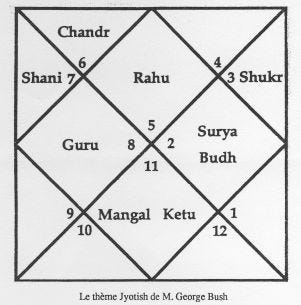
Photo: Equinoxius, CC BY-SA 3.0, via Wikimedia Commons
The twelve houses
The chart is divided into twelve bhavas, or houses. Each house governs a part of life: the first house the self and body, the fourth home and mother, the seventh marriage and partnership, the tenth work and public life. A planet's effect is read through the house it sits in, the sign it occupies and the planets it shares space with. This is why two people born on the same day can have very different charts: the houses shift with the ascendant, which changes roughly every two hours.
Two ways to draw the same sky
If you have seen kundlis from different parts of India, you may have noticed they look nothing alike. North Indian charts are drawn as a diamond lattice where the houses are fixed and the signs move. South Indian charts are drawn as a square grid where the signs are fixed and the houses move. Both carry the same information; only the layout differs. Many online tools let you switch between the two.
What families use a kundli for
Vivah milan: comparing two charts before a marriage, a practice many families still follow as one input among several, alongside the couple's own wishes.
Muhurat: choosing an auspicious time for a griha pravesh, a new venture or a ceremony.
Dasha periods: the Vimshottari dasha system, derived from the birth nakshatra, divides life into planetary periods that astrologers read as phases of emphasis.
Namkaran: picking a starting syllable for a child's name from the birth nakshatra.
If you follow the daily panchang, you are already reading a small slice of the same sky your kundli is drawn from. Our guide How to Read Today's Panchang explains tithi, vara, nakshatra, yoga and karana, the five limbs that appear in every daily almanac.
A tradition, held lightly
Jyotisha is one of the six Vedangas, the classical limbs of Vedic learning, and it has been practised and debated in India for well over a thousand years. It is a living tradition, not an experimental science, and thoughtful practitioners say so themselves. A kundli can be a meaningful mirror: a way to reflect on temperament, timing and choice. Health, money and marriage decisions deserve more than any single chart, and most families today treat the kundli as guidance to consider, not a verdict to obey.
At DharmikVibes, our vision is to enable seekers to meet these traditions with understanding first, so that a reading becomes a conversation, not a mystery.
How to get your kundli made today
Earlier, a family visited a jyotishi who drew the chart by hand from an almanac. Today the chart itself can be generated in seconds, and the math is the easy part. What you need before anything else is accurate birth data:
Date of birth - the easy one, but confirm it against a birth record, not memory alone.
Exact time of birth - this decides the lagna (ascendant), which changes roughly every two hours. Ask the hospital record or the elder who noted it down. A difference of even 20 minutes can shift the rising degree, and with it several house placements.
Place of birth - the town or city, because coordinates set the local sky. If born in a small village, use the nearest known town and tell the jyotishi the actual village.
Free and paid tools online will cast the chart once these three are entered; drikpanchang's janma kundali page is one commonly used option. Treat the generated chart as the map. The reading of the map - which yogas matter, how dashas unfold, what a placement means for your life - is where a trained jyotishi's judgment begins, and no software summary replaces that.
Common mistakes to avoid
Three errors cause most confusion. First, using an approximate birth time and then treating every conclusion as certain. Second, comparing charts generated in different systems (some use different ayanamsa values) and worrying that the planets "moved". Third, reading one placement in isolation: a single planet in a single house never tells the whole story in this tradition; the chart is read as an interlocking whole. When in doubt, ask the jyotishi what they assumed - birth time, ayanamsa, house system - before asking what they concluded.